

The first tranche closed on June 1. The mine won't start producing until sometime in the second half of 2026. So The Metals Royalty Company - a firm whose entire business model is collecting royalties on mineral production - just spent $132.5 million for the right to take a small percentage of revenue from something that doesn't exist yet.
That is weird. But not the weird part.
The weird part is what this means for the one asset TMCR already owns.
Here is the machine, cleaned up. TMCR is a royalty and streaming company. Instead of operating mines, it buys the right to a percentage of future production revenue and sits there collecting checks. It was spun out of The Metals Company (TMC), which is trying to mine polymetallic nodules from the ocean floor. TMCR's sole asset is a 2% gross overriding royalty on TMC's NORI deposit. Deep-sea mining. Not yet producing. Not yet regulatory-approved. The entire value of that royalty is a bet that deep-sea mining happens at all.
Then TMCR announced it would buy a 1% royalty on Mesabi Metallics' iron ore project in Minnesota for $132.5 million, with an option to buy another 1% for the same price - bringing the total commitment to $265 million. On June 1, it closed the first tranche and immediately exercised the option, locking in the second.
The math on the face of it: $132.5 million for 1% of gross proceeds from a mine producing 7 million metric tons of DR-grade iron ore pellets per year. If iron ore pellets sell for, say, $100 per ton - a reasonable number for direct-reduction-grade product - that's $700 million in annual revenue. One percent is $7 million a year. The payback period at that price would be roughly 19 years before you even start counting for your money. At lower iron ore prices, it takes longer. At higher prices, it takes less time but also implies Mesabi Metallics is sitting on even more value.
That is not a terrible royalty deal if you believe the mine gets built, iron ore stays expensive, and the mine runs at capacity for decades. Royalty investors are used to long payback periods. The business model is patient capital deployed once, then decades of low-effort cash flow.
But here is where the frame shifts. This is not mainly a story about whether Mesabi is a good deal. It is a story about what TMCR is actually buying insurance against.
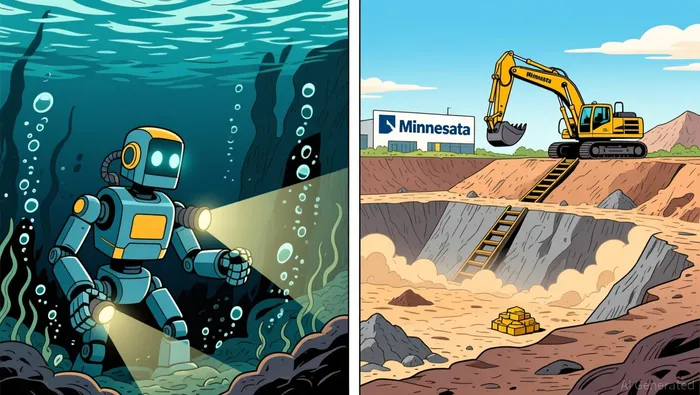
NORI - the deep-sea nodule deposit - is the anchor. It is also the problem. Deep-sea mining is a regulatory fight that could last years. The International Seabed Authority has been moving slowly, environmental groups are pushing back, and the timeline for commercial production keeps evaporating into "eventually." TMCR's existing royalty is a claim on a future that may not come for another decade, if at all.
Mesabi, by contrast, is real dirt in Minnesota. The first new taconite mine in nearly 50 years, backed by India's Essar Group, with over $1.6 billion already invested. Production is targeted for H2 2026 - potentially within months of this closing. It's not a bet on whether deep-sea mining becomes legal. It's a bet on whether a construction project finishes on schedule.
In other words, TMCR is using a terrestrial iron ore deal to buy itself time and credibility while its original asset limps through regulatory purgatory. The Mesabi royalty is the thing investors can point to and say "this is a real asset on real land." It's the part of the portfolio that makes the company look less like a speculative deep-sea vehicle and more like a legitimate royalty platform.
The financing tells part of the story too. TMCR raised $75 million in a PIPE at $13.00 per share and arranged a term sheet for up to $50 million in senior secured credit. The PIPE price anchors the market cap around $715 million. That means a $265 million commitment to Mesabi represents roughly 37% of the company's entire market value going into a single asset. This is a concentrated bet dressed up as portfolio diversification.
Michael Hess - an energy infrastructure investor with over 15 years in the space - was appointed Non-Executive Co-Chairman of the board, announced alongside the closing. That reads like credibility theater aimed at PIPE investors and prospective buyers for the next deal. Energy infrastructure experience helps sell the story that TMCR can evaluate and manage industrial mineral assets, not just sit on a seabed claim and hope.
So what sort of financial machine is this, really? It's a company that started as a royalty wrapper around a controversial deep-sea mining project, realized the valuation needed something more concrete to sustain, and raised debt and equity to buy a traditional terrestrial royalty that it can use as ballast. The Mesabi deal is not just an acquisition. It's a restructuring of the narrative - and of the capital structure - that keeps the whole thing floating.
The counterpoint is simple enough: if Mesabi produces and iron ore prices hold, TMCR has successfully diversified into a cash-flowing asset that could eventually support the stock even if NORI never gets off the ground. Royalty investors have been doing this for decades - buy the claim, wait, collect.
But the timing makes the move look less opportunistic and more like a response to a problem. You don't commit nearly 40% of your market cap to a pre-production royalty unless the existing asset is giving you trouble. The fact that TMCR exercised the option for the second 1% immediately, before the mine has even started producing, suggests the company sees Mesabi not as one deal among many, but as the anchor it needs.
The structural implication is this: TMCR is now a two-asset company where one asset is a question mark with an unknown horizon and the other is a known construction project with a known timeline. The market is being asked to price the whole thing as a royalty platform. The question for investors is whether Mesabi generates enough cash flow, fast enough, to make NORI look like an interesting bonus - or whether NORI remains the real valuation anchor and Mesabi is just the thing that makes the prospectus readable.