

A headline about Ocugen and Assertio joining the Russell Microcap Index while Definium and Tvardi exit sounds like an upgrade list. It isn't.
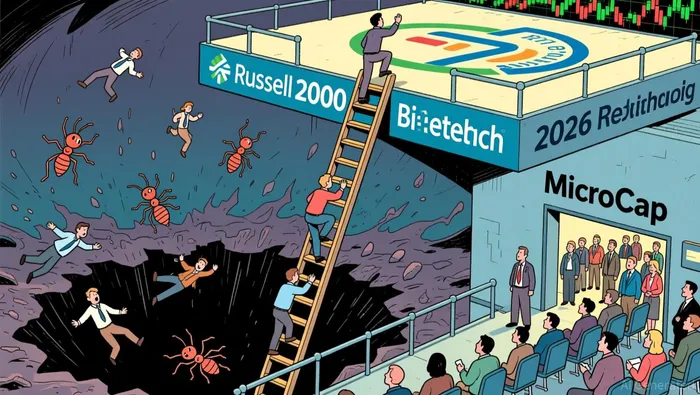
The Russell Microcap is not the index people care about. It is the index companies wait in.
FTSE Russell manages a universe called the Russell 3000 - the 3,000 largest US public companies. The Russell 1000 covers the biggest. The Russell 2000 covers the next 2,000. And the Microcap covers the smallest roughly 1,000 of that pool - the bottom rung. Almost no one tracks it. The iShares Micro-Cap ETF (IWC) is the main passive fund that does, with about $1 billion in assets and a 0.6% expense ratio. By comparison, the iShares Russell 2000 ETF alone manages more than $60 billion. Trillions more flow into Russell 2000–adjacent strategies.
So the word "exit" in this headline is doing work it shouldn't. Definium Therapeutics is leaving the Microcap because it's graduating. Its market cap sits at roughly $2.15 billion, with $373 million in cash. It's too big for the bottom rung. It's moving into the Russell 2000 - where the actual institutional money lives. That's the best thing a micro-cap biotech can ask for.
Tvardi Therapeutics, on the other hand, is exiting for the opposite reason. Market cap around $33 million. $25 million in cash, runway into the fourth quarter of 2026. Tvardi isn't graduating. It's falling off the ladder.
The headline collapses these two exits into the same event. They are not the same event.
Now the additions. Ocugen and Assertio are entering the Microcap. That means they're small enough to qualify but not yet big enough for the 2000. Ocugen has a $454 million market cap and just closed a $130 million convertible note offering to extend its cash runway into 2028. It's building an ophthalmology pipeline. Assertio reported $117 million in full-year 2025 sales from its pain drug Nucynta and guides $110–$125 million for 2026 - enough to cover itself, not enough to grow much. Market cap around $150 million.
Neither is about to force its way into the Russell 2000 this cycle. They're in the antechamber. The question isn't whether they joined an index. It's whether they'll grow big enough to join the one that matters.
This is the pattern that repeats every reconstitution. Eighty-two companies are graduating from Microcap to Russell 2000 in this June cycle alone. They get the passive buying mandate. Forced purchases. Analyst coverage. The whole apparatus that turns a forgotten ticker into a stock someone actually has to hold. The companies staying in the Microcap don't get any of that. They get a press release and a Bloomberg brief.
The 2026 reconstitution also marks the first switch from annual to semi-annual rebalancing - so this antechamber game happens twice as often now. More churn. More noise. More headlines that make "Microcap inclusion" sound like it carries weight.
It doesn't. Not by itself.
The real test for an investor is simpler: look at the exits. When a company leaves the Microcap, ask whether it's going up or off. Definium is going up. Tvardi is going off. The headline treats them the same. The market won't.
The additions are worth watching too - just not for the reason the headline implies. Ocugen and Assertio are small enough to be cheap and big enough to have a path forward. That's the interesting part. The index membership is just the scoreboard.