

Summary
- Salesforce reports Q1 FY27 earnings today, May 27, after a 30% stock decline over three months
- The "AI fear" narrative is a distraction - the real problem is a $50 billion buyback funded by $25 billion in new debt
- AI platform ARR sits at roughly $1.4 billion against $41.5 billion in total revenue: impressive in isolation, negligible as a thesis
- Free cash flow of $14.4 billion in FY26 is strong, but management is deploying it toward buybacks at a 4.5% to 6.7% borrowing cost while paying a ~1% dividend
- I rate Salesforce a Hold - the cash machine is real, but capital allocation has taken a wrong turn
I've been very surprised that nearly every analysis of Salesforce's stock decline reduces it to "AI fears." The narrative runs something like this: investors are worried AI will disrupt Salesforce's core, earnings haven't proved AI monetization yet, and once Q1 FY27 results drop today, the stock will recover.
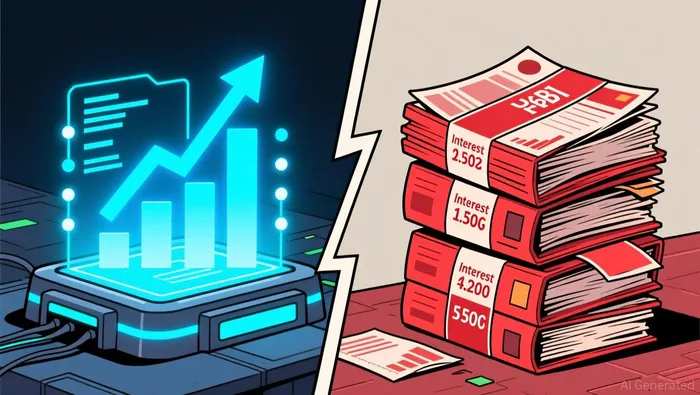
This is a false narrative. It mistakes the symptom for the disease. The stock didn't fall 30% between December 2025 and March 2026 because of abstract AI anxiety. It fell because management authorized a $50 billion accelerated share repurchase program and funded $25 billion of it by issuing senior notes at coupons ranging from 4.5% to 6.7%. That is not a confidence signal. It is a leverage play.
Let me decompose what the structural data actually says.
Pillar one: The cash machine is real, but nobody is disputing that.
Salesforce delivered $41.5 billion in revenue for fiscal 2026, up 10% year-over-year. Operating cash flow was $15.0 billion. Free cash flow - cash generated after capital expenditures, the metric that matters most for shareholder returns - reached $14.4 billion, up 16%. Non-GAAP operating margin expanded to 34.1%. The company returned $14.3 billion to shareholders through buybacks and dividends.
These are excellent numbers. Nobody is arguing otherwise. The stock's sell-off happened despite this strength, not because of it. When a stock drops 30% while FCF grows 16%, the problem is capital allocation, not earnings power.
Pillar two: AI ARR is not the revenue driver the market pretends it should be.
Salesforce's AI platform - Agentforce, Data Cloud, Einstein - reached approximately $1.4 billion in annual recurring revenue heading into fiscal 2027. Data Cloud alone surpassed $1 billion in ARR earlier this year. That's strong growth from a small base.
But $1.4 billion is roughly 3.4% of $41.5 billion in total revenue. Three percent. This is why the market's "AI fear" is so oddly constructed. AI is not what's at risk here. Core CRM license and subscription revenue - the remaining 96% or so - is. If AI disrupts Salesforce, it will come through the bottom up: agents replacing seat licenses, automation reducing renewal expansion, and deal sizes compressing as enterprises get more done with fewer seats. That's the actual threat vector. Nobody is pricing it in, and nobody is talking about it. Everyone is talking about whether the AI pie slice grows from 3% to 4%.
Pillar three: Buybacks at a borrowing cost that erodes the point.
Here is where the thesis turns. Salesforce borrowed $25 billion to buy back its own stock, paying between 4.5% and 6.7% in interest. The company's dividend yield is approximately 1%, meaning actual shareholders earn roughly one-fifth the return that Salesforce's creditors are demanding.
That is not how a buyback creates value. A buyback only makes financial sense when you're deploying capital at a cheaper cost than the return it generates for remaining shareholders. When the interest cost on the borrow exceeds what shareholders earn on the remaining shares, you are effectively transferring value from shareholders to bondholders. That being the case, the $50 billion repurchase program is less a return-of-capital strategy and more a management conviction signal - and one that costs shareholders money every quarter.
The debt-to-EBITDA ratio was about 0.6x as of January 31, 2026, which is still conservative. But adding $25 billion in debt to fund buybacks, not acquisitions, not infrastructure, not R&D - buybacks - when the dividend yield doesn't justify the borrow cost is a structural misallocation. It may not break the balance sheet. But it should make investors question why management prefers leveraged self-purchase over building a meaningful dividend.
Pillar four: The valuation looks cheap, but the cheapness has a reason.
Salesforce trades at roughly 23 times trailing earnings and about 13.5 times forward earnings, near the low end of its historical range and well below the growth premium the market once assigned it. Some analysts call this an opportunity. In my opinion, the market is partially right to discount it - not because of AI disruption, but because the capital allocation playbook has shifted from organic cash generation to leveraged self-financing. The stock is cheaper because the return profile for shareholders is structurally worse than it was three years ago.
The strongest counterargument runs like this: buybacks are accretive to earnings per share regardless of funding source, and Salesforce's FCF growth can easily service $25 billion in debt. This is technically true. Buybacks do boost EPS mechanically. But EPS accretion that costs more in interest than shareholders earn in yield is a hollow win. It grows the number on the spreadsheet while shrinking the real per-share economic value.
What today's earnings can and cannot do
Q1 FY27 results will show whether revenue momentum held, whether the raised FY26 guidance was sustainable, and whether AI ARR is accelerating toward a meaningful share of the top line. If Salesforce delivers 10%+ revenue growth and raises guidance, the stock may rebound tactically. That wouldn't mean the AI-fear narrative was wrong - it would just mean the capital allocation problem is being temporarily ignored again.
The AI story will keep growing. The $1.4 billion ARR will trend higher. But unless management rebalances capital allocation away from leveraged buybacks and toward a dividend that actually competes with the borrowing cost - or at least stops raising debt to buy back stock at rates higher than the yield - the structural drag remains.
That being the case, I rate Salesforce a Hold. The free cash flow engine is one of the best in enterprise software. The AI platform is growing from a credible base. But the $50 billion buyback funded by $25 billion in high-coupon debt is a capital allocation problem that earnings cannot fix. For income investors, the ~1% yield makes Salesforce a pass when higher-quality alternatives exist. For growth investors, the AI monetization timeline is still too early to outweigh the leverage concern. The stock is neither an irrational overreaction nor a home run buy - it's a quality company with a management decision that deserves scrutiny, not dismissal.