

The heart of Samsung's looming labor crisis lies in a stark pay divide: the company wants to give its 27,000 memory chip workers bonuses at least six times larger than those received by its 23,000 logic chip and foundry employees Reuters. This isn't just an internal equity issue-it's a supply chain time bomb ticking at the exact moment AI demand is straining global memory production to the breaking point.
Samsung's memory division is generating extraordinary returns. The company posted roughly $38 billion in operating profit for the first quarter of 2026 alone TechCrunch. Workers are demanding 15% of that operating profit be shared with them-a move that would annualize to over $25 billion in distributed bonuses TechCrunch. Meanwhile, rival memory maker SK Hynix is reportedly preparing average bonuses around $400,000 per employee TechCrunch. These numbers set the stage for what could become the largest strike in Samsung's history, starting May 21.
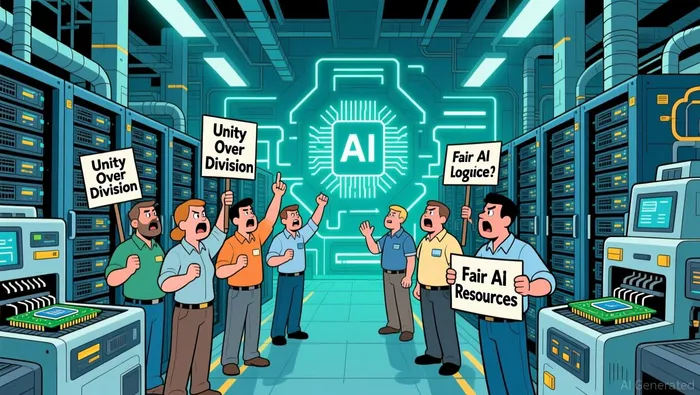
But the tension isn't simply about memory workers wanting more. It's about the 23,000 logic and foundry employees-many working in the same facilities-who generate AI chips for Tesla and Nvidia while their memory colleagues pull away financially Reuters. The foundry business has suffered billions in losses in recent years Reuters. Yet these workers argue they shouldn't be left behind in an AI boom they're directly enabling.
The retention risk is immediate and severe. Samsung's ambition to become the world's only "one-stop" semiconductor shop-spanning memory, logic, and foundry services-depends on keeping all these divisions intact Reuters. A strike that pulls memory workers away, or drives logic workers to competitors like TSMC or Micron, strikes at the core of that strategy. With global AI infrastructure buildout accelerating, the timing couldn't be worse. Samsung represents one of just three major memory suppliers globally TechCrunch. Any production disruption here ripples through the entire AI supply chain.
Production and Supply Chain Implications
An 18-day work stoppage involving more than 45,000 workers would reduce production at the exact moment AI infrastructure buildout is straining global memory supply to its limits. The strike is scheduled to begin May 21, and with government-mediated negotiations having broken down on Wednesday, the timeline is now fixed.
The financial stakes are staggering. JPMorgan estimates the work stoppage could impact Samsung's operating profit by 21 trillion won to 31 trillion won ($14.08 billion to $20.79 billion), with sales losses around 4.5 trillion won. The union's own damage estimate reaches as high as 30 trillion won. These figures represent a material hit to a division that has been the company's profit engine.
What makes this timing particularly damaging is the foundry business's fragile recovery trajectory. After posting losses for years, Samsung's foundry utilization was expected to average in the low-60% range in the first half of 2026, up from the 50% range in the second half of 2025 according to ZDNet. A strike interrupts this recovery at its earliest stages, potentially reversing gains just as the division was becoming viable.
The South Korean government has responded with unusual urgency. Prime Minister Kim Min-seok convened an emergency ministerial meeting after negotiations collapsed, with officials instructed to closely manage the situation given what his office called the potential gravity of the impact on the national economy. The National Labor Relations Commission brokered two days of marathon talks before the union declared it would "no longer consider additional negotiations" until after the strike according to Reuters.
For the AI supply chain, the implications are immediate. Samsung supplies memory chips crucial to AI data centers, and the company uniquely spans memory, logic, and foundry services unlike specialized competitors. Any disruption here doesn't just affect one product line-it threatens the entire "one-stop" strategy that makes Samsung a critical node in the AI hardware ecosystem. With just three major memory suppliers globally, the loss of Samsung's output for nearly three weeks creates a vacuum that competitors cannot immediately fill.
Market Reaction and Competitive Dynamics
Memory spot prices are already climbing in response to the looming strike, with the market pricing in a tangible supply risk as South Korea's government pushes management and labor to resume talks. This price movement is the market's immediate signal that an 18-day production halt at one of just three major memory suppliers globally creates a vacuum that cannot be quickly filled.
The competitive landscape is shifting in real time. Rival SK Hynix has eliminated its bonus pay cap, a move that directly responds to Samsung's internal pay disparity crisis and positions SK Hynix to capture talent and market share if Samsung's labor relations deteriorate further transcripts show. This isn't just about retention-it's about competitive positioning in a market where Samsung's "one-stop" strategy was supposed to be its unique advantage.
For the broader AI chip ecosystem, the implications are layered. Memory prices rising now means higher costs for AI data center operators building out infrastructure. The strike occurs as foundry utilization was only just beginning to recover-expected to average in the low-60% range in the first half of 2026, up from the 50% range in the second half of 2025 according to ZDNet. Any disruption reverses that fragile recovery trajectory at its earliest stages.
The market is also pricing in the risk of escalation. Samsung's government-mediated negotiations having broken down on Wednesday and the union declaring it would "no longer consider additional negotiations" until after the strike signals this could extend beyond the initial 18 days. Foreign investors have already begun to react, with the dispute rattling confidence in Samsung's ability to deliver on its AI chip ambitions at a critical moment in the global infrastructure buildout.
What makes this particularly damaging for Samsung's competitive positioning is that the strike doesn't just affect memory-it threatens the entire integrated model. The foundry business, which supplies AI chips to Tesla and Nvidia, suffers from the same labor unrest. If logic and foundry workers depart for competitors like TSMC or Micron amid the dispute, Samsung loses the very integration advantage that was supposed to make it indispensable to the AI supply chain.
What to Watch: Scenarios and Catalysts
The clock is now ticking toward a fixed deadline. With government-mediated negotiations having collapsed on Wednesday, the union has declared it is "no longer considering additional negotiations" until after the proposed strike. That sets the stage for an 18-day work stoppage beginning May 21-a date that has now become the industry's key risk trigger.
The union's hardline position is clear: it won't return to the table before the strike begins, though it would consider a new offer if Samsung puts one forward. That creates a narrow window for resolution. Samsung's refusal to commit to permanent changes in bonus calculation-offering only a one-time payment for 2026-fell fundamentally short of the union's demands according to union representative Choi Seung-ho. Unless the company reverses course dramatically in the next eight days, the strike proceeds.
For the AI supply chain, the immediate concern is production loss. A one-day walkout in April already cut memory fab output by 18% on affected shifts and dropped contract foundry production by 58% according to factory data. An 18-day stoppage at one of just three major memory suppliers globally creates a vacuum that competitors cannot immediately fill. Memory spot prices are already climbing in response to the supply risk. The question is how high they spike-and whether hyperscalers building AI data centers can absorb those cost increases or need to qualify alternative suppliers.
That leads to the second major catalyst: competitive positioning. SK Hynix has already eliminated its bonus pay cap, a direct response to Samsung's internal disparity crisis transcripts show. If the strike extends or escalates, Samsung risks losing not just production time but talent and customer confidence to rivals. The foundry business, still recovering from years of losses, is particularly vulnerable. Any disruption reverses the fragile utilization gains just beginning to materialize.
On the policy side, the South Korean government has responded with unusual urgency. Prime Minister Kim Min-seok convened an emergency ministerial meeting after negotiations collapsed, citing the potential gravity of the impact on the national economy. The labor minister stopped short of invoking emergency arbitration-a legal mechanism that would freeze industrial action for 30 days-but the tool remains on the table. Given that semiconductors accounted for 37% of South Korea's total exports in April, the economic stakes make this a high-stakes intervention.
The path forward hinges on a few key variables. Will Samsung make a counteroffer before May 21? Will the union accept mediation after the strike begins? Or will the dispute extend beyond the initial 18 days, creating a prolonged supply shock? For now, the market is pricing in tangible risk. The next few weeks will determine whether this remains a contained labor dispute or becomes a structural disruption to the AI hardware supply chain.