

The headline is about union drama. A court injunction. An 18-day strike that almost happened. But if you hold Samsung for the dividend, the question is simpler: does this labor chaos touch the payout? It doesn't. The money is there - the argument is over who gets it.
Samsung's non-chip division workers filed a court injunction this week trying to block a vote on a bonus deal that would give memory chip employees average payouts of roughly $340,000, while mobile and consumer electronics workers would see figures closer to $4,000. The largest union excluded the consumer electronics division from the vote, which is what triggered the legal fight. A South Korean court had already blocked the threatened 18-day strike on May 19, and the unions suspended the walkout after a last-minute deal on May 20. The vote is underway now, and the non-chip backlash is intensifying.
None of it changes Samsung's ability to pay you.
The cash-flow engine has never been stronger. Samsung's chip division reported an operating profit of 53.7 trillion won - about $36 billion - in the first quarter of 2026, up nearly 50 times from the same period last year. Full-year Q1 operating profit surged more than eightfold, beating both management guidance and all of fiscal 2025 combined. This is the AI memory chip boom hitting the bottom line, and it's hitting hard.
Here's what matters for the income investor: Samsung has committed to returning 50% of its free cash flow to shareholders for the 2024-2026 period. The regular annual dividend is set at 9.8 trillion won, and the FY2025 year-end payout was 566 won per share. By the 50% FCF policy, if this year's chip profits hold even a fraction of Q1's momentum, that dividend should meaningfully expand.
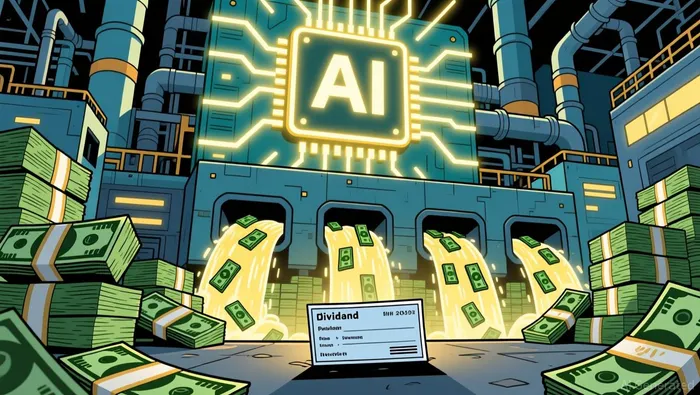
But the yield tells a different story. Samsung currently yields around 0.5% to 0.57%. That's not a retirement-income number. That's a "nice if you already own it" number. The market is pricing Samsung as a growth play riding the AI wave, not an income compounder. You wouldn't buy it to fund your retirement. You'd buy it if you want a small slice of the memory chip cycle and want the dividend to grow into something bigger as cash flow builds.
So what does the union fight actually represent for the shareholder? Not a threat. A signal.
When a company is arguing over how to distribute $27 billion in bonuses - that's the approximate total pool under the chip worker deal - the problem isn't affordability. The problem is internal equity. The non-chip workers see their division as the stepchild while memory chips print money. From the shareholder's perspective, this is the opposite of a red flag. It means cash generation is so strong that even after massive bonus payouts, there should still be plenty left for the 50% FCF distribution commitment.
The risk isn't that Samsung can't pay. The risk is that it might not want to pay much more.
Samsung has historically been stingy with dividends relative to its cash generation. The Lee family holds substantial voting control through cross-shareholdings, and the company has preferred massive stock buybacks and capital expenditures over generous payout ratios. A 0.5% yield from a company generating this much free cash flow is a management choice, not a constraint.
Here's where the income investor has to make a judgment call. If Samsung's AI-era profits are structural - if HBM demand for AI data centers sustains these margins through the rest of 2026 and beyond - then the dividend should have a real runway to climb. That would make the stock worth holding, not for income today, but for the income it could become. But if this is a cyclical spike that fades as competitors like SK Hynix catch up and memory prices normalize, the dividend may settle back down.
The union dispute gives us one useful data point. If Samsung is willing to commit $27 billion in bonuses while simultaneously honoring its 50% FCF shareholder return policy, the cash generation is real enough to support both. Labor unrest and dividend health can coexist - in fact, they often do. The payout doesn't suffer because workers got expensive. It suffers if the business stops printing money.
What would change the story? A court ruling that forces a strike to resume and meaningfully disrupts chip production. A memory price collapse that turns the AI boom into a brief spike. Or the quiet risk: management deciding that even with massive cash flows, the dividend stays decorative while buybacks absorb the excess.
The practical takeaway: Samsung isn't an income holding right now. It's a cash-flow option. The union drama proves the cash is real and the business is flush. Whether management converts that flush into a dividend you can actually live off of is the question. Watch the 50% FCF policy execution over the next two quarterly reports. If the dividend doubles from its current level, the story changes. If it stays near 0.5%, you're paying growth prices for a growth stock that happens to pay a token dividend. Neither is wrong - but don't confuse the two.
We get the urge to watch the price and worry about the union vote. But the income question is simple: the machine is printing money. The question is whether management routes enough of it your way.