

Summary
- Samsung's Q1 2026 operating profit surged 756% to ₩57.2 trillion - but Lee Jae-yong's vow to "find new growth engines" misses the real problem
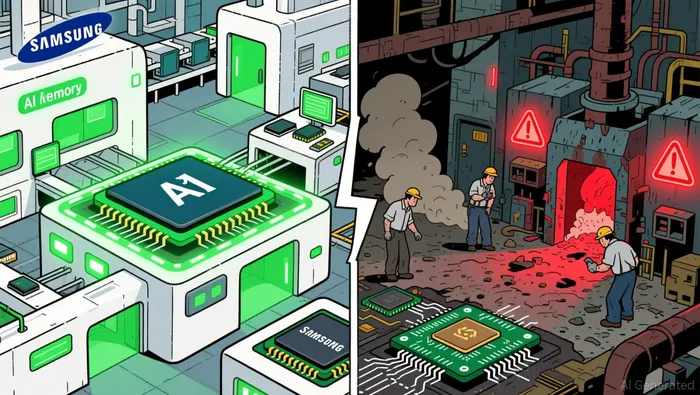
- AI memory already is the growth engine, accounting for 94% of Samsung's profits. The false narrative isn't a growth gap - it's a capital allocation gap
- Samsung is spending ₩110 trillion ($73.3 billion) on capex in 2026, much of it on a foundry business with 2nm yields stuck around 55%, well below TSMC's 70–80%
- The annual dividend is ₩9.8 trillion with a trailing yield of 0.51%. For a company generating this much cash, that dividend is a rounding error
- The stock trades at 19.5x trailing earnings but 4.7x forward - the market already expects the AI memory boom to normalize sharply
I've been very surprised that the market has largely accepted Lee Jae-yong's framing that Samsung needs to "find new growth engines." The language suggests a company searching for its next act. The data says something different: Samsung has found its growth engine. It's called AI memory. In Q1 2026, AI-driven memory demand generated ₩53.7 trillion of operating profit for Samsung's device solutions division - 94% of the company's total operating profit of ₩57.2 trillion.
That being the case, the real story isn't about finding growth. It's about what Samsung does with the cash that growth produces.
Here is the structural problem that Lee's growth-engine narrative conceals.
Samsung plans to spend ₩110 trillion ($73.3 billion) on capital expenditure and research in 2026, up from approximately $60 billion in 2025. That is not maintenance spending. That is the kind of investment that rewrites the balance sheet for a decade. And the destination of most of it is the foundry business - Samsung's custom chip manufacturing operation that has lost billions of dollars for years and still hasn't solved its yield problem at advanced nodes.
As of April 2026, Samsung Foundry's 2nm yields are reported in the mid-50% range, below the roughly 60% threshold needed for mass production. After accounting for backend processes, the effective yield falls to around 40%. Meanwhile, TSMC's 2nm yields are running 70–80% and it is fully booked through 2028.
So the picture is this: Samsung is printing AI money in memory, then spending roughly $73 billion a year to try to close a foundry gap it hasn't been able to close for five years. That is not a "search for growth engines." That is a capital allocation problem dressed up as a growth strategy.
Now let's look at what this means for the shareholder.
Samsung's free cash flow for the quarter ending March 2026 was $35.5 billion - up 88% year-over-year. Impressive on its face. But free cash flow is what remains after capex, and with $73.3 billion of capex planned for 2026, you need to ask what that number looks like when the full year's spending is deducted. Samsung's shareholder return program promises 50% of free cash flow over the 2024–2026 period, with an annual regular dividend of ₩9.8 trillion. That works out to roughly $6.5 billion per year.
Divide that $6.5 billion against Samsung's approximately $1.35 trillion market cap, and you get the trailing dividend yield of 0.51%. That is not a dividend. That is a courtesy.
Comparisons with TSMC on this point are not only unjustifiable and irrational; in my opinion, they are irresponsible - because TSMC's foundry is actually working. But if we're going to talk about capital allocation, Samsung's 0.51% yield should put any income-focused investor off the stock immediately. The company's five-year dividend growth rate is negative 8%, according to GuruFocus. This is a company that generates trillions in operating profit and returns less than one percent in dividends. The rest goes into the foundry capex machine.
Here is what the valuation is telling us that Lee's growth narrative does not.
The stock trades at 19.5 times trailing earnings but just 4.7 times forward earnings. That is the market speaking plainly: it does not believe the Q1 profit surge is sustainable. A forward P/E of 4.7x implies analysts expect operating profits to collapse from current levels as the AI memory supercycle normalizes. That is a brutal discount, and it reflects the reality that memory is cyclical - and cycles turn.
Samsung's HBM (high-bandwidth memory) position reinforces why the cycle matters. As of mid-2026, Samsung holds roughly 17% of the HBM market. SK Hynix leads with 62%, and Micron sits at 21%. Samsung is the third-place player in the most important memory segment in the AI buildout. It is gaining ground - both companies raised 2026 HBM3E order prices by 20% - but the gap is structural, not temporary. SK Hynix's lead in HBM3E production and HBM4 development is not something Samsung closes with more spending. It closes with better execution, and that is the one thing the foundry record doesn't inspire confidence in.
That being the case, my view is this: Samsung is not a growth story in search of a narrative. It is a capital allocation story in search of discipline. The AI memory boom is real, and it will be profitable for as long as hyperscaler spending on data center infrastructure remains aggressive. But Samsung is spending roughly $73 billion a year to chase a foundry business that TSMC has already won, while returning 0.51% to shareholders in dividends.
For investors who want AI exposure through semiconductors, the market is telling them where the money flows. TSMC is fully booked through 2028 at 70–80% yields on 2nm. SK Hynix dominates HBM with 62% market share. Samsung is the third option in both categories, spending the most capital to close gaps that may never close.
I rate Samsung as a Hold. The AI memory profits are genuine and the Q1 numbers are extraordinary, but the 4.7x forward P/E already prices in a significant profit normalization. The foundry capex trajectory - $73.3 billion annually on a business with 40% effective yields at the cutting edge - is a structural drag on free cash flow and shareholder returns that I don't see changing under Lee's current strategy. For income investors, the 0.51% dividend yield eliminates the stock from consideration regardless of how bullish you are on AI memory. For growth investors, the valuation gap between trailing and forward multiples tells you the market already knows what Lee is trying to sell: the growth engine is here, but it's expensive to own and expensive to maintain.
The false narrative isn't that Samsung needs new growth engines. It's that this one needs a capital allocation committee that prioritizes shareholders over foundry dreams.