

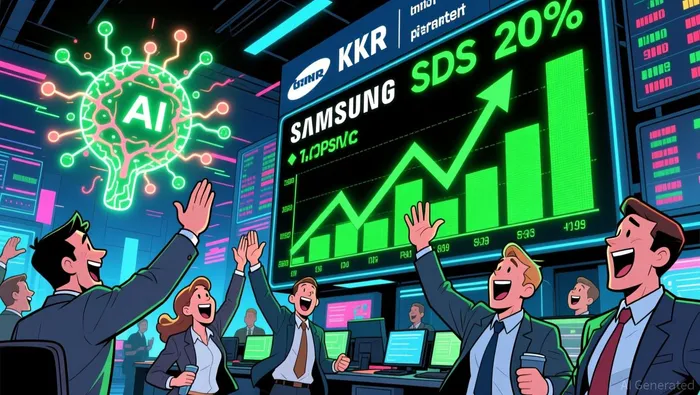
The market's reaction to Samsung SDS's partnership with KKR is a textbook case of extreme optimism. Shares surged as much as 20% on the news, a move that signals investors are pricing in a near-perfect execution of a transformative strategic plan. The prevailing sentiment is one of relief and excitement, viewing the deal as a major vote of confidence that will unlock immediate value. Yet, the concrete mechanics of the agreement reveal a more measured reality, setting up a clear expectations gap.
The core of the deal is a $820 million convertible bond purchase, not a direct equity investment. This structure is crucial. It means KKR is providing capital with a built-in conversion option, but the company's stock price must rise above the conversion price of 180,000 won per share for the bondholders to convert into equity. At the time of the announcement, shares were trading just above that level, meaning the bond's conversion feature is essentially at-the-money. The market's 20% pop suggests it's already betting the stock will climb significantly beyond that point, driven by the promised strategic guidance.
KKR's role is advisory, not operational. The firm will serve as a long-term adviser for six years, focusing on mergers and acquisitions, capital allocation, and expansion as a full-stack AI solutions provider. This is a partnership for growth, not a takeover or a governance overhaul. The funds, combined with Samsung SDS's existing cash and cash equivalents of 6.4 trillion won, are earmarked for AI infrastructure investment and potential acquisitions. The transaction is expected to close in the second quarter of this year.
The bottom line is that the market is pricing in a significant acceleration in growth and value creation from day one. The 20% share surge reflects expectations for immediate strategic guidance and a powerful funding boost for AI and M&A. The deal's mechanics, however, are a more conventional capital raise with a conversion feature and an advisory role. The market's exuberance may already be priced for perfection, leaving little room for the company to simply meet its stated plans.
Valuation and the "Priced for Perfection" Risk
The market's 20% surge has pushed Samsung SDS's share price to around 180,600 won. This level implies the partnership is being valued as a near-certain catalyst for accelerated growth and global expansion. The question for investors is whether this price already reflects the full benefits of the deal, or if there's still room for further upside.
On paper, the financial setup is strong. The company has significant cash reserves of 6.4 trillion won, and the new $820 million convertible bond proceeds are additive to that war chest. Analysts note this expanded investment capacity is the core driver of the rally, with expectations focused on overseas expansion or global M&A preparations. The stock's move suggests the market is pricing in a rapid ramp-up in AI infrastructure spending and a successful hunt for strategic acquisitions, all backed by KKR's advisory muscle.
Yet, the deal itself does not guarantee these outcomes. The partnership is advisory, not operational, and the bond's conversion feature is currently at-the-money. This means the market's optimism is not anchored to a change in control or governance, but to a promise of future execution. As one analyst pointed out, the investment does not appear to have a strong focus on corporate governance improvements. The "Korea discount" that some foreign investors are betting on is a structural issue, not something this deal directly addresses.
The risk here is that the stock is now priced for perfection. The 20% pop likely embeds high expectations for immediate strategic guidance and a clear path to global M&A. If the company's subsequent announcements or financial results merely meet these elevated expectations-without exceeding them-the stock could face pressure. The valuation now hinges almost entirely on the company's ability to execute its stated plans of building out AI infrastructure and securing global business footholds. Any stumble in that execution would be met with a skeptical market, as the partnership's benefits are already front-loaded into the share price.
Catalysts, Scenarios, and Key Watchpoints
The forward path for Samsung SDS is now set by a clear sequence of events and metrics. The primary near-term catalyst is the closing of the bond deal in the second quarter of this year. This will unlock the $820 million in new capital, providing the tangible fuel for the company's stated plans. The market's 20% surge suggests this closing is already priced in as a positive event. The real test begins after the deal closes, when investors will demand concrete proof of execution.
The key watchpoints are the company's announcements on how it deploys these funds. The first tangible signal will be concrete plans for AI infrastructure spending and any early-stage M&A targets. These are the direct outcomes of KKR's advisory role in capital allocation and M&A. Any delay or vagueness in these announcements would be a red flag, indicating the partnership's promised strategic guidance is not translating into action. Conversely, specific details on overseas expansion or new business ventures like physical AI would validate the market's growth thesis.
The risk/reward scenario hinges entirely on Samsung SDS's ability to execute its growth plans. The stock is now priced for a rapid ramp-up in investment and a successful hunt for global business. If the company merely meets these elevated expectations without exceeding them, the recent gains could face pressure. The partnership does not guarantee improved corporate governance or an immediate resolution to the "Korea discount," which some foreign investors are betting on. Therefore, the stock's direction will be determined by future investment execution and business results, not the initial deal announcement.
In essence, the market has moved from the hype of the announcement to the reality of execution. The next six months will be critical for separating priced-in optimism from future value creation.