

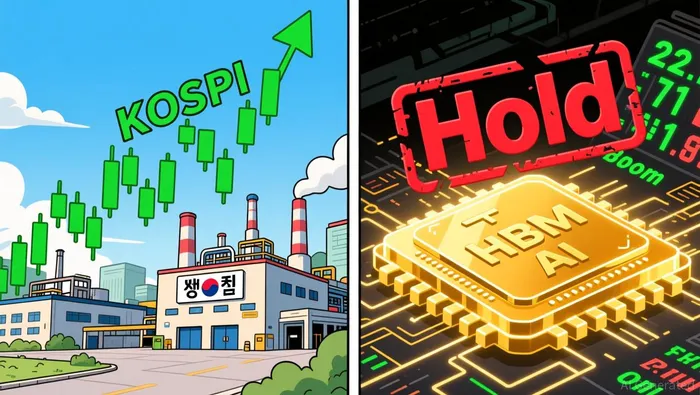
The market relief trade is already underway. Samsung shares jumped nearly 4 percent after the company's union agreed to suspend its planned 18-day strike, and the KOSPI pushed to fresh record highs. Samsung carries roughly a 32 percent weight in that index - any move on Samsung's behalf drags the whole Korean market with it.
The tension is resolved. The question for investors is whether the stock has earned its new price.
Let me start with the cash flows, because those are what actually determine whether a semiconductor company can absorb higher labor costs and still compound shareholder value. Samsung reported operating profit of KRW 57.2 trillion in the first quarter of 2026 - compared to KRW 6.69 trillion in the same quarter last year and KRW 43.6 trillion for all of fiscal 2025. That eightfold quarterly surge is the result of AI-driven demand for HBM (high-bandwidth memory) chips, which Samsung manufactures at scale alongside SK Hynix. The memory cycle is not just turning; it is roaring.
Now let's talk about what the union wanted versus what it got. The union representing roughly 47,000 workers - more than a third of Samsung's global workforce - had demanded performance bonuses equal to 15 percent of the memory division's annual operating profit. At the profit levels Samsung is now generating, that figure would have run into hundreds of billions of dollars in additional compensation. Management had offered a structure based on 10 percent instead. The sides settled on a 6.5 percent across-the-board wage increase. Against quarterly operating profits of KRW 57.2 trillion, that raise is a rounding error. Even at full implementation, it does not meaningfully dent the cash flow profile that's driving the stock.
The strike risk was always the more dramatic problem for investors than the economics of the wage bill itself. An 18-day shutdown at Samsung's Korean fab facilities would have disrupted memory supply during the tightest market cycle in a decade. That supply risk is gone now. That's the relief the market priced in Monday.
From a valuation perspective, however, the picture is less flattering. Samsung's market capitalization surpassed $1 trillion in early May - before this union headline - and sits near $1.2 trillion today. The stock has nearly doubled year-to-date. The KOSPI as a whole is up roughly 75 percent this year, after posting a 76 percent gain in 2025. Samsung's trailing P/E ratio has climbed to approximately 41x - 228 percent above its own 10-year median of around 12.5x. Even using forward estimates, the stock trades near 7x, which looks cheap only because earnings projections have been pushed skyward by analysts who expect the memory boom to compound for the full year.
Here's the thing about cyclical semiconductors: the most attractive entry point is when the cycle is troughing and multiples are depressed, not when profits have already exploded eightfold and the stock has run 150 percent over the past two years. The memory cycle is cyclical by nature. Demand will soften at some point. Pricing power will erode. SK Hynix, already commanding a premium valuation with a $865 billion market cap and a forward P/E of just 5.5x against its own projected earnings surge, is the benchmark Samsung can no longer claim to be cheaper than.
Samsung is forecast by some analysts to generate $151 billion in net profit this year - figures that would dwarf TSMC's output and transform the company's financial profile permanently. But forecasts that large are baked into the current share price already. The $1.2 trillion valuation assumes the AI-driven memory boom sustains without a meaningful pause through at least the next two years.
Even if the cycle does hold up and Samsung delivers on those numbers, the margin of safety - which is the only thing that separates a value purchase from a momentum trade - has evaporated. There's no discount to history. There's no dislocation between fundamentals and price. The stock is priced for perfection in a cyclical business.
While it's true that Samsung's cash flow generation is extraordinary and that the union risk removal eliminates a real operational threat, the investment opportunity that existed six months ago - when the stock was trading at a fraction of current levels and the memory cycle was just beginning - is no longer there. The crisis is resolved. The upside is too.
All things considered, I would rate Samsung a Hold at current levels. The company is operating at peak cycle conditions with best-in-class margins, but the market has already rewarded that reality. Value investing is about buying cash flows at a discount, not paying a premium for cash flows that everyone already loves. At $1.2 trillion, Samsung is not the bargain it was. The risk/reward has shifted the other way, and I'd wait for a pullback before considering a position.