

The factual picture is stark. Tutanota's unsolicited mini-tender offer comes in at $1,150 per share-below the market close of $1,382.72 on the last trading day. That's a discount of roughly 17%, not a premium. The offer covers less than 0.07% of outstanding shares, a rounding error in the context of SanDisk's $205 billion market cap.
The stock's recent trajectory explains why this offer looks so peculiar. SanDisk has run up 40-fold from its 52-week low of $35.79 last May, riding the AI memory supercycle narrative to a 52-week high of $1,600 just four days ago. The current price sits 14% below that peak. The market has clearly priced in perfection-optimism about AI infrastructure demand, memory chip shortages, and continued margin expansion.
Tutanota's offer carries a curious condition: the stock must close above $1,150 on the last trading day before expiration (currently May 20, 2026). If the price dips below that threshold, shareholders tendering at $1,150 would receive a below-market price. This structure essentially bets that the stock stays elevated while capturing shares from investors who either miss the current market price or don't bother comparing the offer to prevailing quotations.
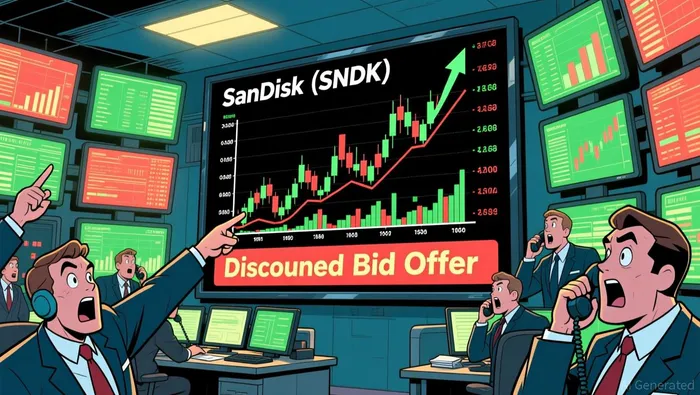
The SEC has warned about exactly this dynamic-bidders making mini-tender offers at below-market prices, hoping investors won't check the current market value. SanDisk itself recommended shareholders take no action and does not endorse the offer.
The asymmetry here is striking. The market has already priced SanDisk for a perfect execution of the AI memory story. A bid 17% below that price isn't an attractive alternative-it's a reminder of how far the stock has run, and a test of whether any investor will accept a discount when the market is already offering a premium.
Second-Level Thinking: Why Now? What Is Tutanota Betting On?
The timing of Tutanota's offer warrants scrutiny. The bid arrives after SanDisk's 40-fold run-up and just as the stock pulled back from its 52-week high of $1,600.00 four days ago. The current market price hovers around $1,370-still 14% below that peak, but well above Tutanota's $1,150 bid. This isn't a desperate fire-sale scenario; it's a calculated bet that the stock stays elevated while capturing shares from inattentive or impatient sellers.
The extension mechanism reveals the real asymmetry. Tutanota can extend the offer for successive periods of 45 to 180 days, delaying payment indefinitely while locking in the option to buy at $1,150. This gives the bidder first dibs at a discount while shareholders face uncertainty about when-or if-they'll be paid. Meanwhile, the condition that the stock must close above $1,150 on the last trading day means shareholders tendering at the offer price risk receiving a below-market value if the stock dips even slightly. It's a structure designed to protect the bidder, not the seller.
SanDisk's response carries weight. The company publicly flagged this as an unsolicited offer and explicitly recommended shareholders take no action. Management has the best view of whether the current price fairly values the AI memory demand story. When a company signals that a bid doesn't reflect true value, that's a signal worth weighing-especially when the bid comes in 17% below market.
The question for shareholders isn't just whether $1,150 is attractive relative to where the stock was months ago. It's whether the market's current pricing-reflecting optimism about AI infrastructure, memory supercycles, and margin expansion-is justified. Tutanota's offer implicitly bets the answer is yes, but the structure of the deal suggests the bidder is more interested in capturing discounted shares than in making a fair market transaction.
The Recommendation: Reject and Hold-The Risk/Reward Is Asymmetric
The actionable conclusion is clear: reject the tender offer and hold. The asymmetry here works entirely against the selling shareholder.
The offer sits at $1,150 per share-roughly 17% below the closing price of $1,382.72 on the last trading day. Meanwhile, the stock has already delivered a 40-fold return from its 52-week low of $35.79. That explosive move upward is already priced in. The market has rewarded SanDisk for the AI memory supercycle narrative, pushing the stock to a 52-week high of $1,600 just days ago. What Tutanota is offering isn't a hidden value opportunity-it's a discount bid on a stock that has already priced in perfection.
The deal structure reinforces the asymmetry. Tutanota can extend the offer for 45 to 180 days at its discretion, delaying payment indefinitely while locking in the option to buy at $1,150. The condition that the stock must close above $1,150 on the last trading day means shareholders who tender risk receiving a below-market price if the stock dips even slightly. This structure protects the bidder, not the seller.
For shareholders who have already tendered, the withdrawal right provides an exit. Stockholders who have already tendered their shares may withdraw them at any time prior to the offer's expiration. This is a critical safeguard-and a signal that the offer is not a favorable alternative to holding.
SanDisk's recommendation carries weight. The company explicitly recommends that stockholders take no action and does not endorse the offer. Management has the best view of whether the current price fairly values the AI memory demand story. When a company signals that a bid doesn't reflect true value, that's a signal worth weighing-especially when the bid comes in well below market.
The bottom line: the market is offering a premium price for SanDisk shares. A bid 17% below that price isn't an attractive alternative-it's a reminder of how far the stock has run and a test of whether any investor will accept a discount when the market is already paying more. Reject and hold.