

In April 2026, the Consumer Price Index rose 3.8% year-over-year. The Federal Reserve's preferred gauge - core PCE, which strips out the volatile food and energy categories - climbed to 3.3%, up from 3.1% in January. Inflation isn't coming back to 2%. It's accelerating.
And while investors debate what Bitcoin will hit by year-end - with predictions ranging from $63,000 to $110,000, depending on which website you trust - the asset itself is trading at roughly $63,000, down about 30% from its six-month high near $98,000.
The number matters because it reveals something the Bitcoin bulls never want you to admit: when inflation runs structurally high and interest rates stay elevated, speculative assets that produce nothing can fall hard. Fast.
The question everyone is asking is the wrong one
"What price will Bitcoin reach in 2026?" - this is a question that assumes the only thing that matters is direction. It assumes that if Bitcoin goes up, you win. If it goes down, you lose. It assumes that price movement is the same thing as investment merit.
I don't think price prediction is the right way to frame this. The better question is: in a regime where inflation is 3.3% and still rising, what actually protects your purchasing power?
Bitcoin's answer is a narrative about scarcity and institutional adoption. The fixed supply of 21 million coins. The ETF flows. The idea that central banks will keep printing and Bitcoin captures the overflow.
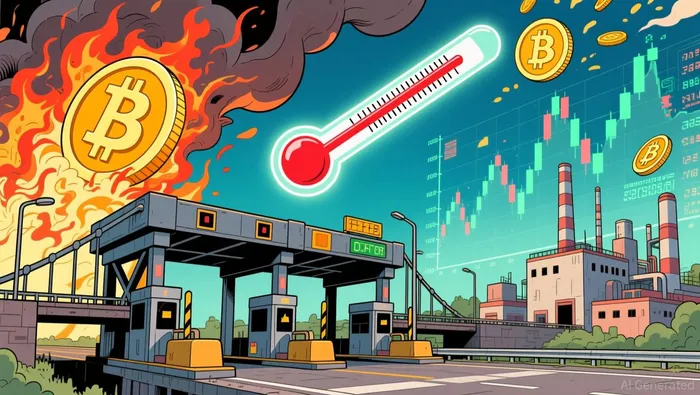
Here's the thing: narratives don't pay dividends. They don't produce cash flows. They don't let you raise prices when your costs go up because you have a competitive moat and customers who have no alternative.
When Bitcoin falls 30% from its high, there are no earnings for the price to "recover" toward. There is no free cash flow to justify the valuation. There is no payout that grows faster than inflation. There is only the hope that someone else pays more tomorrow.
What you need when inflation won't cooperate
I believe inflation is likely to remain structurally above the Fed's 2% target for the foreseeable future. The drivers aren't temporary: deglobalization, supply-chain reconfiguration, energy transition costs, fiscal dominance, and aging demographics all push prices higher. The Fed may tolerate it - the recent resistance to rate cuts despite growing pressure suggests policymakers understand the growth and employment trade-offs of over-tightening.
In this regime, there is only one filter that matters: pricing power.
Can the company raise prices without losing customers? If yes, it can grow its revenue through inflation. It can grow its cash flow. It can grow its dividend. If no, it cannot pass through its cost increases and will either shrink margins or lose market share. The dividend eventually follows.
This is why I focus on the real economy - energy, industrials, defense, logistics, midstream infrastructure - and not the financial economy or speculative digital assets. These are companies that provide things the economy cannot function without. They operate in oligopolistic markets with high barriers to entry. Their customers need their products regardless of whether sentiment is bullish or bearish.
The toll road advantage
Consider the midstream energy sector. These companies own pipelines, storage facilities, and processing infrastructure. They charge fees based on volume, not commodity prices. When energy prices rise, more production flows through their systems and they collect more. When inflation drives construction costs up, their long-term contracts often include price adjustment clauses.
Compare that to Bitcoin, which is up roughly 30% year-to-date as of early June 2026, but has no floor. The same forces that push energy prices higher - supply constraints, geopolitical risk, infrastructure underinvestment - are tailwinds for toll-road infrastructure companies. They don't need you to believe in a narrative. They just need energy to keep flowing.
Or consider defense contractors. Global defense spending is rising structurally - NATO targets, Indo-Pacific tensions, Middle East instability - and these companies have pricing power built into government contracts with inflation-adjusted clauses. Their dividends grow because their revenue grows, not because retail sentiment shifts.
The compounding case the Bitcoin crowd ignores
Here's what the Bitcoin narrative never addresses: the math of compounding income.
A stock yielding 2.5% that grows its dividend at 12% annually reaches a 60% yield on cost after 30 years. That is growing income that keeps pace with and outpaces persistent inflation. The cash flows are real. They are contractually committed. They come from businesses that produce tangible products and services.
Bitcoin gives you nothing until you sell. And when you sell, you're asking the market to agree with you about the price. There is no cash flow floor. No earnings recovery. No dividend compounding. Just price discovery between two willing parties at a single point in time.
That works in a rising market. It also works in a rising-rate, rising-inflation environment where the market stays euphoric and liquidity flows endlessly into risk assets. But we're not in that environment. Core PCE is 3.3% and climbing. The Fed is resisting rate cuts. Treasury yields are rising.
In this regime, duration risk - the risk that far-dated cash flows are worth less when discounted at higher rates - kills speculative valuations. It's why Bitcoin fell 30% from its high even with "institutional adoption" as its thesis. The institutions that bought ETFs also need to mark to market, and when the discount rate rises, assets with no near-term cash flows get re-rated down.
So what do you do?
This isn't about being contrarian. It's about being rational.
If inflation runs at 3% or above for years - not months, not quarters, but years - the assets that win are the ones with pricing power, pricing power, pricing power. The businesses that can raise prices because customers have no realistic alternative. The companies with investment-grade balance sheets that can weather rate volatility without cutting payouts. The dividend growers that compound income on top of compounding income.
Bitcoin belongs to a different universe. It is speculation - an asset class whose value depends entirely on collective belief rather than cash generation. There is nothing wrong with speculation if you understand what you're doing and size it accordingly. But from an income and risk/reward point of view, it solves no portfolio problem that real-economy dividend growth stocks solve better.
The question isn't what price Bitcoin will reach in 2026. The question is whether you can sleep at night knowing your retirement income depends on collective belief rather than a company that just raised prices by 5%, increased free cash flow by 12%, and announced its 14th consecutive dividend raise.
I don't need Bitcoin to go to zero for this framework to work. I just need inflation to stay above 2% and businesses with pricing power to keep growing their dividends faster than prices rise. From what I'm seeing - core PCE at 3.3%, Fed pushing back on cuts, structural supply-side pressures that aren't going away - that's not a stretch. That's the base case.
Not owning enough real-economy income compounders is the risk. The rest is noise.