

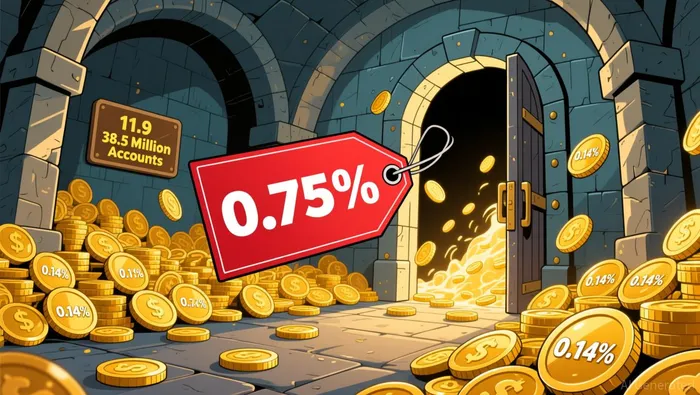
The potential capital pool is staggering. Charles Schwab's direct crypto on-ramp targets its 38.5 million active brokerage accounts and $11.9 trillion in client assets. This isn't a niche product launch; it's a distribution event for a wall of money that could dramatically reshape retail crypto flows.
Yet the entry fee creates an immediate competitive trap. Schwab's 0.75% per transaction fee is a steep 3 to 37 times higher than the 0.02% to 0.25% fees charged by dominant spot Bitcoin ETFs. For a market where price action is driven by institutional flows, this pricing disadvantage is a fundamental hurdle.
Bitcoin's current trading near $82,000 sets a high-stakes environment. In this range, fee efficiency is paramount. The data shows ETFs are already absorbing hundreds of BTC daily, removing liquid supply. Schwab's model must overcome this cost barrier to capture even a fraction of that capital.
The Flow Battle: ETF Inflows vs. Brokerage Fees
The current flow battle is one-sided. Spot Bitcoin ETFs have attracted more than $1.25 billion in May alone, marking their sixth consecutive week of positive inflows. This momentum is concentrated in the lowest-cost products, with Morgan Stanley's ETF leading the pack with a fee of just 0.14%.
Schwab's 0.75% per transaction fee creates a direct pricing disadvantage against this entrenched ETF liquidity. For most investors, the upfront cost of entering the market via Schwab is 3 to 37 times higher than buying an ETF. This gap makes the ETFs the default choice for direct exposure, as they offer lower initial fees and seamless integration into existing brokerage accounts.
The key question is whether Schwab's launch triggers a flow shift from ETFs to direct ownership. The data suggests it will not, at least not initially. The fee premium Schwab charges for the convenience of holding assets directly is unlikely to be justified for the average investor, especially given the current ETF inflow surge. The battle is less about product features and more about who controls the capital's entry point.
Catalysts & Watchpoints
The immediate test is ETF flow divergence. The current trend of more than $1.25 billion in May inflows must continue unabated. Any sustained drop in daily net inflows, as tracked by tools like the SoSoValue ETF Dashboard, would signal that Schwab's launch is not diverting capital. The primary signal to watch is whether ETFs maintain their liquidity advantage despite Schwab's entry.
The next major data point arrives in July. Schwab's Q2 2026 earnings call is the first formal opportunity for the firm to disclose crypto trading volume or asset flows. Management's commentary on adoption rates and fee impact will be critical. Silence or vague language would reinforce the thesis that the product is not yet moving meaningful capital.
The overarching risk is fee inelasticity. If Schwab's 0.75% per transaction fee fails to attract significant flows, ETFs will remain the dominant vehicle for institutional and retail capital. The launch validates the on-ramp scale, but the fee trap ensures it does not disrupt the existing flow hierarchy.