

The business model you think you own is not the one the company runs.
Sebang Global Battery (KRX:004490) was kicked out of the KOSPI 200 index in May 2026, alongside GS E&C, GKL, and Green Cross Holdings. The official reason: multi-quarter relative underperformance and structural capital outflows. Most market commentary has been busy trying to explain away Sebang's weak earnings as an accounting quirk - "statutory earnings don't tell the whole story" is the refrain. That framing misses the actual problem entirely.
The real issue isn't how Sebang accounts for its profits. It's what business Sebang actually is.
Sebang is not an EV battery company
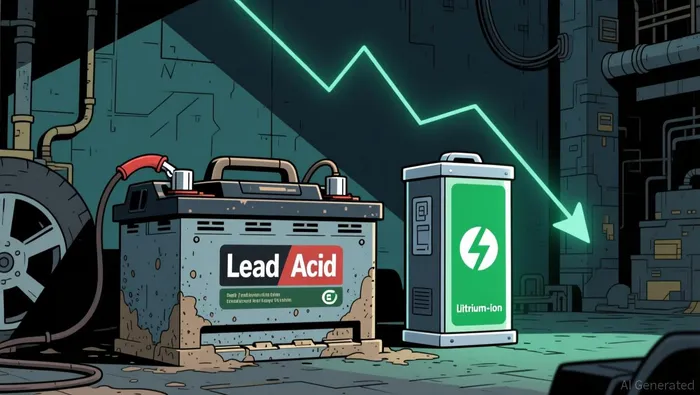
Here is the fact that retail investors, and apparently many institutional holders, appear to have forgotten or never learned: Sebang Global Battery is a lead-acid battery manufacturer. The company sells starting batteries and specialized start-stop batteries to automakers, with exports to more than 130 countries. It has been one of the world's largest lead-acid battery producers, operating under a joint venture and technical alliance with Japan's GS Yuasa Corporation since 1975.
None of this is the lithium-ion cell business that powers electric vehicles. None of it is the $178 billion EV battery market that's growing at an estimated 18% CAGR through 2033. Lead-acid batteries - the heavy, low-energy-density chemistry that started your car engine three decades ago - are growing at roughly 3.2% CAGR globally. That is a mature, slowly expanding market. That is the business Sebang runs.
The confusion matters because it has driven Sebang's valuation assumptions. If you bought this stock thinking you had exposure to the EV battery transition, you own a different company than you intended.
The numbers confirm the structural problem
Sebang's trailing twelve-month revenue is approximately $1.51 billion (roughly ₩2 trillion). Revenue did grow impressively in the past - a 12.5% compound annual growth rate over the prior five years, pushing past the ₩2 trillion threshold in 2023. But that growth came from lead-acid demand cycles, geographic expansion in start-stop battery adoption, and currency tailwinds, not from any fundamental shift toward high-growth battery chemistry.
Forward-looking analyst consensus projects revenue growth of roughly 4.7% per year over the next three years. That number tracks the lead-acid market growth rate almost exactly. It does not track the growth rate of any EV-adjacent battery player.
Operating margins have fluctuated widely - from a low of 5.5% in FY2022 to higher peaks - reflecting the cyclical nature of lead-acid pricing and raw material costs. The trailing twelve-month net profit margin sits at around 7%. The TTM P/E ratio? The market doesn't even price it - the multiple is essentially broken. That is not the mark of a temporarily misunderstood growth stock. That is the mark of a business whose earnings trajectory the market can no longer project with confidence.
The stock at ₩56,300 (as of late May 2026), with a market cap of roughly ₩771.6 billion, has no earnings multiple because the earnings story has collapsed.
KOSPI 200 removal is the institutional verdict
The KOSPI 200 removal is not a cosmetic event. It means index funds tracking the benchmark are forced to sell. It means the company has fallen out of the automatic rebalancing cycle that provided institutional liquidity. For a stock of Sebang's size - ₩771.6 billion market cap - passive index exposure is not a trivial source of buyer support.
The removal citation - "structural capital outflows" - is worth parsing. That is not a phrase used for a company that is temporarily muddling through an accounting rough patch. That is a phrase used for a company where institutional money has been leaving and isn't coming back.
Sell-side consensus has been offering 46.5% upside from current levels, with fair value models suggesting ₩67,800 to ₩75,100 per share. That kind of target range requires a recovery thesis that the business itself hasn't earned.
What the "statutory earnings" argument ignores
The competitor narrative - that statutory earnings understate Sebang's health - relies on the assumption that underlying operations are fine and accounting treatment is the only distortion. But even if you add back every conceivable non-recurring charge, restructuring cost, or accounting adjustment, you still have a lead-acid battery company in a 3.2% growth market competing against GS Yuasa and global players with better scale.
Sebang does not have a lithium-ion cell production plan that moves the needle. It does not have a battery pack assembly JV with an automaker. It does not have a backlog of EV orders that characterizes the high-growth battery suppliers everyone is actually investing in - LG Energy Solution, Samsung SDI, SK On.
The company's business model is based on selling lead-acid batteries to a network of automakers and distributors. That model worked. It grew revenue for years. But it is not a growth story anymore, and no accounting restatement changes the underlying economics.
The cross-currents
A few factors cut in Sebang's direction:
- Lead-acid batteries remain the dominant starting battery for internal combustion and hybrid vehicles. Demand is not disappearing - it is just not growing.
- Sebang has scale and global distribution that smaller players lack. The company supplies OE batteries to global automakers.
- The stock has fallen enough that value-oriented investors may see the ₩56,300 price as a floor rather than a ceiling.
Against those factors:
- Every new EV adoption reduces the long-term addressable market for lead-acid starting batteries, even if the transition is slower than headline numbers suggest.
- Lead-acid pricing has been under persistent downward pressure as manufacturing efficiency improves globally. Battery prices declined roughly 8% in 2025 alone across the industry, squeezing margins.
- The KOSPI 200 removal triggers forced selling from index funds, a mechanical headwind that will take quarters to resolve.
Directionally, the headwinds are structural. The tailwinds are residual.
The story here is not that Sebang's statutory earnings are misleading. The story is that investors who bought Sebang as an EV battery proxy own a mature lead-acid business that the Korean market's largest index has just told them is no longer worth automatic ownership. When the accounting distraction fades - and it will - what remains is a company whose business model has been categorized as "not KOSPI 200 quality" for reasons that have nothing to do with how it fills out its financial statements.