

What more do you need to make a decision on US energy stocks?
- The claim: Russia's Rosneft CEO Igor Sechin said on June 6 that American oil companies are the "main beneficiaries" of the Strait of Hormuz closure, earning "noncompetitive advantages" and potentially more than $60 billion in additional profit this year.
- The counter-claim: Goldman Sachs projects global oil demand has fallen by 1.7 million barrels per day in Q2 2026, with a Q4 Brent forecast of $90 carrying downside risk. Futures are already pricing in Hormuz reopening.
- The disconnect: Occidental Petroleum (OXY) trades at roughly 11x forward earnings. Exxon Mobil (XOM) at 14x. Both are up substantially year-to-date. The market is partly celebrating the windfall and partly fearing the hangover - simultaneously.
- The call: This is arguably one of the more attractive risk/reward setups on the tape right now. If Hormuz stays closed, the demand destruction Goldman fears won't be enough to offset the supply gap. If Hormuz opens, the downside from these valuations is limited. Asymmetric. Buy.
Sechin Isn't Wrong
I must admit that coming from Sechin, the statement was meant as geopolitical provocation. He's the head of Russia's largest oil company, and there's always a motive when Moscow's inner circle talks about American energy. But the numbers underneath his rhetoric check out.
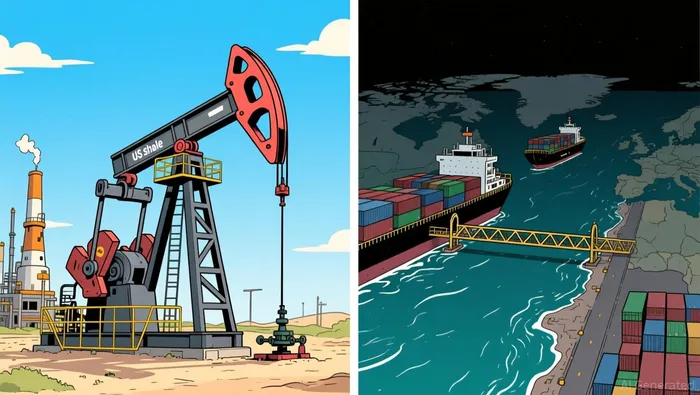
Iran effectively closed the Strait of Hormuz on February 28, 2026, in response to US and Israeli strikes. It remains closed as of this writing. Roughly 20% of global oil shipments moved through that waterway. Those barrels simply aren't reaching the market.
Rystad Energy, an independent market research firm, estimates that US shale producers alone could earn an additional $63 billion from the price surge - nearly identical to Sechin's $60 billion figure. In their Q1 results, publicly listed US shale producers increased capital expenditure forecasts by $490 million compared to the prior year. They're already drilling for that premium.
The US is now a net oil exporter, not a net importer. In 2026, when the Hormuz closes, the economic plumbing works differently than it did in 1979 or 1990. American producers don't just avoid the pain of import shortages - they capture the margin expansion directly.
Goldman's Demand Destruction Problem
Here's where the picture gets complicated.
High oil prices destroy demand. That's not a theory - Goldman Sachs estimates demand destruction may have already reached 2 million barrels per day in May. Global oil consumption is falling as transport costs crush logistics, manufacturing slows, and consumers cut back. Goldman sees Q2 demand down by 1.7 million barrels per day, with the full-year impact still unfolding.
The bank's Q4 Brent forecast is $90 per barrel, and they've explicitly flagged downside risk. Brent futures for October trade at roughly $90.70, November at $88.68, December at $87.05. The market is pricing in a gradual recovery - either Hormuz reopens, or demand destruction drags prices down as we move through the second half.
This is the tension that makes this trade interesting rather than obvious. If Goldman is right and demand destruction caps prices well below current levels through H2, then the US energy windfall is shorter than investors think. The stocks that rallied from March to June would have a limited ceiling.
Where the Contrarian Argument Starts
The key insight is this: the demand destruction thesis only wins if prices fall enough for long enough to meaningfully dent 2026 earnings. Let's be specific about what that means.
Brent was in the mid-$60s before the Hormuz crisis. It's in the $90-100 range now. Occidental trades at 11x forward earnings at these prices. Exxon at 14x. These aren't speculative multiples. They're the kind of valuations that say the market has baked in some serious uncertainty about whether these earnings hold.
For demand destruction to crater 2026 results, Brent would need to fall back toward $70 - close to pre-crisis levels - and stay there for most of the remaining nine months. That would require either a rapid Hormuz reopening or a global recession severe enough to cut oil consumption permanently.
Neither is the base case. The strait is still closed. No diplomatic breakthrough has emerged. And the US economy, while strained, hasn't entered the kind of demand-collapse scenario that would drive oil back to the $60s from this distance.
Goldman's $90 Q4 forecast, even if it materializes, still means Brent stays roughly 30-40% above pre-crisis levels. At $90, US shale is still highly profitable. The $63 billion windfall Rystad estimates gets trimmed, but it doesn't vanish.
The Moat Check
Before calling this contrarian, I need to verify that the competitive advantage holds under stress. In this case, the moat isn't a technology lock-in or a network effect - it's geography. When the world's most critical oil chokepoint goes dark, the producers closest to the largest consumer market gain a structural edge that no competitor can replicate. That's what Sechin meant by "noncompetitive advantages." It's not a moat you build. It's one that appears when geography does the work.
US shale has been criticized for years - for volatility, for capital discipline, for failing to produce enough when prices spike. Those critiques were fair when oil was cyclical. They lose force when the supply disruption is geopolitical and persistent. Shale doesn't need to be the cheapest barrel in the world. It just needs to be the barrel that's still flowing.
So What Do You Do?
The market is stuck between Sechin's windfall thesis and Goldman's demand destruction warning. That indecision is what's keeping valuations compressed. The stock moves up on each day the strait stays closed, then sells off on Goldman research about H2 demand collapse. Back and forth.
I argue that the risk/reward tilts decisively toward the buyer here. If Hormuz remains closed through H2 - which it appears to be - oil stays elevated, and these multiples re-rate higher as earnings certainty returns. If Hormuz reopens unexpectedly and prices collapse, the downside from 11x-14x forward PE is cushioned. You're not buying at peak euphoria.
Occidental at 11x forward earnings is arguably dirt cheap for a company that sits on one of the best Permian acreage positions in the country. Exxon at 14x with $15.6 billion in structural cost savings since 2019 and a planned $20 billion in buybacks for 2026 is the more conservative entry - same tailwind, bigger balance sheet.
Don't let this buying opportunity go to waste. The setup is constructive at these levels. I would reassess if Brent falls below $80 per barrel and stays there for more than a month, or if a credible diplomatic framework emerges that points to Hormuz reopening on a clear timeline. Until then, the disconnect between what the strait closure is delivering and what these multiples imply is the kind of gap that closes in your favor.
Rating: Upgrade on OXY and XOM. Add on weakness, hold through H2. Reassess if Brent breaks below $80.