

Veteran semiconductor investor Gavin Baker, CIO of Atreides Management and a former Fidelity portfolio manager overseeing more than $17 billion, recently laid out several views that directly challenge market consensus.
His core argument is clear: Amazon Trainium is the most underappreciated AI chip in the market; space-based data centers are not a gimmick, but a technically viable path that should be proven within two years; and the AI investment cycle may avoid becoming a repeat of the dot-com bubble because TSMC and memory suppliers remain unusually cautious on capacity expansion.
💡 Amazon Trainium: The Most Underrated AI Chip
In an interview with Blackstone senior partner Jas Khaira, Baker was asked which Nvidia challenger is most underappreciated by the market: Google TPU, Amazon Trainium, or Intel Gaudi.
His answer was immediate: “Trainium, without question.”
Baker’s reasoning is technical. Today’s leading frontier AI models increasingly use a Mixture of Experts, or MoE, architecture. Running inference for these models requires infrastructure known as a switched scale-up network.
According to Baker, only two companies in the world currently have operating switched scale-up networks: one powers Nvidia GPUs, and the other powers Amazon Trainium.
That is an easy technical barrier for investors to miss. Baker argued that Google’s TPU does not have the same capability in this area. He pointed to one telling detail: Google invented the MLPerf benchmark, yet does not submit TPU results to its own benchmark. Baker said it is obvious this drives Jensen Huang crazy.
Baker also believes that once Trainium 3 enters large-scale production in the second half of this year, Trainium’s position in 2026 will resemble TPU’s position in 2025. He noted that he previously invested in TPU supply-chain companies such as Celestica, adding that he believes he is qualified to make that comparison.
He was careful not to frame this as a short thesis against Google or Broadcom. “I would never short Google, and I would never short Broadcom,” he said. But in his view, Trainium is severely underestimated today.

🛰️ Orbital Data Centers: A Two-Year Test
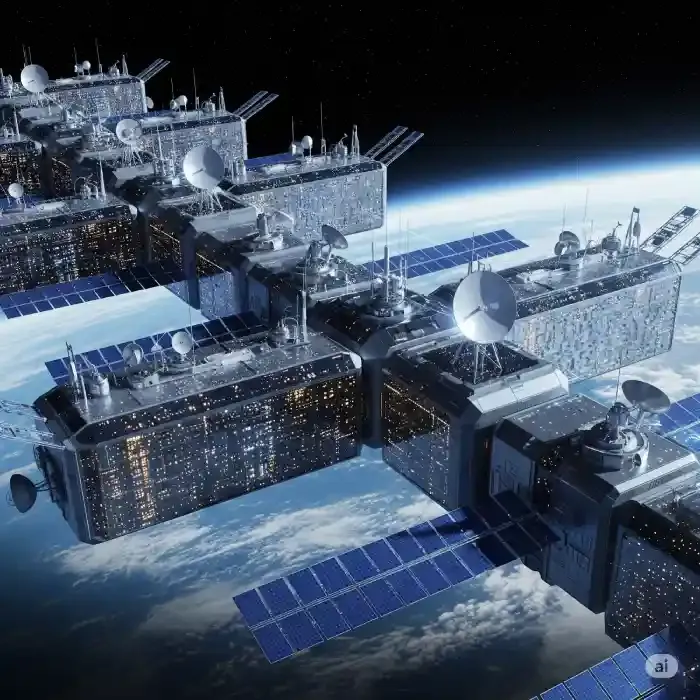
Another major topic in the conversation was orbital compute: the idea of putting data centers in space.
Khaira asked when this could become commercially real. Baker gave a clear timeline: he believes its feasibility and economics will be validated within the next two years, and that by the end of this decade, it will begin taking meaningful market share.
The logic is simple. Ground-based data centers face two hard constraints: power and cooling. In space, power comes from the sun, while cooling comes from the shaded side of the satellite.
Baker described the design he had seen from one potential orbital compute provider. The satellite’s radiator would be 300 to 400 feet long. The satellite body itself would effectively be a rack: eight feet tall, two and a half feet wide, and four feet deep. Multiple racks would be connected by lasers to form a virtual data center, with radiators positioned behind the rack’s shadow.
If this approach works, Baker said, the biggest disruption would hit suppliers of power and cooling equipment for ground data centers. Industrial companies that have aggressively expanded capacity to support data center construction could suddenly face a sharp stop in demand.
He stressed that existing ground data centers would still have value. Training and reinforcement learning would still happen on the ground. He said he cannot imagine a world in which no new ground data center is built over the next seven years. But the direction of incremental demand is being redefined.
🏭 TSMC’s Caution May Prevent an AI Bubble
A common market question is whether AI investment will become another version of the internet bubble.
Baker’s answer is that this cycle may be different, for a surprising reason: the conservatism of TSMC’s management.
Historically, almost every major new technology, from railroads and canals to PCs, the internet and AI, has produced a bubble. Investors get excited, consensus forms, valuations inflate, and bubble capital ultimately funds the infrastructure buildout. That is how the internet era unfolded.
“We do not want a bubble,” Baker said. “Bubbles are terrible, the experience of living through a bubble is painful, and the aftermath is even more painful.”
This time, however, he is optimistic that the market may avoid a full bubble because of real-world physical constraints: watts and wafers.
The wafer shortage depends heavily on TSMC’s posture. Baker said TSMC is run by stubborn people in their seventies, joking that 70 is the new 50, and that he himself is 50. These executives lived through Taiwan Semiconductor’s decades-long journey from chasing Intel, once considered an impossible dream, to eventually achieving it.
They understand what a bubble and crash would mean for TSMC. As a result, they refuse to expand capacity as fast as Jensen Huang would like.
Baker said Huang visits TSMC roughly every three months, and TSMC expands capacity by about 5%. Huang wants capacity to double or triple. If capacity truly doubled or tripled, Baker argued, Nvidia could probably sell $1.5 trillion of chips next year. He said he was serious. But the other side of that outcome could be extremely painful for everyone.
Baker’s conclusion is that these stubborn older executives, by enforcing a real physical constraint in the real world, are helping everyone avoid a bubble. In his view, that kind of constraint did not exist in previous technology revolutions.
📈 Memory Cycle and AI Revenue Upside
Baker also made two other investment-relevant observations.
On memory, prices have already risen 60% to 70% this year. Micron’s gross margin could exceed 60%, far above its historical average of roughly 16%. Baker acknowledged that, based on the memory cycle patterns of the past 25 years, investors should “100%” be selling memory stocks right now.
But he thinks this cycle may resemble the true capacity cycle of the mid-1990s. In other words, the market may still be early, and investors should not simply apply the old historical template.
On AI revenue, Baker believes the point at which OpenAI and Anthropic reach a combined $200 billion in revenue is no longer far away. He cited Jensen Huang’s view that his best engineers should spend at least half their compensation on AI tokens.
Baker believes this trend implies a major adjustment in the labor structure of S&P 500 companies. He also thinks AI pricing will shift from monthly subscriptions to usage-based billing, which could make revenue grow faster than outside observers expect. He compared it to the old mobile-phone industry model, where carriers made substantial profits by charging users by the minute once they exceeded their plan.
📚 Investment Philosophy: Reading and Pattern Recognition
Khaira also asked Baker where his investment edge comes from.
Baker’s answer was concise: reading, overwhelmingly.
He said he almost never proactively meets with public-company management teams anymore. In his view, they are extremely well trained and rarely say anything that is not already in an earnings call or 10-Q. He added that he can read much faster than they can talk.
Baker also discussed one of the most painful lessons of his career. He once wrote to a company’s board asking it to repurchase stock. Eighteen months later, the company went bankrupt. He called it a permanent lesson about high leverage: sometimes not everything goes according to plan.
He also said one weakness he has been trying to overcome is that he finds it too hard to sell winners. He is highly valuation-sensitive, deeply contrarian, and most comfortable looking at the 52-week low list.