

The Senate Banking Committee is scheduled to vote on the Digital Asset Market Clarity Act on May 14, 2026.
This vote marks a significant shift from prolonged debate to a formal markup process for U.S. digital asset regulation.
Industry experts anticipate the vote will proceed along party lines, though further negotiations could secure additional Democratic support.
The legislation aims to provide comprehensive regulatory clarity by establishing clear boundaries between Securities and Exchange Commission and Commodity Futures Trading Commission oversight.
A bipartisan compromise released in May has removed a major barrier to the bill's advancement.
Senators Thom Tillis and Angela Alsobrooks proposed a compromise that structures crypto company rewards to avoid directly competing with bank deposit yields.
Major crypto exchanges, including Coinbase, have endorsed this approach after previously withdrawing support due to concerns over stablecoin reward treatments.
The compromise prohibits paying rewards on stablecoins that are economically or functionally equivalent to interest on bank deposits.
However, the draft allows exceptions for rewards tied to governance, validation, staking, or those calculated by referencing a user’s account balance.
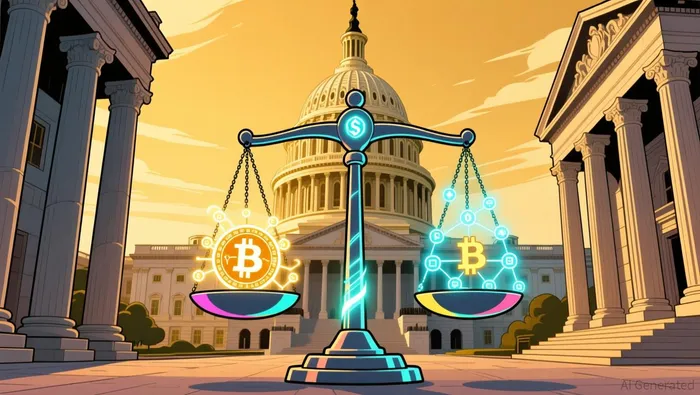
How Are Banks Responding to the Bill?
A coalition of the nation’s top banking trade groups has issued a joint rejection of the Tillis-Alsobrooks compromise.
The American Bankers Association, the Bank Policy Institute, and other groups argue the language contains loopholes allowing digital asset exchanges to distribute rewards tied to customer tenure.
These groups contend that yield-bearing stablecoin alternatives could siphon enough liquidity to reduce available capital for consumer and small-business loans.
They claim such mechanisms could reduce available capital for loans by as much as 20 percent.
The coalition has launched a coordinated campaign including media ads and CEO lobbying to stall the legislation.
The American Bankers Association launched targeted Washington media ads on May 6 with an estimated budget of $2.5 million.
The campaign frames stablecoin yield mechanisms as unregulated deposit theft and seeks to apply direct pressure on Senate offices.
Banking trade groups argue that programs structured like money market mutual funds would incentivize customers to move funds from low-yield bank deposits to stablecoins.
They have requested rewording the language to prohibit payments substantially similar to yield and to strike references to account balances entirely.
Despite this unified front, Senate leadership appears confident in moving forward with the May 14 vote.
Senate aides suggest the debate on yield is largely closed, with lawmakers focusing on other provisions such as ethics rules and consumer protections.
What Are the Remaining Legislative Hurdles?
The bill must be reconciled with the version advanced by the Senate Agriculture Committee earlier in the year.
The Agriculture Committee’s version moved forward without Democratic support, partly due to concerns over political figures’ financial interests in the crypto space.
Democrats have proposed amendments to block federal officials from engaging in certain digital asset transactions.
Senator Kirsten Gillibrand has warned that no final deal will be made without an ethics provision in the reconciled bill.
Senator Ruben Gallego is leading Democratic efforts to include these ethics rules directly in the committee-approved text.
Republicans have pushed back, arguing such provisions fall outside the committee’s jurisdiction.
The debate is partly driven by concerns over President Donald Trump’s family crypto interests, including memecoins and the World Liberty Financial project.
The CLARITY Act cleared the House with a bipartisan vote in July 2025 and now faces a critical test in the Senate.
SEC Chair Paul Atkins has signaled that both the SEC and CFTC are ready to implement the legislation immediately upon its passage.
The Act establishes a clear regulatory divide, with the SEC retaining oversight of digital asset securities and the CFTC regulating most blockchain-native tokens as commodities.
This shift is expected to move the vast majority of existing tokens from SEC to CFTC jurisdiction.
Prediction markets are currently pricing in a roughly 55 percent chance of the act becoming law in 2026.
The White House has set a July 4 target for the President’s signature on the legislation.
A successful markup will merge the Banking Committee’s text with the Senate Agriculture Committee’s portion before advancing to the full Senate.
If the Senate passes the bill with 60 votes, it will move to the House for final passage.
The May 14 vote is considered a pivotal moment for the U.S. crypto industry and a potential legislative loss for the banking sector.