

The headline says consolidation. The capex data says the opposite.
The market's instinctive read of the $23.5 billion SFR acquisition is straightforward: French telecom rivals - Bouygues Telecom, Orange, and Free–iliad - are combining assets, reducing competition, and investing their way to a stronger duopoly. The consensus story treats telecom consolidation as an automatic pipeline for infrastructure spending.
That story no longer holds. Consolidation in today's European telecom market is a supply discipline exercise, not a capex expansion play. The four-operator market is compressing to three precisely because the existing infrastructure spending trajectory is already declining, and the remaining players need scale to survive on less.
The deal structure
The consortium split is fairly clear. Bouygues Telecom takes the largest slice at 42 percent of SFR's assets, Free–iliad claims 31 percent, and Orange takes the remaining 27 percent. The parties signed a memorandum of understanding on June 6, with definitive agreements expected in the second half of 2026 and closing targeted for the second half of 2027. Break-up fees are included, signaling the regulatory risk the deal carries.
What matters structurally is not who wins which asset but what happens to the aggregate infrastructure investment budget once the dust settles. Four separate capex budgets become three. Overlapping fiber builds get eliminated. Redundant 5G sites get rationalized. The natural outcome of consolidation is reduced duplication, which means reduced equipment orders.
The French capex decline is already here
This is not a hypothetical. Investment by French telecom operators and tower companies fell 15 percent year-over-year in 2025, to €10.3 billion excluding spectrum costs. That figure represents a structural deceleration, not a temporary dip.
The fiber build-out cycle that drove French telecom investment for the past decade has run its course. France has now become the leading country for fiber deployment in Europe, and the addressable remaining build is a fraction of what it was five years ago. 5G-associated infrastructure spending peaked and is rolling off. The EU has shifted its emphasis away from greenfield deployment, and operators are responding by cutting budgets, not defending them.
The implication is fairly straightforward. When the primary driver of telecom capex - fiber rollout and 5G buildout - has already decelerated, consolidation does not restart the spending cycle. It compresses it further.
The semiconductor bifurcation
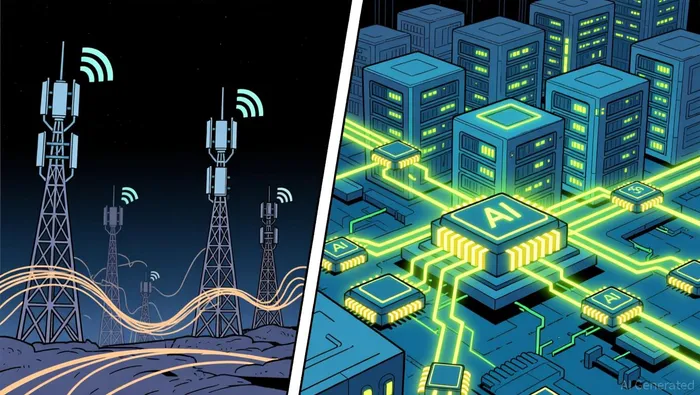
This is where the SFR deal connects to the semiconductor cycle. The network equipment supply chain is splitting into two distinct markets, and the SFR consolidation reinforces the direction of capital flows.
On one side, traditional telecom equipment vendors - Nokia and Ericsson - are caught between declining operator spending and a desperate attempt to pivot toward AI networking. Nokia reported a 54 percent jump in comparable operating profit to €281 million in the first quarter of 2026, and now expects the addressable market for AI and cloud networking to grow 27 percent annually through 2028. Ericsson closed 2025 with roughly $22 billion in revenue and a 17 percent operating margin. Both companies are trying to reposition toward AI-driven networking demand.
On the other side, the actual beneficiaries of the AI capex cycle are semiconductor companies like Broadcom, which guides full-year fiscal 2026 AI semiconductor revenue of approximately $56 billion - up roughly 180 percent from fiscal 2025. Broadcom's first quarter of fiscal 2026 delivered $19.3 billion in consolidated revenue, up 29 percent year-over-year. The AI networking demand flowing through hyperscalers is dwarfing what telecom operators are willing to spend.
The constraint has migrated. It no longer sits with telecom operators building nationwide fiber and 5G networks. It sits with hyperscalers demanding optical switches, custom networking chips, and AI interconnect bandwidth. Broadcom controls the constraint. The telecom equipment vendors are chasing it.
Compounding the problem for Nokia and Ericsson: both companies have warned that AI-driven chip demand is creating component shortages that are driving up costs for telecom network equipment. The semiconductor bottleneck that is powering Broadcom's revenue growth is simultaneously squeezing the margins of its downstream telecom customers.
Why consolidation accelerates the squeeze
The SFR deal reinforces this split. When Bouygues, Orange, and Free absorb SFR's assets over the next 18 months, they will not increase their combined network spending. They will eliminate overlap. They will delay redundant builds. They will negotiate harder pricing with equipment vendors because the market now has three buyers instead of four.
The exact capex trajectory post-merger is not yet public - the deal does not close until the second half of 2027, and the buyers have not committed to infrastructure investment schedules. That uncertainty itself is a data point. If the thesis were genuinely about capex expansion, the consortium would already be advertising investment plans to justify the price to regulators and investors. The absence of such commitments tells you what the buyers actually intend.
Investor Takeaway
The SFR deal is not a signal for telecom equipment vendors. It is a confirmation that the European telecom capex cycle has entered a structural decline phase, and the remaining operators need scale to manage through it.
For semiconductor investors, the structural winner in this environment remains clear. Broadcom's AI networking revenue trajectory of $56 billion in fiscal 2026 is driven by hyperscaler demand that is entirely disconnected from whether France has three or four telecom operators. Nokia and Ericsson are trying to ride the same AI capex wave, but their revenue base remains predominantly telecom, and their exposure to declining operator budgets is structural, not cyclical.
Looking ahead, the key issue is not whether the SFR deal closes. The more important question is whether European telecom operators collectively continue to reduce network spending as consolidation completes. If they do - and the 15 percent decline in French investment in 2025 suggests they will - the pressure on traditional telecom equipment vendors intensifies, while the hyperscaler-driven semiconductor winners continue to move on a different trajectory entirely.