

The headline says consolidation. The supply-side math says the opposite.
A consortium of Bouygues Telecom, Free-Iliad, and Orange signed a memorandum of understanding on June 6 to acquire Patrick Drahi's SFR from Altice France for over $23 billion. The deal compresses the French market from four to three MNOs. The market's instinctive read: consolidation creates stronger, more efficient operators with greater capacity to invest. Equipment vendors and their semiconductor suppliers should cheer.
That conclusion is increasingly wrong. Telecom consolidation does not preserve total capital expenditure. It reduces it. And for the companies that sell network chips, optical transceivers, and RAN (radio access network) components into European operators, fewer competing builders means fewer orders - not more.
The capex that disappears when an operator vanishes
Altice France reported €1,535 million in total accrued Capex for fiscal year 2025, with Q1 2026 capex running at €323 million. That is the spending pipeline going dark. When SFR ceases to exist as an independent operator, its buyers do not need to replicate that spend. They already own their own networks. They absorb SFR's subscriber base, reuse existing infrastructure where it overlaps, and retire the rest.
The arithmetic is not speculative. Every major telecom consolidation in the past two decades has followed the same pattern: the combined entity spends less per subscriber than the separate operators did before the merger. The 2020-2022 wave of European telecom mergers - Vodafone Germany, Three UK, Telefonica Germany - all produced capex reductions in the years immediately following close, even as the combined entities argued that more investment was needed to compete.
SFR's €1.5 billion annual capex does not translate into €1.5 billion in new orders for Nokia, Ericsson, Broadcom, or Marvell. A significant portion of that spend goes to internal labor, site leases, spectrum license amortization, and fiber trenching - none of which is equipment-vendor or semiconductor spend. The portion that is semiconductor-adjacent - base station chips, optical modules, networking processors - gets compressed even further because the buyers rationalize overlapping coverage rather than expanding it.
The two-market split: AI capex versus telecom capex
Here is the structural bifurcation that most semiconductor analysis misses. The networking chip market has split into two distinct demand pools, and they are moving in opposite directions.
On one side: hyperscaler AI infrastructure capex, driving demand from Broadcom's custom ASICs and Marvell's optical interconnects. Google announced $175 to $185 billion in AI Capex for 2026, roughly double its 2025 spend. Marvell delivered record fiscal 2026 revenue of $8.195 billion, overwhelmingly data center-driven. This is the growth pole.
On the other side: telecom operator capex, which has been in structural decline since the 5G build-out peaked around 2022-2023. Ericsson exited 2025 with roughly $22 billion in revenue and an operating margin of around 17 percent, but Nokia issued conservative 2026 profit guidance that sent shares down ~6%. The capex trough that Deloitte warned about in early 2024 - where each spending trough has seen vendor consolidation - is exactly where the industry sits now.
The SFR deal accelerates the telecom-capex trough, even as the AI-capex pole continues to expand. Investors who treat networking semiconductor vendors as a single block are conflating two markets that are no longer correlated.
Where the constraint migrates
The bottleneck in telecom semiconductor supply has shifted from equipment availability to operator willingness to buy. Ericsson and Nokia have warned that AI-driven component shortages are raising costs for network equipment vendors. But the downstream problem is not supply. It is demand discipline. When you have three operators instead of four, you do not need three times as many base stations. You need fewer than you already had.
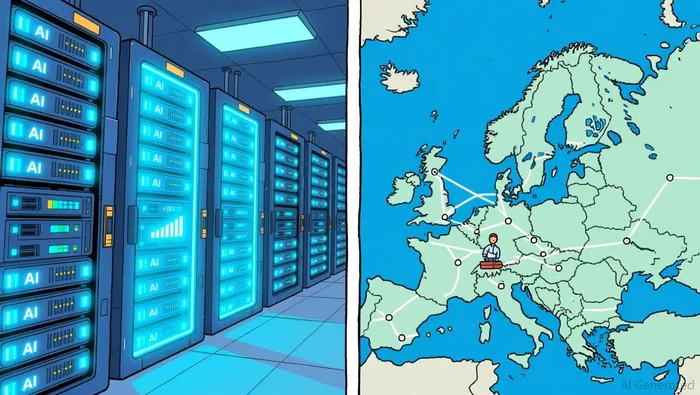
The European Union's telecommunications investment gap has reportedly doubled to €200 billion by 2025, according to COMSOC analysis. Proponents argue that consolidation is the panacea - fewer operators, larger balance sheets, more ability to invest. The counter-evidence is that consolidation reduces the competitive incentive to invest in the first place. Pricing power replaces infrastructure build as the margin lever. That shift benefits operator shareholders. It does not benefit their equipment and semiconductor suppliers.
Investor Takeaway
The SFR acquisition is structurally a net reduction in European telecom capex, not a rebasing upward. The €1.5 billion annual pipeline that Altice France spent does not get replaced. It gets absorbed and rationalized. For network semiconductor and equipment suppliers - particularly those with meaningful European telecom exposure - this deal reinforces a cycle that is already in decline.
The key issue is not whether the SFR deal closes - it almost certainly will, pending regulatory approval. The more important question is how much of a networking semiconductor vendor's revenue comes from telecom operators versus hyperscale AI infrastructure, and whether the AI pole is growing fast enough to offset the telecom trough. Broadcom and Marvell are increasingly positioned on the AI side of that split. Nokia and Ericsson remain structurally exposed on the telecom side. The bifurcation determines who wins and who gets squeezed - not the headline about consolidation.
Watch two signals: Nokia's next quarterly order book versus guidance, and the ratio of telecom-related revenue in networking semiconductor vendors' latest filings. If telecom capex continues to compress as consolidation accelerates across Europe, that ratio will tell the story before the earnings miss does.