

The move into physical retail fundamentally rewrites BODI's growth equation. For over a decade, Shakeology has proven its product-market fit through direct-to-consumer channels, generating more than $4 billion in cumulative sales since 2009. That track record provides the foundation-but retail is the lever that unlocks scale.
The Vitamin Shoppe partnership alone opens over 640 locations nationwide, placing Shakeology alongside premium nutrition brands where health-conscious consumers already shop. The Sprouts rollout adds more than 80 locations with a demographic that prioritizes natural and organic products. But the real TAM expansion lies through KeHE Distributors, which gives BODI potential access to more than 30,000 retail locations across grocery, supermarket, and online channels. This isn't incremental distribution-it's a complete channel transformation from niche DTC to mass-market availability.
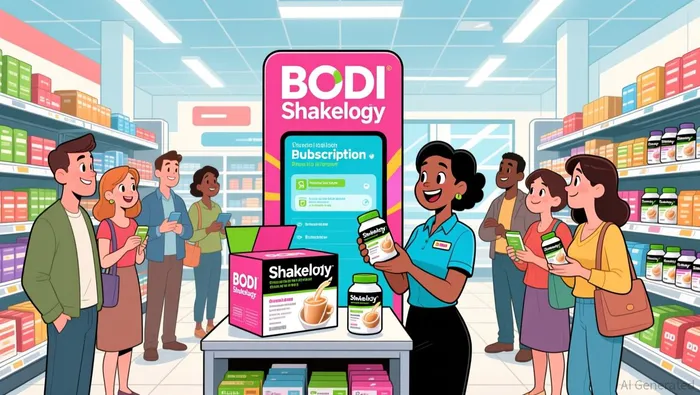
The financial foundation is now in place to support this expansion. Q1 2026 delivered $54.3M revenue with a third straight quarter of profitability, demonstrating the business has stabilized after its strategic pivot. Nine consecutive quarters of positive adjusted EBITDA and a strong balance sheet provide the runway to fund retail penetration without compromising operational discipline.
For a growth investor, the question isn't whether Shakeology can sell in stores-it's how quickly this distribution network converts shelf space into recurring revenue. The product has already validated demand at scale through DTC. Now retail removes the friction of subscription fatigue and discovery barriers, positioning Shakeology for the kind of market penetration that transforms a category leader into a household name.
Q2 Guidance Analysis: Near-Term Dip or Strategic Pause?
The Q2 guidance range of $46 million to $51 million sits below Q1's $54.3 million revenue, and on the surface that decline invites scrutiny. But for a growth investor tracking retail expansion trajectories, this dip is exactly what the base effect model predicts-and the reversal timeline is already visible on the calendar.
The critical context: Shakeology's retail debut lands squarely in Q2. The Sprouts launch went live May 18, and Vitamin Shoppe follows later this year. That means Q2 is the foundation-laying quarter where shelf placement costs get incurred before revenue contribution scales. The $34.99 seven-serving bag premium price point at The Vitamin Shoppe establishes the right unit economics for retail, but initial shelf placement is a setup phase-not a reflection of demand.
What matters for the growth thesis is when clean year-over-year comparisons become possible. Management has flagged Q3 2026 as the first clean YoY comparison, meaning the Q2 dip is essentially a one-time base effect from transitioning out of the old DTC-only model. By H2, as Sprouts placement scales and Vitamin Shoppe goes live across 640+ locations, the retail contribution should flip from cost center to revenue driver.
The strategic read: this guidance range is a pause, not a pivot. The company is investing in distribution infrastructure during a period when the old DTC base is still stabilizing. For investors focused on TAM expansion and market penetration, the question isn't whether Q2 underperforms-it's whether the retail network can convert shelf space into recurring revenue at scale. The answer arrives in H2, when the base effect reverses and the growth trajectory from retail becomes visible.
The Turnaround Backdrop: From MLM to Multi-Channel
The retail expansion story cannot be understood without first acknowledging what BODI has already accomplished: a complete business model transformation that restored profitability a year ahead of schedule. The shift from MLM to multi-channel distribution is not a future plan-it is an executionally advanced reality that has already delivered nine consecutive quarters of positive adjusted EBITDA and, critically, positive net and operating income in 2025.
The financial foundation is solid. Q1 2026 delivered $54.3M revenue with a third straight quarter of profitability, building on the 2025 turnaround that achieved positive net and operating income. But the full-year 2024 revenue of $418.8M-down 20.5% year over year-captures the cost of that transformation. Those declines were the inevitable consequence of exiting the MLM model, which had provided a high-cost, high-commission distribution channel. The company deliberately traded volume for sustainability, and the result is a leaner operation with improved gross margins and a strong balance sheet.
What matters for the growth thesis is what came after. The nine consecutive quarters of positive adjusted EBITDA demonstrate the business model works without MLM economics. The operating leverage story is now in play: fixed costs that once supported a declining DTC base can spread across a much larger retail network. As management has indicated, the company expects strong operating leverage as retail volume scales. This is the classic transformation playbook-stabilize the base, then deploy excess capacity into new growth channels.
For a growth investor, the critical insight is this: the market is still pricing BODI as a declining DTC business, not a multi-channel growth story. The retail expansion into 30,000+ locations through KeHE, 640+ Vitamin Shoppe stores, and 80+ Sprouts locations represents a TAM expansion that the current revenue base hasn't yet reflected. The operational foundation is in place-the profitability, the cost structure, the balance sheet. What remains is the revenue conversion from shelf space to recurring sales.
The thesis is straightforward: the turnaround removed the downside risk, and retail provides the upside optionality. The market hasn't priced in the revenue contribution from retail because those launches are still in their early stages. But with Q3 2026 marking the first clean year-over-year comparison, the growth trajectory from the multi-channel strategy should become visible within months. The question for growth investors isn't whether the turnaround worked-it clearly did. It's whether the retail network can convert its distribution advantage into sustained revenue growth that exceeds what the old MLM model ever delivered.
Catalysts and Risks: What Moves the Stock
For a growth investor, the BODI thesis hinges on two things: visible proof that retail shelf space converts to recurring revenue, and the timing of that visibility. The catalysts are clear-retail sell-through data, new channel additions, and the Q3 2026 earnings call will provide the first clean year-over-year comparison since the retail launches began.
The primary catalyst is retail sell-through velocity at Sprouts and Vitamin Shoppe. The Sprouts launch went live May 18, and the seven-serving bag at $34.99 is the unit economics blueprint for retail. What management sees in the first 60-90 days of shelf performance will dictate how aggressively they scale to the broader KeHE network. That network represents the real TAM expansion-more than 30,000 retail locations across grocery, supermarket, and online channels. This isn't incremental; it's a distribution multiplier that could fundamentally reshape the revenue base if the product-market fit translates from DTC to shelf.
The second catalyst is the August 4, 2026 earnings call. This is the first major checkpoint after Q2 retail ramp and before the H2 scaling phase. Management has flagged Q3 2026 as the first clean YoY comparison, meaning the base effect from transitioning out of the DTC-only model should reverse. Investors should watch for two signals: (1) sequential revenue growth from Q2 to Q3, and (2) commentary on retail inventory turnover and repurchase rates. These are the metrics that confirm the retail model works beyond initial placement.
But the main headwind is execution risk in a competitive nutrition category. The protein and superfood shake space is crowded, with established players and private label options gaining shelf presence. BODI's retail success depends not just on placement, but on converting first-time buyers into repeat subscribers-a different skill set than DTC acquisition. The company has limited track record in managing complex retail logistics, trade spend, and category competition at scale. Any slowdown in sell-through at Sprouts or Vitamin Shoppe could signal broader challenges in penetrating the mass market.
The risk/reward setup is straightforward: the upside is a multi-channel growth story with 30,000+ location potential; the downside is that retail execution proves harder than DTC, and the revenue contribution stalls. For now, the operational foundation is solid-third straight quarter of profitability and nine consecutive quarters of positive adjusted EBITDA provide the runway. The question is whether the retail network converts fast enough to justify the TAM expansion thesis. The answer arrives in the next two quarters.