

Shell is returning $3 billion to shareholders through Q2 2026-a deliberate capital allocation decision made at the company's all-time high stock price. This is not reactive noise. It is the latest execution in a disciplined, multi-year pattern of shareholder returns that has now continued for 17 consecutive quarters.
The mechanics matter. Shell has authorized the maximum capacity approved by shareholders at the 2025 AGM: up to 320 million ordinary shares, to be repurchased and cancelled before the Q2 2026 results. The program runs for approximately three months, winding down by July 24, 2026. By cancelling all repurchased shares, the company reduces its issued share count-a direct lever on per-share metrics that benefits remaining holders.
At current prices around $40, the implied dividend yield sits at roughly 3.5%. That yield, combined with the buyback's scale, frames the core value proposition: management is returning capital at a moment when the market is valuing the company at its historical peak. For long-term investors, the question becomes whether this represents prudent capital deployment or an opportunity to accumulate at a price that already embeds significant optimism.
The 17th consecutive quarter of $3 billion or more in buybacks speaks to a structural commitment, not a one-off. It signals that Shell views its current valuation as appropriate terrain for capital return-even as it navigates production headwinds, a prolonged Chemicals downturn, and the execution risks surrounding LNG Canada, Bonga South West, and the Dragon project. The buyback is a statement about confidence in cash flow generation, not just a reaction to short-term price movements.
The Bear Case: What Could Break This Thesis
Any serious investment thesis must survive the bear case. For Shell, the challenges are not hidden-they are laid bare in the financial statements and operational data. The value investor's question is straightforward: is this a value trap, or does the buyback and dividend provide sufficient margin of safety?
The revenue trajectory is the most immediate concern. Shell's top line has contracted sharply from $381.3 billion in 2022 to a projected $260.3 billion in 2026-a 32% decline in four years. This is not a cyclical dip but a structural compression that reflects both lower oil prices and deliberate production discipline. Combined with EBITDA margins compressing to 20.6%, the earnings power underlying each barrel sold is diminishing. For a company whose valuation rests on cash flow generation, this squeeze is material.
Production headwinds have already materialized. In Q1 2026, oil and gas output fell 4% compared to the final three months of last year, directly attributable to the Iran conflict disrupting operations. This is not an isolated incident-it underscores the geopolitical vulnerability of Shell's asset base. At the same time, the company's reserve life has fallen to roughly 7.8 years, meaning the existing asset portfolio would deplete in under eight years at current production rates. That is a short runway for a company claiming long-term compounding potential.
Project execution remains uneven. Despite U.S. general licenses issued February 13 that could unlock Venezuela's Dragon project, the asset remains frozen. LNG Canada continues to face ramp-up challenges, and Bonga South West has not yet reached final investment decision. The buyback itself was reduced from $3.5 billion to $3 billion in the most recent quarter-a subtle signal that management may be conserving flexibility amid uncertainty.
So where does this leave the value investor? The bear case paints a picture of a company returning capital at its peak valuation while underlying fundamentals deteriorate: revenue shrinking, margins compressing, reserves depleting, and production vulnerable to geopolitical shocks. The question is whether the 17th consecutive quarter of $3 billion-plus buybacks and the 3.5% dividend yield provide enough margin of safety to offset these structural headwinds. For some investors, that income stream is sufficient. For others seeking growth or capital appreciation, the thesis may already be fully priced.
Cash Flow Strength: The Engine Behind the Returns
The $3 billion buyback rests on a foundation of genuine operational cash generation, not financial engineering. Shell's full-year 2025 results reveal CFFO reaching $43 billion with free cash flow exceeding $26 billion-numbers that anchor the buyback in real economic value created, not debt-fueled speculation.
The Q1 2026 earnings reinforce this picture. Adjusted earnings surged to $6.92 billion, more than double the $3.26 billion reported in the prior quarter. This wasn't a one-off accounting adjustment-it reflected increased contributions from trading and optimization, higher realized prices and refining margins, and reduced operating costs. The cash flow statement confirms the substance: cash flow from operations at $6.06 billion, with working capital-adjusted cash flow from operations at $17.24 billion-up sharply from $11.94 billion year-ago.
What makes this sustainable is the structural cost foundation. Shell hit its $5.1 billion structural cost reduction target three years ahead of schedule, reaching the lower bound of its 2028 target early. This isn't temporary cost-cutting-it's a restructured cost base that improves the cash flow floor across commodity cycles. Combined with a 15% Mobility ROACE and 21% Lubricants ROACE, the operating model is delivering returns that justify capital deployment.
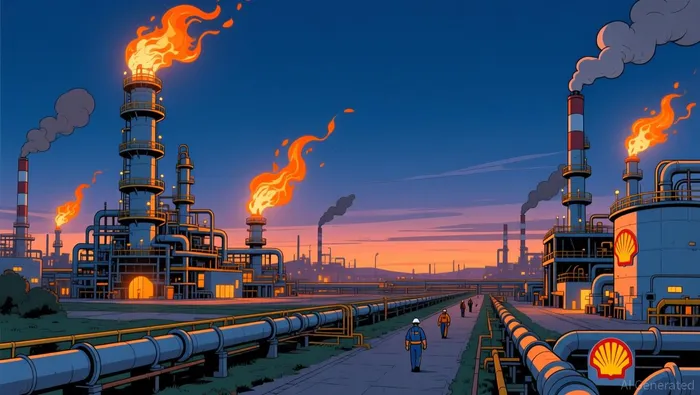
The production growth engine has also been refreshed. The ARC Resources acquisition adds 370,000 barrels of oil equivalent per day, supporting a 4% compound annual growth rate in production from 2025 through 2030. This provides the volume trajectory needed to sustain cash flow growth even as legacy assets deplete.
For the value investor, this cash flow profile is the margin of safety. The buyback is funded by operating strength, not leverage. The question becomes whether the current valuation fully recognizes this cash-generative capacity-or whether the market, focused on reserve depletion and geopolitical risk, is underpricing the compounding engine beneath the noise.
Growth Catalysts: Can Shell Sustain 10%+ FCF Per Share Growth
The $3 billion buyback and 3.5% dividend yield provide income, but long-term value investors care about something more fundamental: can Shell compound per-share cash flow over the next decade? The answer hinges on three specific projects, all currently in execution but none yet delivering results.
LNG Canada must ramp to full capacity by 2027. The facility is Shell's largest growth lever, and its successful operation is essential to offsetting legacy production decline. Bonga South West in the Gulf of Guinea must reach final investment decision in 2027-this deepwater project represents the company's primary oil growth option for the next cycle. Meanwhile, Venezuela's Dragon project remains the wildcard: U.S. general licenses issued February 13 could unfreeze it, and if execution proceeds smoothly, first gas could arrive in approximately three years.
These three projects determine whether Shell maintains double-digit FCF per share growth as its 7.8-year reserve life depletes. The evidence is clear: the market is pricing in execution. At $40, the stock sits at all-time highs, embedding optimism that LNG Canada ramps on schedule, Bonga South West reaches FID, and Dragon delivers gas within the projected timeframe. The valuation model referenced by analysts suggests a mid-case price of $47.1 by December 2030-an 18.7% total return, but only a 3.6% annualized IRR from current levels.
For the Buffett disciple, this raises the classic question: is the margin of safety sufficient? The cash flow engine is real-CFFO reaching $43 billion and free cash flow exceeding $26 billion anchor the thesis in operational strength, not speculation. But the projects themselves carry execution risk: LNG ramp-up challenges, deepwater development timelines, and geopolitical uncertainty in Venezuela. The P/E multiple is projected to compress at -4.8% annually in the mid case, meaning EPS growth alone won't drive returns.
The value investor's conclusion must be sober. Shell offers disciplined capital return and a restructured cost base, but the growth catalysts required to sustain 10%+ FCF per share growth are not yet in the bank. They are promises in execution. At all-time high valuations, the market has already priced those promises. The question is whether the margin of safety remains when execution falls short-and for long-term compounding, that uncertainty is the real cost.
Valuation at All-Time Highs: Risk or Opportunity?
The most immediate objection to Shell's buyback is also the simplest: the stock is trading at its all-time high of $40. For any disciplined investor, buying at a peak price feels inherently risky. The question is whether this represents a genuine opportunity or a trap disguised as shareholder-friendly capital return.
Shell is currently trading at $40, its all-time high, while the buyback represents $3 billion against a market capitalization that places the company at exactly this valuation level. The mechanics are straightforward: repurchasing $3 billion of shares at these prices delivers meaningful per-share accretion by reducing the denominator that determines earnings and cash flow per share. With 320 million shares authorized for cancellation, the math is explicit and the benefit to remaining holders is immediate.
But price alone tells an incomplete story. The Iran conflict created a paradoxical situation for Shell in Q1 2026: it boosted trading profits by $1.93 billion while simultaneously suppressing oil and gas output by 4%. This is the distinction between transient windfall and structural strength. The trading gain was a one-time benefit from volatility-a noise event, not a sustainable earnings driver. What matters for intrinsic value is what persists when the geopolitical turbulence settles.
That's where the competitive moat becomes relevant. Shell's integrated downstream network, its LNG infrastructure spanning multiple continents, and its established trading capabilities form a durable cash flow engine that exists independently of any single commodity price or geopolitical event. The CFFO reaching $43 billion and free cash flow exceeding $26 billion in 2025 weren't anomalies-they were the output of a system designed to generate cash across cycles. The $5.1 billion structural cost reduction, achieved three years ahead of schedule, further anchors this capacity.
For the Buffett disciple, the all-time high price is not inherently a problem. The real question is whether the intrinsic value underlying that price is also at a historical peak-or whether the market, distracted by reserve depletion concerns and production headwinds, is underpricing the compounding engine beneath the noise. Shell's integrated model means cash flows are not dependent on a single asset, region, or commodity. They derive from the network itself-the refineries, the LNG terminals, the trading desk, the distribution network. These assets have value regardless of whether oil trades at $60 or $100.
The buyback at $40 is a statement: management believes the current price fairly values, or possibly undervalues, that intrinsic capacity. For long-term investors, the margin of safety lies not in buying at a low point-but in buying a durable business at a price that reflects its true compounding potential. The risk is not that the stock is high. The risk is that the market has already priced in perfect execution on LNG Canada, Bonga South West, and Dragon-while underpricing the structural cash flows that exist regardless of whether those projects deliver on schedule.