

The odd thing is not that the IMF chief is warning about risks. The odd thing is what she actually warned about.
At the April 2026 Spring Meetings, Kristalina Georgieva didn't point to a specific threat - no new pandemic, no market crash, no geopolitical flashpoint. She warned that the international community is becoming less able to respond to shocks. Not that the dangers are growing. That the response capacity is shrinking.
That was weird. It sounded like an insurance adjuster telling you your deductible just went from $500 to $50,000.
The basic plumbing
The simplest model is this: a decade ago, when something broke, governments could print money, raise debt, or draw on emergency reserves. The pandemic proved the machinery worked. In 2020, the US ran deficits of roughly 15% of GDP and the world survived. Markets barely blinked because the mechanism - sovereign debt issuance absorbed by deep capital markets - was trusted.
Then two things happened. The bills came due, and nobody rebuilt the cushion.
The IMF's April 2026 World Economic Outlook puts US public debt at 124 percent of GDP in 2025, projected to reach 142 percent by 2031. The general government deficit is running at 7% to 8% of GDP. The euro area has similar trajectories. For developing economies, the picture is worse: high borrowing costs and limited fiscal space to respond to new shocks.
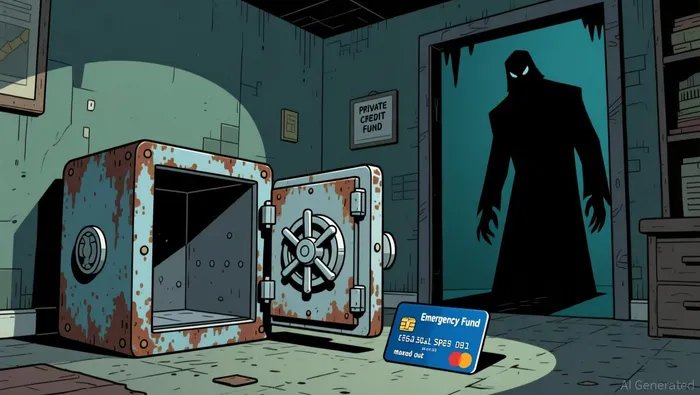
The IMF's own language is "high public debt, rising interest costs, and limited fiscal space." In plain English: the emergency fund is empty and the credit card is maxed out.
That matters because it changes the math on every future crisis. If oil spikes, a country with fiscal space can subsidize fuel, extend unemployment benefits, or prop up its currency. A country without fiscal space can only watch, raise rates, and hope the IMF still has appetite. The April 2026 Global Financial Stability Report already showed the mechanism in action: when the war in the Middle East pushed energy prices higher, global equity prices have declined 8% while sovereign bond yields have risen sharply, and volatility spiked across asset classes. The system absorbed it - this time - but barely.
The new risk bucket
Here's the part that makes the Georgieva warning sharper. While governments are running out of fiscal room, a different pool of risk has been growing in the background - and it's called private credit.
Private credit - loans made by non-bank lenders like direct-lending funds, rather than traditional banks - has ballooned to roughly $1.8 trillion. It's attractive because it fills the lending gap banks retreated into after financial crisis regulations. Companies that used to get bank loans now borrow from funds that sit outside the standard regulatory perimeter.
2026 is showing its first real stress test. Leveraged loan defaults surfaced in late 2025. The use of payment-in-kind deals - where interest is paid in more debt rather than cash, essentially kicking the can down the road - has increased in senior lending. The Financial Stability Board released a May 2026 report warning on private credit vulnerabilities, noting the system is heavily concentrated in a few jurisdictions.
The economic point is simple. When banks lend, the Federal Reserve (or equivalent) ultimately stands behind the system. When private credit funds lend, the money comes from investors - pensions, endowments, insurance money - who don't have a formal lender-of-last-resort promise. If a wave of defaults hits, there's no guaranteed buyer. The shock doesn't disappear. It migrates.
The calm that makes it worse
The IMF's May 2026 Global Financial Stability Report presser noted that financial markets have remained broadly stable despite ongoing geopolitical tensions. I don't know the full picture behind that assessment, and the May report's exact posture on private credit wasn't as sharply drawn as the April edition - there's a real question about whether conditions have normalized since the war-related spike or whether the system is just on a short leash.
But that calm is part of the structural problem. Markets that aren't pricing stress don't incentivize anyone to build buffers. Issuers keep borrowing. Funds keep originating loans. Policymakers don't feel pressure to rebuild fiscal space because the pain hasn't arrived yet.
It's the same dynamic that made the pre-2008 era feel so stable. Everything was working fine, which meant nobody was fixing what would break next.
Who actually bears the risk
The useful question isn't whether a shock is coming. It's where the shock will land when it does.
If you're a sovereign with low debt and strong revenue, you'll be the one absorbing the spillover - through IMF arrangements, reserve deployments, or diplomatic pressure to backstop weaker partners. If you're a pension fund or insurance company sitting in private credit, you own the exposure with no formal safety net. If you're in an emerging-market economy that imports energy, you're in the category Georgieva flagged as "especially vulnerable" - facing higher borrowing costs with no fiscal cushion to deploy.
The interesting asymmetry is that the parties creating the most new risk - private credit funds, deficit-spending governments - are not the ones most likely to absorb the losses when it goes wrong. The parties who will absorb the losses - taxpayers, long-term institutional investors, central banks facing impossible tradeoffs - didn't sign up for the terms.
That's not a prediction of crisis. It's a description of where the shock absorbers used to live, and what happens when they're gone.
The world isn't unprepared because the future is unknowable. It's unprepared because the last time something broke, everyone spent the same reserves that were supposed to last for the next time.