

SK Hynix shares rebounded last week after chairman Chey Tae-won announced plans to double the company's wafer capacity by 2030 - a move the market immediately read as confirmation that AI memory demand is unstoppable. The stock, which recently topped a $1 trillion market cap, has since pulled back slightly to roughly $957 billion, but the rally thesis remains intact: more capacity, more HBM, more profit.
The problem is that the market is celebrating a capital expenditure plan as if it were a profit plan. Those are not the same thing - not in the memory business, and especially not now.
Let's start with the cash-flow math. SK Hynix posted record results for fiscal year 2025: revenue of ₩97.1 trillion and operating profit of ₩47.2 trillion - more than double the prior year. That is the kind of number that makes analysts cheer. But the company also raised its annual capital expenditure to ₩29 trillion, up 58% from ₩22 trillion a year earlier, and announced a ₩19 trillion ($13 billion) investment in a new advanced packaging facility in Cheongju. When capex absorbs nearly all of your operating cash flow, the business is not generating free cash - it's recycling earnings back into the factory at the fastest pace in its history.
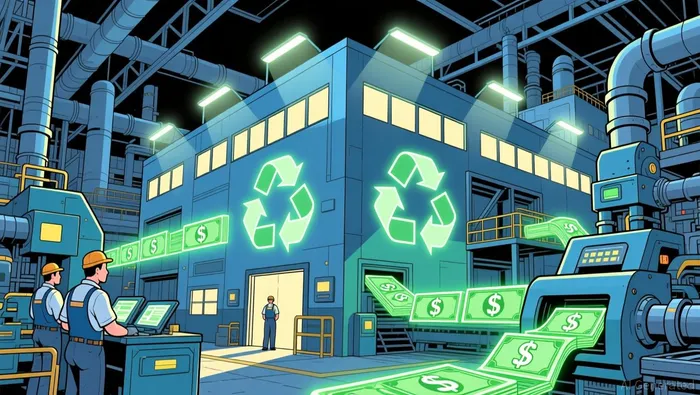
That matters because memory chips are one of the most cyclically brutal businesses in all of semiconductors. The DRAM industry has a long and repetitive history: demand surges, all three major players expand capacity in lockstep, pricing spikes during the shortage, then capacity overshoots and margins collapse. Everyone cuts prices to protect utilization. The cycle repeats. SK Hynix is currently doubling capacity at what appears to be the earnings peak of a cycle. That is the exact moment when memory companies historically plant the seeds of the next downturn.
This does not mean the HBM story is wrong. It isn't. SK Hynix is the clear leader in high-bandwidth memory - the high-speed chip used in AI servers - with analysts projecting roughly 70% market share of NVIDIA's next-generation Rubin platform. The global HBM market is expected to grow from approximately $38 billion in 2025 toward $100 billion within a few years. SK Hynix holds 29% of the broader DRAM market, behind Samsung's 38%. The company also earned an upgrade to investment-grade BBB+ from Fitch in April 2026, which cited revenue expected to more than double in 2026 alone to over ₩230 trillion. These are real structural tailwinds.
However, HBM is still a component of a commoditized semiconductor supply chain. Even the dominant supplier operates within a pricing structure that is set by the balance of global supply and demand - not by brand loyalty or switching costs. When Samsung and Micron also expand their memory output, the margin compression comes regardless of who leads. SK Hynix's ₩29 trillion capex is not just an investment; it's an invitation for competitors to match or exceed it, because in memory, capacity share is the only currency that matters.
From a valuation perspective, the stock trades at roughly 7.8 times forward earnings - which looks cheap by historical standards and even cheaper than some semiconductor peers at first glance. But that cheapness depends entirely on the assumption that earnings stay near cycle-peak levels. In a commodity-exposed business, multiples measured at the cycle top are misleading. The forward P/E of 7.8x implies the market believes these record 2025 profits will sustain. Analyst models project a median forward P/E of roughly 16x over the next five years, which would price in a cyclical pullback followed by a recovery. The gap between 7.8x today and that longer-term average tells you what the market currently believes about earnings durability - and it's placing a lot of faith in the AI cycle not breaking.
Even if HBM demand continues to compound and SK Hynix maintains its leadership position, the question for a cash-flow investor is whether doubling capacity creates shareholder value or merely builds a bigger factory that requires ever-larger reinvestment. At ₩29 trillion in annual capex and rising, the company is reinvesting approximately 60% of its record operating profit back into the business. That leaves very little room for debt reduction, share buybacks, or a meaningful free cash flow cushion when the cycle turns.
While it's true that SK Hynix's balance sheet has strengthened enough to earn an investment-grade rating, the trajectory of reinvestment intensity makes that a moving target. More capacity means more debt or more dilution if earnings fall short. The BBB+ upgrade reflects where the company is, not where it will be if capex outpaces cash generation for multiple years - a scenario that has played out in every prior memory cycle.
All things considered, SK Hynix is a high-quality player in a high-growth niche, and its HBM leadership is genuine. But the capacity doubling plan is not a bullish signal - it's a stress test. The market is pricing this name as if the AI-driven memory boom will last long enough to justify peak-cycle capex, but the memory industry's history suggests the opposite: the companies that expand most aggressively at the cycle top are the ones that suffer the deepest in the downturn. I would not rate this a Buy at current levels. Even if the bull case plays out, there are better opportunities elsewhere in the AI supply chain where capex intensity is lower and the cash-flow profile is less dependent on commodity pricing staying elevated.