

Everyone is fixated on SK Hynix's planned U.S. listing, reported for as early as August. The company filed a confidential Form F-1 to raise $9.6 billion to $14 billion, giving Wall Street access to the world's largest HBM chipmaker for the first time.
The only problem is: the opportunity isn't the listing. The opportunity is the valuation. SK Hynix is already trading at a $1 trillion market cap - it broke that threshold in late May - and at only 7.83x forward earnings on the KOSPI. For context, most U.S. AI semiconductor names trade at 20x to 40x forward earnings. SK Hynix is pricing like a cyclical commodity name while operating a monopolistic niche in the scarcest component in AI infrastructure.
Here's what actually matters beneath the IPO headline.
1. HBM capacity is fully booked, and SK Hynix is raising prices.
HBM - high-bandwidth memory, the stacked memory chips that sit directly on Nvidia's GPUs - is the bottleneck in the AI buildout. SK Hynix holds 61% of the global HBM market. Industry sources indicate that 2025 and 2026 HBM capacity is fully booked. More importantly, SK Hynix and Samsung have reportedly negotiated 20% price increases on HBM3E contracts for 2026. This isn't aspirational demand. It's contracted revenue at rising prices, which is the closest thing to visibility in semiconductors.
2. HBM sales more than doubled in 2025 - the growth rate doesn't match the multiple.
SK Hynix's HBM sales more than doubled in 2025. The company posted revenue of ₩32.8 trillion ($23 billion) for the full year, doubling profit on the back of the memory shortage. EBITDA margins could peak at 59%, according to S&P Global. Revenue is forecast to grow another 24% in 2025 before moderating to about 6% in 2026. That growth trajectory at 7.83x forward P/E is not "reasonably valued" - it's cheap. The growth rate is far above the multiple, which is the textbook GARP signal.
3. Samsung's HBM threat is real but not existential.
The bear case has one strong point: SK Hynix's HBM market share has declined from 69% in early 2025 to 58% in Q1 2026 as Samsung gains ground. The share erosion is real. But 58% is still a commanding lead, and Samsung is years behind on HBM4 process maturity. SK Hynix is the exclusive HBM supplier to Nvidia - that design-win lock-in is structural, not a one-quarter advantage. The market is treating a gradual share decline like an imminent loss of dominance. It isn't.
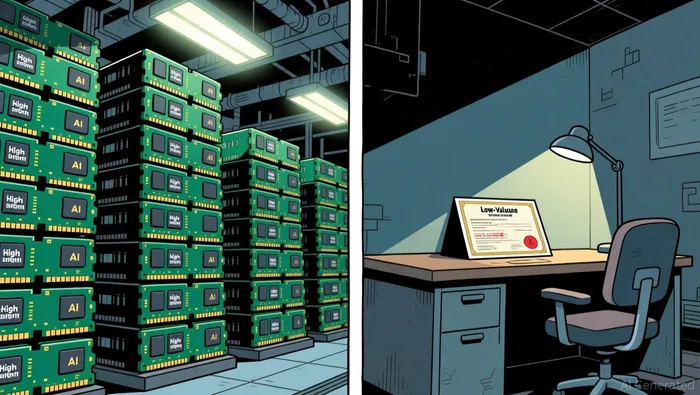
4. The capex is enormous, which is why the P/E looks "cyclical."
SK Hynix's 2026 capex is expected to reach approximately ₩40 trillion - roughly $29 billion - a sharp increase from ₩28 trillion in 2025. The company also committed ₩5.3 trillion to fast-track its M15X fab as a dedicated HBM production base for volume output in 2026. This is where the valuation disconnect lives. Massive capital spending drags on GAAP earnings and makes the P/E look cheaper than the underlying earnings power suggests. The IPO raise of up to $14 billion is partly intended to fund these fabs, reducing equity dilution pressure. Wall Street is reading the capex as cyclical overhang. It's actually capacity expansion to defend a monopolistic position.
5. The IPO is a catalyst, but the thesis exists without it.
A U.S. listing brings liquidity, analyst coverage, and inclusion in AI-focused ETFs. It could compress the valuation gap as American investors who can't trade KOSPI finally get access. But the stock is cheap regardless of the listing. The disconnect is between a 7.83x earnings multiple and a company with fully booked HBM capacity, 20% price increases, and an exclusive Nvidia supply relationship. The IPO accelerates the re-rating. It doesn't create the case.
The risk.
If Samsung catches on HBM4 and Nvidia diversifies its supply chain, the premium evaporates. The declining share trajectory from 69% to 58% is the real metric to watch, not the quarterly profit headline. A loss of the Nvidia-exclusive relationship would break the thesis entirely.
The number.
At 7.83x forward earnings, SK Hynix is trading like a cyclical memory name in a downturn - not like the dominant supplier of the scarcest component in the AI economy. The stock doesn't price in the contracted revenue growth, the pricing power, or the capacity expansion already underway. The U.S. listing makes the math visible to investors who couldn't see it before. The math was always there.