

The letter of intent (LOI) signed by Tohoku Air Service is a tangible step forward, but its real significance is measured against a tighter timeline and a more rigorous certification path. This agreement marks SkyDrive's first sale to a Japanese helicopter operator, a key validation that an established regional player sees value in the technology. More importantly, it comes as SkyDrive's SD-05 has secured critical Approved Design Organization (ADO) certification from Japan's aviation authority. This status is a prerequisite for the Type Certification needed to fly commercially, confirming the company's design processes meet international safety standards.
The LOI's true benchmark, however, is the revised national roadmap. In March, Japan's government moved the target for first commercial eVTOL operations to 2027 or 2028. The Tohoku Air Service deal, with its planned 2028 delivery, now aligns directly with this official timeline. This creates a clear, public deadline that tests SkyDrive's ability to execute. The company's progress on certification and its first operational sale provide early evidence that the path is being walked. Yet, the milestone also highlights the work ahead: commercialization depends on a full ecosystem of infrastructure, traffic management, and scalable operations, not just a single aircraft sale.
Historical Parallels: Testing the Ecosystem Hypothesis
The Tohoku Air Service LOI forces a comparison with past aviation transitions, where success hinged on parallel ecosystem development. The most direct parallel is the 1950s shift from helicopters to commercial airlines. That expansion required not just new aircraft, but the simultaneous build-out of air traffic control networks and maintenance infrastructure. Today's eVTOL rollout faces the same structural challenge: commercialization depends on a full system of urban traffic management (UTM) and charging networks. The LOI's 2028 delivery target, aligned with Japan's revised roadmap, creates a tight timeline for this ecosystem to mature in parallel with certification.
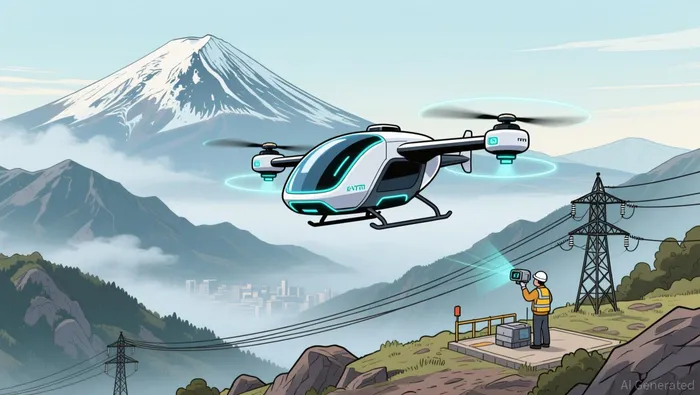
Historically, helicopter adoption also followed a pattern where utility roles paved the way for broader commercial use. Early applications in medical transport and power line inspection provided the operational proof and regulatory familiarity that later enabled passenger services. The cited potential for eVTOLs in disaster response and natural disaster response mirrors this trajectory. Tohoku Air Service's background in power line inspection, leveraging its more than 38 years of power line inspection experience, suggests a similar utility-first path. This could generate the operational data and public trust needed to justify scaling into urban passenger routes.
Yet, history also shows a persistent risk: certification pace for new aircraft types often lags behind design milestones. The 2027-2028 commercialization target is a direct test of whether regulators can keep up. SkyDrive's recent ADO certification is a crucial step, streamlining the design review process. But the company still needs Type Certification, and the broader UTM framework remains unproven. The historical pattern suggests this lag is a real vulnerability. If certification or infrastructure development falters, the 2028 target could slip, undermining the momentum built by the LOI.
The bottom line is that the LOI is a promising start, but it validates the aircraft design, not the ecosystem. The historical parallels show that utility roles and parallel infrastructure build-out are essential. For SkyDrive, the coming years will test whether it can navigate this complex system, turning a single sale into a scalable commercial reality.
Assessing the Operational and Financial Feasibility
For Tohoku Air Service, the LOI represents a calculated test, not a full-scale bet. The operator's cited advantages of quiet operation and lower purchase and maintenance costs are the core economic drivers. These factors directly improve the unit economics for the utility roles the company already excels in, like power line inspection and cargo transport to remote areas. In these applications, reduced noise can ease community relations, while lower operating costs enhance profitability on each mission. The planned 2028 delivery date is critical; it must align with the operator's capital expenditure plans and the projected revenue from launching these new services. A single aircraft purchase is a small-scale investment to validate this math before committing to a larger fleet.
Yet, this is precisely the point of a test. The LOI is a single aircraft purchase, a small-scale experiment. Scaling this model into a viable commercial operation requires massive additional investment in infrastructure, traffic management systems, and pilot training. This is the systemic hurdle that past aviation transitions have always faced. The historical parallel is clear: the utility-first path for eVTOLs mirrors the early use of helicopters for inspection and support, which later paved the way for broader passenger services. Tohoku Air Service's background in power line inspection suggests it is following this proven trajectory, using its operational expertise to de-risk the initial phase.
The bottom line is that the LOI is a financially sound test for the operator. It leverages known cost advantages for new applications, fits within a defined timeline, and carries limited risk for a single aircraft. For SkyDrive, the deal provides a crucial real-world partner to refine its operational model. But the test's success hinges on the ecosystem. If the planned 2028 delivery slips, or if infrastructure and traffic management fail to materialize, the operator's investment could become stranded. The LOI validates the aircraft's appeal for utility roles, but it does not yet prove the scalability of the entire urban air mobility system.
Catalysts, Risks, and What to Watch
The path from a single LOI to a scalable business model is narrow and hinges on a few critical factors. The primary catalyst is the successful Type Certification of the SD-05 by 2027. SkyDrive's recent ADO certification is a major step, but it streamlines the design review process-it does not grant the final commercial airworthiness. Achieving Type Certification on the revised 2027-2028 timeline is now the make-or-break dependency. This certification would validate the aircraft for safe operation, unlocking the regulatory green light for the planned 2028 delivery and the utility roles Tohoku Air Service has in mind.
A key risk is the pace of regulatory approval for specific operational use cases. The LOI cites applications in medical service provision and natural disaster response, but these require separate operational authorizations beyond the basic aircraft certification. Regulators may approve the aircraft for sightseeing or regional transport first, while the more complex and safety-critical roles in emergency services face a longer, more scrutinized approval path. If this lag occurs, it could delay the revenue-generating utility applications that are central to the business case for operators like Tohoku Air Service.
The benchmark to watch is follow-on orders from other Japanese operators. The 50-aircraft deal signed by Eve Air Mobility with AirX earlier this year is a clear signal of market interest. For SkyDrive, the next step is to see if the Tohoku Air Service test leads to a broader order book. The operator's background in power line inspection provides a proven utility model, but scaling requires other companies to see the same value proposition. The coming year will show whether this initial LOI is an isolated experiment or the first of many, setting the stage for a competitive domestic market.