

I don't think SoftBank's stalled $6 billion OpenAI margin loan is a story about one deal. It's a stress test that the entire speculative-growth thesis has been avoiding.
Here's what happened: SoftBank first tried to arrange a $10 billion loan backed by its OpenAI shares in April. Lenders pushed back. They cut the target to $6 billion in May. And now, as of this week, even that has stalled. Bloomberg first reported the stall, and the details have been confirmed by multiple outlets.
The numbers alone tell you everything you need to know about why.
OpenAI was valued at $852 billion after a $122 billion funding round in March - the largest private financing in history. SoftBank owns roughly 13% of that, making its stake worth approximately $110 billion on paper. In its fiscal 2025 earnings, SoftBank booked a $25 billion gain on its stake in the ChatGPT maker. That's enough to quadruple the company's annual profit.
But here's the thing: paper gains don't collateralize loans. And OpenAI doesn't generate the kind of cash flow that lenders care about.
The company brought in roughly $13.1 billion in revenue last year - up sharply, no doubt. It now generates about $2 billion per month. But it burned through roughly $8 billion of cash in 2025, and that burn rate is accelerating. Inference costs - the compute expenses of running AI models - hit $8.4 billion in 2025 and are projected to reach $14.1 billion in 2026. The gross margin is 33%. Management expects the company to remain unprofitable through at least 2029, possibly 2030.
OpenAI will spend more than $600 billion between now and 2030, by its own projections, chasing a path to profitability that's still four to five years away. For a lender evaluating collateral, that is not a balance sheet. It is a promise.
Why lenders said no - and why it matters to you
A margin loan backed by equity works like this: the lender takes your shares as collateral, gives you cash, and if the value of the shares falls too far, they can force you to repay or liquidate the position. For the lender, the critical question is what they can mark the collateral at and whether they can sell it if things go wrong.
OpenAI's $852 billion valuation is not a market price. It's a private financing round negotiated among a handful of deep-pocketed investors. There is no public market for the shares. There is no daily price discovery. There is no way for a bank to know, with any confidence, what the position would actually fetch in a forced sale.
Worse, the private credit market - the pool of non-bank lenders that would typically be the home for a deal this size - is already under pressure. US banks raised borrowing costs for private credit funds in the first half of 2026, citing AI disruption fears that are pummeling valuations across the sector. The market is entering 2026 facing its most challenging environment since 2008, according to multiple industry assessments.
So the credit system is telling us something the equity hype machine has been ignoring: when you strip away the narrative and look at cash flows, the most expensive private company in the world fails basic collateral tests.
This is not an anti-AI argument. It's a cash flow argument.
I'm not here to debate whether AI is transformative. It is. The question is whether transformative equals investible, and whether valuations that ignore cash flows will eventually meet financial gravity.
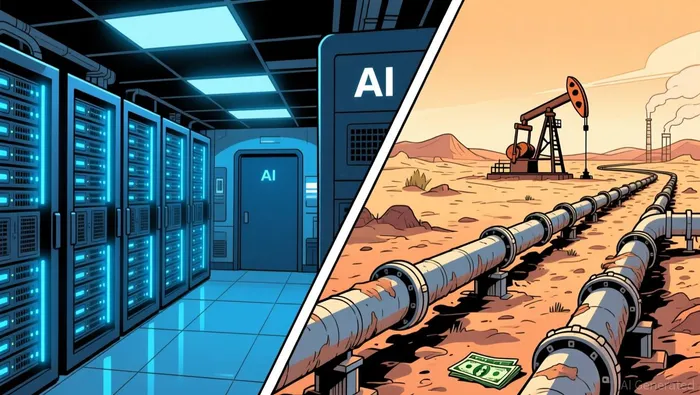
Think about the contrast. OpenAI burned $8 billion last year on $13.1 billion of revenue and won't profit until at least 2029. Meanwhile, the energy midstream companies I cover routinely generate $3 billion to $8 billion in free cash flow on similar revenue levels, with 90%+ margins because they operate toll-road infrastructure that moves oil, gas, and renewables. Those companies pay dividends that grow 8-12% a year. They have pricing power - they raise prices without losing customers - because the economy cannot function without their infrastructure.
That is the difference between the real economy and the speculative economy. One produces cash. The other produces stories. Both can create wealth, but only one creates wealth you can borrow against, distribute to shareholders, and compound through inflation.
The valuation gravity that always wins
SoftBank raised over $60 billion from investors to fund its OpenAI bet. It's now trying to borrow against the same position to fund further commitments. That is not a strategy - it's a leverage loop. You raise equity, you book paper gains, you try to borrow against the gains, you deploy the borrowed money into the same position. It works beautifully as long as nobody asks for collateral you can actually sell.
I've seen this pattern before. Not with AI - the technology is different - but with the structure of speculative valuations decoupling from cash generation. Private companies at absurd multiples, funded by patient capital, trying to bridge the gap to profitability with more capital. The question is always the same: does the cash flow thesis materialize before the credit thesis catches up?
In 2021, we had private companies valued at tens of billions with negative unit economics and no path to profitability. When the credit cycle tightened, the valuations collapsed. The companies didn't go away, but the multiples reset from "inevitable" to "prove it." The difference now is the scale: $852 billion is not a number. It's a civilization.
So what do you do?
I don't think the lesson here is to sell your technology stocks or declare AI a bubble. The lesson is to understand what kind of risk you're holding and make sure your portfolio contains companies that earn money in the business, not from the hope that someone else will pay more later.
If inflation runs closer to 3-4% - as I believe it will, structurally, because of deglobalization, demographics, energy transition costs, and fiscal dominance - then companies with pricing power and real cash flow become even more valuable. They can raise prices without losing customers. They can grow dividends. They can serve as collateral because their earnings are tangible, not theoretical.
That is why I focus on energy, industrials, defense, logistics, and infrastructure. These are "TOLL" stocks - companies that provide toll-road economics in sectors the economy cannot function without. They don't need to raise $122 billion to survive. They generate the cash, they pay the dividend, and they compound.
From an income and risk/reward point of view, the SoftBank stall is a reminder: valuations built on hope don't survive when credit applies discipline. The companies that do survive - the ones that produce cash, have pricing power, and pay dividends that grow through cycles - are the ones worth holding when the music stops.
I don't need OpenAI to fail for this framework to make sense. I just need credit markets to keep asking the same question they always should: what can you actually borrow against, and what cash flow backs it up?