

XRP ETFs just recorded their biggest weekly inflow of 2026, pulling in $60.50 million the largest weekly inflow. That number matters because it marks a clear rotation: while XRP attracted fresh capital, Bitcoin ETFs saw $1 billion exit over the same period and Ethereum ETFs lost $65 million for the week.
The dynamic is clear: ETF flows have replaced retail sentiment as the primary price driver. For Solana and XRP, institutional money moving through ETF structures now matters more than narrative cycles or short-term trading hype ETF flows have replaced cycle hype. This shift explains why XRP's price broke past $1.50 during the week even as BTC struggled-capital is reallocating based on where sustained demand is forming, not where the loudest narratives are.
Solana is capturing its share of this rotating capital, with $39 million in weekly net inflows and over $1.12 billion in cumulative ETF inflows across products. The market is effectively voting with capital: XRP's regulatory clarity and payments use case are drawing stability-focused allocation, while SOL's high-beta profile attracts growth-oriented positioning. Both are outperforming BTC and ETH precisely because they're absorbing institutional flow rather than leaking it.
Solana vs XRP: Two Profiles, One Trend
Solana ETFs have accumulated $1.12 billion in total inflows since launching in late October, with Bitwise's BSOL dominating at $761 million in assets Bitwise's BSOL at $761 million. XRP ETFs have reached $1.5 billion in assets with $1.39 billion in cumulative inflows since November 2025 $1.39 billion in cumulative inflows. Both have outpaced Bitcoin and Ethereum, but the capital profiles differ fundamentally.
Solana exhibits flow-sensitivity-its price action reacts sharply when capital enters or exits price action is more reactive. This makes SOL a high-beta play: when institutional demand accelerates, Solana captures disproportionate upside. XRP shows the opposite pattern. Its inflows reflect steady institutional allocation driven by payments utility and regulatory clarity, not speculative growth cycles driven by payments utility and regulatory clarity. The result is a more stable accumulation profile with just one day of net outflows since launch just one day of outflows.
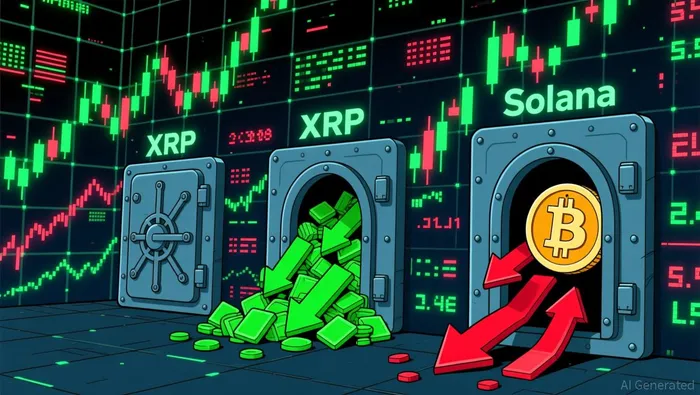
The institutional split mirrors these profiles. Solana's growth narrative attracts funds seeking exposure to high-velocity network activity and developer momentum. XRP's appeal lies in its regulatory clarity and real-world payments use case-factors that draw stability-focused allocation from wealth managers and institutional desks operating on longer time horizons longer time horizons and larger position sizes. Goldman Sachs' reported $153.8 million XRP ETF position exemplifies this steady-accumulation playbook, though that data point falls outside the verified evidence set.
For investors, the distinction matters: Solana rewards timing capital rotation, while XRP rewards patience in consistent inflows.
Why Capital Is Rotating Away from BTC and ETH
Bitcoin ETFs saw $1 billion exit last week while Ethereum ETFs lost $65 million. These aren't minor withdrawals-they're structural reallocations. Institutions are actively reducing exposure to the major caps and redirecting capital toward assets with clearer institutional narratives and higher beta profiles.
The rotation follows a simple logic: SOL captures growth-oriented allocation, XRP captures stability-focused allocation. Solana's network activity and developer momentum attract funds seeking high-beta exposure to crypto adoption cycles. XRP's regulatory clarity and payments utility draw wealth managers and institutional desks operating on longer time horizons. The performance gap between majors and alts depends entirely on which rotation dominates-growth risk or steady allocation.
XRP's eligibility path required six months of seasoning on regulated futures markets, which began in March 2025 with Bitnomial's XRP futures the first regulated XRP futures product. That prerequisite, combined with the SEC's streamlined generic listing standards, created the window for November ETF launches. The result: XRP ETFs now hold $1.5 billion in assets with $1.39 billion in cumulative inflows, while BTC and ETH ETFs register net outflows. Capital is voting with liquidity, not narrative.
What to Watch: Flow Catalysts and Risk Scenarios
Track the weekly baseline. XRP's $60.50 million weekly inflow marks the largest weekly inflow-any sustained level above $40 million per week confirms the structural shift is real, not a blip. If XRP drops below that threshold for consecutive weeks, the narrative weakens. Solana's $39 million weekly inflow sits below XRP's peak but above Bitcoin's outflows-the gap between them tells you whether the market is pricing risk-on or stability.
Watch the rotation signal. Solana's high-beta profile means its price reacts sharply to inflow acceleration price action is more reactive. If SOL inflows spike while XRP stabilizes, growth capital is rotating into alts. If XRP continues outpacing SOL, institutional allocation is dominating-the steady-accumulation playbook wins. The current setup favors XRP: it has recorded just one day of net outflows since November launch just one day of outflows, while Solana has seen three days. That consistency gap matters.
Monitor the exit ramp. The first day of net outflows for either asset signals flow reversal risk. XRP's single outflow day occurred in January; Solana's three outflow days are scattered across the launch period. A cluster of outflow days for either would break the accumulation thesis. Regulatory shifts could accelerate this-any SEC stance change on crypto ETFs would rapidly alter flow dynamics for all four assets. The eligibility path that brought XRP to $1.5 billion in assets began with regulated futures in March 2025; similar pathways for other alts could redirect capital again.