

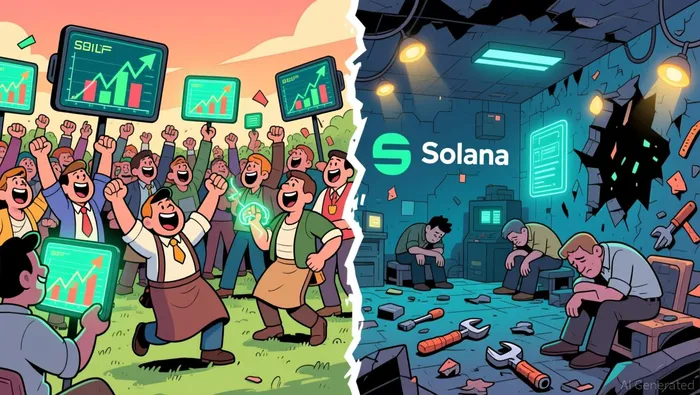
The core story for Solana in early 2026 is a stark divergence between price-driving hype and on-chain reality. While the token's price action is being fueled by capital and sentiment, the underlying network activity is showing clear signs of fatigue.
On-chain engagement has contracted sharply. Weekly active addresses have fallen 44% from their February peak, settling at 2.89 million. This decline in organic user participation suggests the network's utility and daily transaction volume are not keeping pace with the market's bullish narrative.
Yet, social media sentiment tells a different story. Despite this drop in engagement, bullish sentiment on social media platforms has reached its highest level since January. This disconnect points to a market driven by external hype rather than internal network growth.
The primary engine for this retail-driven hype is the Solana meme coin sector. As of March, this niche boasts a multi-billion-dollar market cap, with tokens like BONK and WIF acting as cultural and speculative magnets. Their explosive volatility and community-driven narratives are pulling capital into the Solana ecosystem, creating a price rally that exists apart from the decelerating on-chain flow.
The Capital Inflow Engine: ETFs and Institutional Builds
The price rally is being propped up by a powerful, external capital engine. Spot SOL ETFs have seen nearly $1 billion in cumulative inflows since their launch, providing a steady, institutional-backed bid that directly supports the token's valuation.
This institutional interest is expanding beyond pure investment. In March 2026, major payment firms Mastercard, Western Union, and Worldpay began building on Solana. Their choice to develop next-generation settlement infrastructure on the network signals a new, high-stakes use case for institutional capital.
Even more telling is the emergence of AI-driven activity. The Solana Foundation reported that AI agents have processed 15 million on-chain payments on the network. This marks a nascent but significant institutional application, moving the narrative from retail speculation to potential enterprise utility.
Together, these flows create a capital-driven support system. ETF inflows inject direct buying pressure, while the build-out by payment giants and AI agents promises future liquidity and use. This institutional capital is the primary counterweight to the fading on-chain engagement, explaining why price remains elevated despite the network's internal slowdown.
The Path to Reconciliation: Catalysts and Risks
The investment question hinges on whether institutional capital can reinvigorate the network's organic flow. The current setup is a bet on translation: can the builds by payment giants and AI agents convert into sustained, high-volume transaction activity, or will they remain isolated from the core user base?
The key catalyst is the translation of these institutional projects into measurable on-chain volume. The 15 million AI payments and the builds by Mastercard and Western Union are promising signals. If these use cases drive a meaningful, recurring increase in transaction throughput and active addresses, they could close the gap between price and flow. This would validate the capital inflows and create a self-reinforcing cycle of utility and valuation.
The primary risk is that price support from ETFs and social hype fails to reignite organic growth. With weekly active addresses already down 44% from their February peak, the network's core user momentum is weak. If institutional projects don't materially boost daily engagement, the price rally becomes increasingly detached from fundamentals. This creates a vulnerability where a shift in sentiment or ETF flows could trigger a sharp, flow-led correction.
Watch for a reversal in the weekly active addresses trend. A sustained decline below the 2.89 million level, especially if it breaks below 2.5 million, would signal deepening network decay. This would be the clearest data point that the current capital-driven price is not being supported by a growing user base, widening the divergence and increasing the risk of a painful re-rating.