

Tramplin.io, a prominent application on the Solana network, has overhauled its reward distribution mechanism to significantly reduce the advantage previously held by large holders over small stakers. This structural change aims to improve retail participation by compressing the odds advantage from 5,000x down to approximately 70x in major draws. The adjustment represents a critical shift in the staking model, designed to lower whale dominance and increase fairness for retail participants.
Solana is currently trading around $86, down approximately 71% from its all-time high of $294 in January 2025. This decline stems from a collapse in meme coin speculation, declining institutional ETF inflows, and a delayed Alpenglow upgrade. However, network fundamentals remain strong with record transaction volumes and dApp revenue, suggesting a potential recovery if the consensus upgrade launches successfully.
While the broader network has maintained 100% uptime since March 2023, individual validator performance varies significantly. The Harmonic Major validator experienced 32 delinquencies in 30 days, creating a $413 per hour opportunity cost for delegators despite the network's overall stability. This highlights a structural distinction where network-level block production continues even when individual validators fail to vote, resulting in lost rewards without principal slashing. Implement a long-only Mean Reversion strategy for SOL over the past 2 years. Entry: price closes above the 0.5 level of the 14-day Bollinger Bands lower band. Exit: price closes above the 20-day SMA, or after 20 trading days, or TP +10%, SL -8%.
How Does The New Staking Model Alter Reward Distribution?
Under the previous system, a wallet staking 5,000 SOL held a 5,000x advantage over a 1 SOL staker in certain draws. The new setup reduces this edge to approximately 70x in the Big Draw, granting relatively higher chances to smaller participants. Structural changes include reduced draw frequency and more balanced allocation to foster broader participation. By balancing reward allocation and reducing the disparity in probability, the network aims to foster long-term liquidity distribution and network strength.
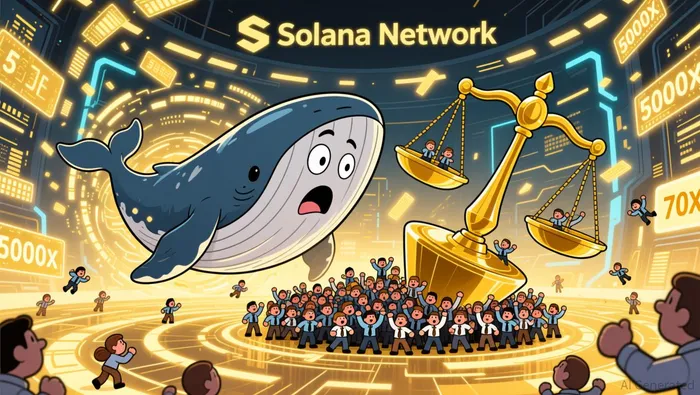
This shift is critical for increasing retail participation, a key factor for long-term network strength. The divergence between price stagnation and improving fundamentals potentially signals an upcoming accumulation phase as selling pressure is absorbed. Technically, SOL is holding firm near the $85 demand zone, suggesting early signs of a base formation.
Why Are Network Fundamentals Diverging From Market Price?
Solana has outpaced Ethereum in weekly dApp revenue for five straight weeks and processed a record $650 billion in monthly volume in February. Real-world asset value on the network has also reached approximately $1.85 billion. Conversely, the meme coin boom that previously drove activity has unwound, with daily active addresses crashing to a 12-month low of 3.3 million.
SOL spot ETF inflows have declined for six consecutive months, dropping from $419 million in November 2025 to just $34 million in April. This indicates fading institutional conviction, further compounded by the Bank of Japan's monetary tightening in early 2026 which triggered a risk-off environment.
The primary catalyst for recovery is the Alpenglow upgrade, expected to reduce transaction finality from 12.8 seconds to 150 milliseconds. While the upgrade was delayed to late 2026, contributing to a 68% year-on-year revenue drop in Q1, a successful launch could provide a competitive edge over Ethereum.
What Risks Do Validator Delinquencies Pose To Delegators?
Unlike some proof-of-stake chains, Solana does not slash validators for going offline, so the principal stake is not at risk. However, delinquent delegators miss out on vote credits, inflation rewards, and MEV shares. The validator tracking service estimates the opportunity cost at roughly $413 per hour while the node is inactive.
A Solana validator is flagged delinquent when its root slot drifts significantly behind the supermajority, effectively stopping its vote. While cluster-level uptime accurately reflects the blockchain's timeliness in producing blocks, validator-level uptime measures if a specific node was voting. These numbers can diverge dramatically, as seen in Harmonic's case where the cluster produced blocks but the validator missed 32 votes.
By April 13, 283 delinquency events were counted across the network, totaling 1,322 hours of downtime, with Harmonic topping the list. Additionally, Harmonic's RPC, gossip, and TPU ports were intermittently unreachable, though the company has not publicly addressed these incidents.
The network's resilience is further demonstrated by external utility expansions, such as a recent integration allowing XRP trading via WhatsApp through an AI-powered interface. This move toward seamless, real-world usability signals a transition from speculation to utility, a key driver for sustained growth.