

SpaceX's planned IPO is not merely a corporate listing-it is a paradigm-shift event that will redefine the infrastructure layer for the next wave of AI expansion. At $1.75 trillion, the valuation surpasses by far any company in history, and the targeted $75 billion raise would be the biggest public debut ever. This is the S-curve inflection point that deep tech investors have been waiting for.
The investment thesis centers on exponential adoption. Starlink has crossed the chasm from niche to mass market: 9.2 million subscribers across 150 countries, with the user base doubling for two consecutive years. That is the signature pattern of an S-curve in its steepest phase. The financials confirm it: $16 billion in revenue and $7.5 billion in EBITDA in 2025 alone. These are not startup metrics-they are infrastructure-scale economics.
For portfolio companies positioned in the AI stack, this creates a clear value capture pathway. SpaceX is building the compute and connectivity rails that every AI model will run on. Starlink's global satellite network is the physical layer for distributed inference. xAI, despite its current burn rate, represents a vertical-integration play on proprietary model development. The $1.75 trillion valuation-up from $800 billion just three months ago-reflects the market's recognition that AI infrastructure is no longer speculative. It is scaling.
The timing matters. With OpenAI and Anthropic also reportedly considering IPOs before year-end, SpaceX's offering will set the pricing benchmark for the entire AI infrastructure layer. How the market absorbs this $75 billion offering will determine whether the S-curve holds or whether we see a correction in valuations across the sector. For investors, the question is not whether to bet on AI infrastructure-but whether existing portfolio companies are positioned to capture the value flowing through these rails.
Alphabet: The 125x Return Nobody's Talking About
While everyone focuses on the $75 billion raise, the real story is who already owns a piece of this S-curve play. Alphabet holds a 6.11% stake in SpaceX according to a regulatory filing-the clearest AI-titan exposure to the IPO, and one that has already generated extraordinary returns.
At a $2 trillion valuation, that stake is worth $122 billion. The math is almost too clean to be real: Google invested $900 million in 2015 when SpaceX was valued around $12 billion, receiving roughly a 7% stake. Ten years later, that bet has compounded to a 125x return. The gains are already visible in Alphabet's financials: an $8 billion profit boost from SpaceX in Q1 2025 alone, and $24.1 billion in net gains on equity securities for the year largely tied to its private holdings.
But this is more than a financial win. It's a strategic positioning play. Google has been building an AI infrastructure portfolio in parallel with its public business. It holds an estimated 75-83% of Waymo last valued at $126 billion and a 14% stake in Anthropic last valued at $380 billion. Together, these three stakes-SpaceX, Waymo, Anthropic-represent a coherent thesis: control the infrastructure layer where AI actually runs.
For investors tracking the AI S-curve, Alphabet's SpaceX stake is a leading indicator. It shows that the most sophisticated capital in Silicon Valley sees these private valuations as not just sustainable but accelerating. The $122 billion mark is not a ceiling-it's a floor that keeps rising as the infrastructure thesis plays out.
Microsoft: The Strategic Partnership Play
Microsoft holds no equity in SpaceX, but its Starlink partnership delivers something arguably more valuable in the S-curve race: operational exposure to exponential subscriber growth at the infrastructure layer.
The collaboration pairs Microsoft's cloud services with Starlink's low-Earth orbit satellite network to connect rural and underserved regions where traditional infrastructure cannot reach. The first phase launches in Kenya, connecting 450 community hubs-farmer cooperatives, warehouses, storage depots, and digital centers-across the country 450 community hubs in Kenya. This builds on Microsoft's existing connectivity mission, which has already brought more than 299 million people online worldwide 299 million people brought online.
For SpaceX, this is a direct revenue and subscriber pathway ahead of the IPO. Starlink already commands 97% of all satellite internet traffic globally 97% market share in satellite internet and serves over 10 million subscribers across 160 countries 10 million+ subscribers in 160 countries. The Microsoft partnership adds another deployment vector-community-based models combined with local ecosystem partnerships-that accelerates adoption in emerging markets community-based deployment models and local ecosystem partnerships.
The strategic synergy runs deeper than subscriber counts. Microsoft is explicitly framing this as infrastructure-layer integration: satellite connectivity paired with digital skills, tools, and ecosystem coordination to support agricultural productivity, market access, and AI-enabled services support agricultural productivity, access to markets, and adoption of digital and AI-enabled services. This is the S-curve play in action-expanding the addressable market for AI infrastructure by bringing new users online.
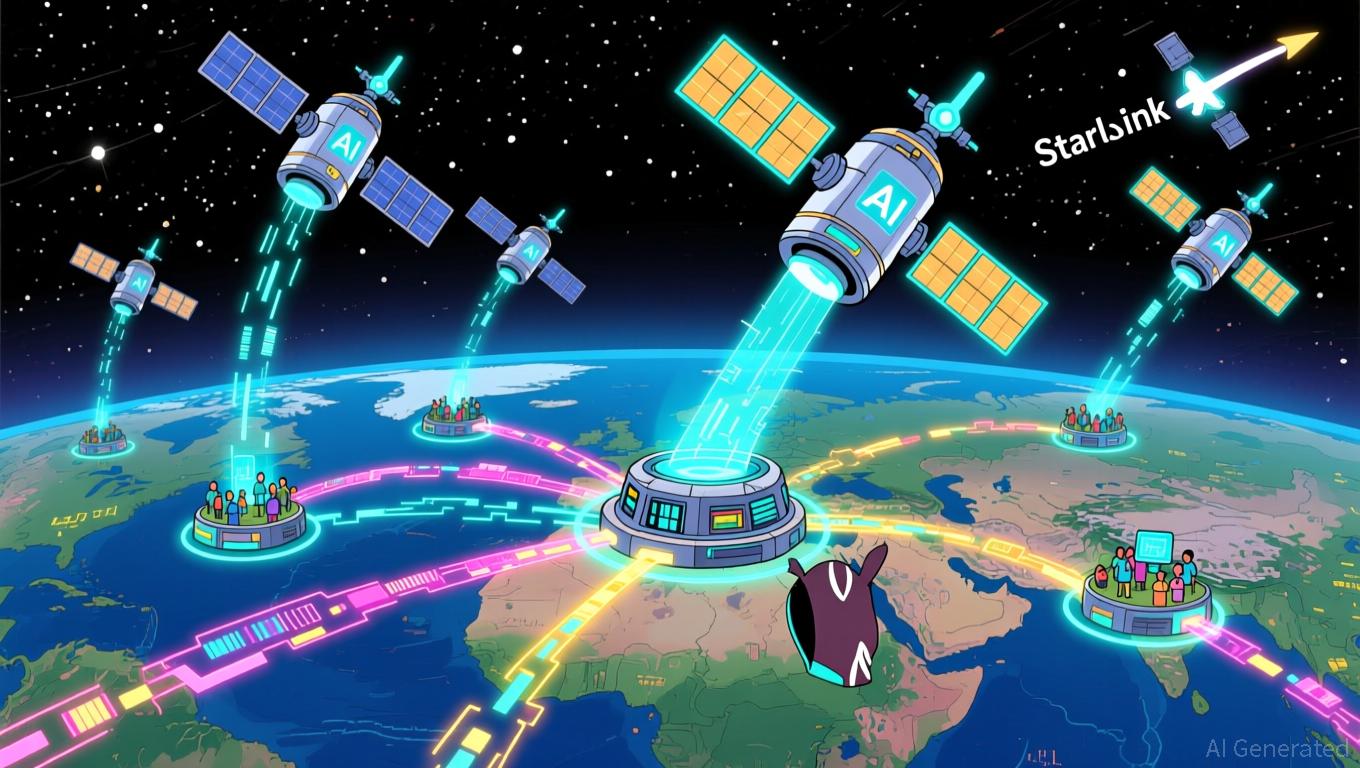
The context matters. Elon Musk is in a $134 billion legal dispute with Microsoft-backed OpenAI Musk seeking $134 billion from OpenAI, yet the collaboration proceeds unabated. That signals something critical: both companies see this partnership as strategically essential regardless of legal tensions. For SpaceX, it adds pre-IPO subscriber momentum. For Microsoft, it secures a foothold in the space-based connectivity layer that will underpin distributed AI inference.
And the infrastructure ambition extends beyond Earth. SpaceX is targeting an "insane flight rate" for Starship to support AI data centers in space and a lunar base insane flight rate for Starship, AI data centers in space and a base on the moon. Microsoft's partnership positions it to potentially leverage that orbital infrastructure as the compute layer for AI scales beyond terrestrial limits.
This is infrastructure-layer synergy, not equity ownership. But in the AI S-curve race, operational exposure to the rails often matters more than passive stakes. Microsoft is betting on the same exponential adoption curve that drives SpaceX's valuation-and that bet, combined with Alphabet's 125x return, signals that AI titans see the infrastructure thesis as accelerating, not slowing.
What to Watch: Valuation, Timing, and the AI IPO Window
SpaceX's $75 billion offering is not an isolated event-it is the market test for the entire AI infrastructure layer. How investors price this deal will set the tone for OpenAI and Anthropic, both reportedly considering IPOs before year-end OpenAI and Anthropic also considering IPOs. The S-curve thesis either holds across the sector, or it fractures.
The key catalyst is straightforward: Starlink's metrics are undeniable. 9.2 million subscribers, doubled for two consecutive years, with $16 billion in revenue and $7.5 billion in EBITDA in 2025. These are the numbers that justify exponential adoption pricing. But the xAI piece introduces friction. At $1 billion monthly burn with all original co-founders departed, it is the part of the story that gives sophisticated investors pause losing about $1 billion each month. The $1.75 trillion valuation-up from $800 billion three months ago-rests heavily on the AI narrative layered on top valuation up from $800 billion just three months ago.
For Alphabet, the SpaceX stake is already baked into the $122 billion mark. The question is whether the market assigns a premium to the hidden optionality: the way these private holdings compound as the infrastructure S-curve steepens. The $8 billion profit boost from SpaceX in Q1 2025 alone suggests the upside is still unfolding according to a regulatory filing.
For Microsoft, the watchpoint is operational conversion. The Starlink partnership must translate into measurable Azure revenue growth-not remain a CSR initiative. The 450 community hubs in Kenya are a proof of concept, but the market will reward scale: 450 community hubs in Kenya is a pilot; 299 million people brought online is the trajectory. If Microsoft can demonstrate that Starlink connectivity drives Azure consumption in emerging markets, the partnership becomes a revenue story, not a reputation play.
The risk is clear: if the market rejects SpaceX's valuation, it compresses the entire AI infrastructure layer. OpenAI and Anthropic valuations would face immediate pressure. For investors holding positions in public AI companies, the SpaceX IPO is the canary in the coal mine. Either the S-curve holds, and valuations accelerate-or the market corrects, and the infrastructure thesis takes a hit.
The timing is deliberate. SpaceX targets June 2026, with the S-1 expected in April or May targeting a June 2026 listing. That gives the market weeks to digest the offering before the summer trading window. For the AI titans watching, this is the moment of truth. The rails are built. The question is whether the market rides the exponential curve-or steps off.