

SpaceX priced at $1.77 trillion on its first day as a public company. Elon Musk says revenue could reach $1 trillion by 2030. The headline says the stock jumped 19 percent on debut.
None of that is the question. The question is simpler and harder: for $1.77 trillion, what business did you actually buy?
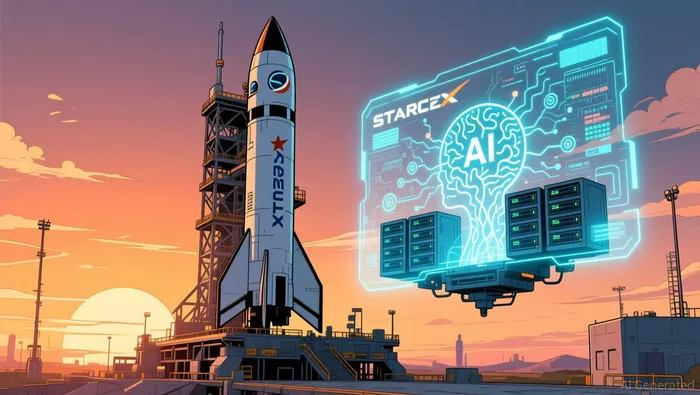
The obvious answer is rockets. That's what SpaceX does. It launches things. It runs Starlink. It's the most capable launch provider on Earth. But a $1.77 trillion company needs to earn back that price through cash flows, not through prestige. And the actual numbers make you squint.
SpaceX generated $18.7 billion in revenue in 2025 - up 33 percent - with Starlink providing roughly 60 percent of that. It reported $6.6 billion in adjusted EBITDA (a rough proxy for operating cash flow before heavy capital spending), but also a GAAP net loss of $4.94 billion. That loss wasn't a rounding error. It was real money burned, much of it on the AI division Musk wants to build.
So here's the arithmetic problem. At $18.7 billion of revenue and a net loss, SpaceX is priced at roughly 95 times its last year's sales. Most investors don't price companies at those multiples unless the business is about to grow explosively. That's where Musk's $1 trillion revenue claim enters. It's not aspirational fluff. It's the entire justification for the valuation.
If you believe that number - or even a fraction of it - the stock is fine. If you don't, you need to explain what you own.
This is where the story gets interesting, because the revenue bridge Musk and Goldman Sachs are drawing almost entirely runs through one segment: AI. Goldman Sachs projects SpaceX's AI revenue will surge from $3.2 billion in 2025 to $322 billion by 2030. Evercore ISI goes further, expecting $755 billion from the AI division by 2031. These are not incremental growth forecasts. This is a 100-fold increase in five years for a business unit that barely existed two years ago.
That's not a forecast. It's a wager.
No technology company in history has taken a business from $3 billion to $300 billion in five years. Not Amazon, not Nvidia, not Google. The closest analogue - cloud computing - took AWS roughly a decade to approach that kind of scale, and it benefited from being built inside a company that already dominated online retail and search. SpaceX's AI division, xAI, has none of those advantages. It has a lot of cash to burn and a lot of ambition.
Here's what some analysts noticed when they read the S-1 filing. One described parts of it as "borderline dishonest." The skepticism isn't about whether SpaceX will grow. It's about whether the filing's revenue projections match the reality of what the company has actually built. As one skeptic put it: either Musk is correct and the S-1 is materially misleading, or the S-1 is correct and Musk is up to his old habits.
There's a third option. Maybe the market is buying the narrative and pricing in a future that doesn't exist yet. That happens all the time at IPOs. Day one is a party. The real test comes when earnings season arrives and the company has to show whether $6.6 billion in adjusted EBITDA is a trajectory or a peak.
Consider the cash flow story. Adjusted EBITDA fell 35 percent in the first quarter of 2026 to $1.13 billion, while the company posted a $1.94 billion loss for the quarter alone. Revenue came in at $4.69 billion for Q1, which annualizes to roughly $18.8 billion - flat year-over-year. The growth story slowed while the burn accelerated.
At the $161 closing price on day one, the market is telling you that it believes the AI story. You're paying $1.77 trillion for a company that earns $6.6 billion in operating cash flow proxy and loses $5 billion on a GAAP basis. That pricing only works if xAI becomes one of the biggest revenue engines on the planet within three years.
I suspect most people who bought SPCX on day one don't realize how binary the bet is. The rocket business alone doesn't justify a trillion-dollar-plus valuation. Starlink is a great growth story - satellite internet is real demand, it's profitable, and it's scaling - but even a wildly successful Starlink doesn't get you to $1 trillion in revenue by 2030. You need the AI moonshot to work. Not half-work. Fully work.
That's a narrow path for a company priced this high.
Here's the test. Watch the next two earnings reports. If AI revenue grows 388 percent as Goldman forecasts for 2026 and then keeps accelerating toward the triple-digit trajectory, the narrative holds and the stock can compound. If AI revenue sputters and the company remains a rocket launcher with a satellite internet business, the math won't support the current price. The stock could trade at $1.77 trillion on day one and trade at $800 billion six months later - that's not a prediction, it's what the numbers imply.
The way to invest in SpaceX is not to buy the headline. It's to decide whether you believe an AI startup embedded inside a rocket company can outscale every existing AI infrastructure play in the market, and do it fast enough to matter before the valuation demands it. Most people think SpaceX is a space company that dabbles in AI. But look at the revenue projections. By 2030, Goldman expects AI to represent more than 60 percent of total revenue. SpaceX may turn out not to be a better version of a rocket company at all. It may be an AI infrastructure play wearing a spacesuit.
Which it is will determine whether this stock rewards its early buyers or teaches them an expensive lesson in the difference between a vision and a business.