

SpaceX's S-1 asks investors to fund a sequence, not just rockets
The core thesis
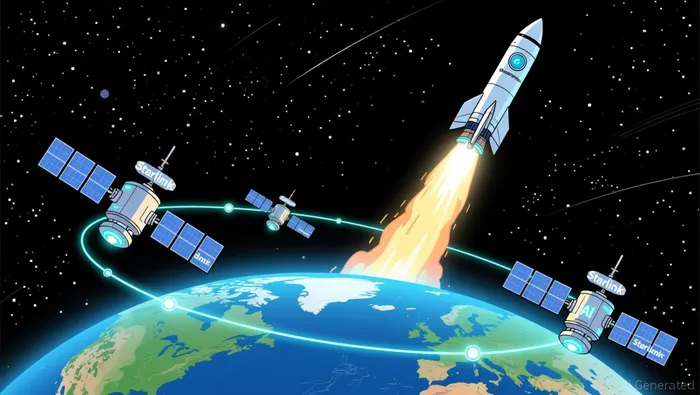
This is not just a rocket story. It is a bet that SpaceX can become the infrastructure layer for compute, connectivity, and launch economics. The filing lays out a sequence: Starlink generates cash, Starship lowers launch costs, and cheaper access to orbit helps fund a still-emerging AI business. If that chain works, SpaceX's value rests on much more than launch volume.
The central tension
The market is being asked to price that vision before the execution path is proven. SpaceX disclosed a $4.28 billion quarterly loss while targeting a $1.75 trillion valuation, with a likely Nasdaq debut next month under ticker SPCX.
That is the core debate. Bears see too many moonshots and too little proof that the sequence will hold together. Bulls see an infrastructure platform still in buildout. Either way, the filing makes clear that public-market value now depends on whether one business can fund the next.
Starlink is the cash engine behind SpaceX's broader ambitions
Starlink is already carrying the business
The bull case starts with existing cash flow, not a distant dream. Reuters noted that SpaceX filed its S-1 and disclosed consolidated financials after merging with xAI, while also reporting that $18.67 billion in consolidated 2025 revenue came through the combined entity. In the article's framing, Starlink is treated as the operating core funding the next phase of expansion.
That matters because large infrastructure buildouts usually need one business to support the rest while capex stays high. If Starlink remains the cash rail, SpaceX can keep investing in launch, data access, and AI infrastructure without relying immediately on public-market patience alone.
Starship is the leverage point
Starlink alone makes the case more credible. Starship is where the upside could become larger. SpaceX has reduced launch costs by orders of magnitude and built the world's largest satellite constellation. If Starship delivers on cheaper access to orbit, the economics of the broader platform could improve materially.
xAI is the biggest proof point investors still need
The AI bet is still expensive
The filing also exposes how much of SpaceX's future value depends on a business that is still burning cash. xAI lost $6.4 billion from operations on just $3.2 billion in revenue in 2025, and the filing points to even more spending as SpaceX plans to scale Grok to multiple trillions of parameters.
That contrast is the real issue. SpaceX is not asking investors to fund one proven business and a small experimental unit. It is asking investors to fund a proven core alongside a capital-intensive AI expansion whose economics are still unfolding.
Why the sequence matters more than the headline valuation
The bear case is straightforward: if any link in the sequence breaks, the valuation has less support. Starlink cash must help finance an unproven rocket, and that cheaper launch capacity must help support an ambitious AI push. If Starship slips or AI spending keeps outrunning monetization, the story becomes harder to defend.
Reuters also warned that Starship delays or cost overruns could threaten AI, satellite expansion and overall growth. That makes execution risk more concrete than a simple valuation debate.
The finance test is harder once SpaceX goes public
Losses and valuation now sit side by side
SpaceX disclosed a $4.94 billion net loss for the year while targeting a $1.75 trillion valuation. That combination is not automatically disqualifying for a company in heavy buildout, but it does raise the bar for future execution.
The market will now have to decide whether current losses are the price of building a broader platform or an early sign that the funding stack is too large for the current revenue base.
What could invalidate the bull case
Investors should watch three signals closely: - Starship progress, because delays or cost overruns would hit the whole sequence - xAI economics, because the losses are poised to grow - IPO timing and pricing, because a crowded mega-IPO window could make valuation harder to defend
For now, SpaceX's S-1 does not settle the debate. It sharpens it.