

SpaceX's S-1 prospectus went public on Thursday, revealing $18.7 billion in 2025 revenue, $6.6 billion in adjusted EBITDA - and an AI segment that posted a $6.35 billion operating loss.
The gap between that loss and the $2 trillion target valuation is the entire story of this IPO.
What the S-1 Actually Shows
The numbers separate into three buckets. Starlink, the satellite internet business, is the cash engine - generating approximately $11.4 billion in 2025 revenue with a 63% EBITDA margin, which means roughly $7.2 billion in cash earnings from the segment alone. The launch and government segment - Falcon 9 missions, Starshield military contracts, and NASA's Artemis HLS program - contributed roughly $5 billion in revenue and $8 billion from government contracts including Starshield work. Then there's the AI segment, which is where the filing tells a story that no amount of enthusiasm can disguise.
The AI segment absorbed the weight of SpaceX's February 2025 merger with xAI, Musk's artificial intelligence company. In 2024, the combined AI effort still produced $347 million in adjusted EBITDA profit. In 2025, it swung to a $1.2 billion adjusted EBITDA loss - and a $6.35 billion operating loss. R&D inside the AI segment alone consumed $5 billion. Cost of revenue jumped 29% to $2.18 billion, driven by infrastructure and cloud computing expenses.
Put plainly: SpaceX's only profitable cash engine is currently bankrolling an AI infrastructure operation that burned through more than six billion dollars in one year.
The Architecture Bet
Here's the thesis that the $2 trillion valuation demands you accept. Musk has articulated a plan to build data centers in orbit - satellites generating compute power, beaming it down, solving the ground-based energy and supply constraints that are already choking AI infrastructure growth. His math: launch one million tons of satellites per year, each generating approximately 100 kilowatts of compute per ton, yielding 100 gigawatts of new global AI capacity.
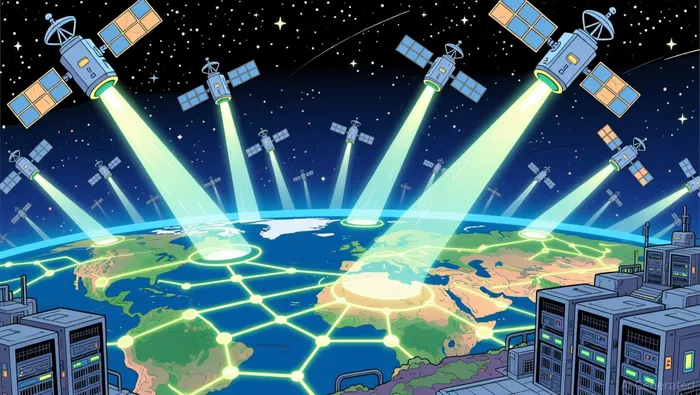
The S-1 confirms the capital commitment behind this vision. xAI's capital spending surged from $3.8 billion in 2024 to $12.7 billion in 2025. Total company capex exceeded $20.7 billion. The filing shows $53.9 billion in property, plant, and equipment - factories, launch infrastructure, GPU clusters, and data center assets bundled together.
What the filing does not show is any working orbital data center. No orbital compute product. No customers buying space-based AI inference. No revenue from a system that has left the drawing board. The $12.7 billion in xAI capex was spent on ground-based infrastructure - GPU clusters and conventional data centers - while the orbital architecture remains a concept.
This is an infrastructure transition play being made before the architecture exists. In the semiconductor space, I watch for the moment when a competitor's architecture ships and starts eating into the incumbent's TAM. Here, the architecture hasn't shipped. The transition is being funded in advance.
The Supply Signal
This is where the capex data becomes the leading indicator. Total capex of $20.7 billion on $18.7 billion in revenue means SpaceX spent more than it earned in one year - and has done so for multiple years while remaining privately funded. Starlink's roughly $7.2 billion in EBITDA covers approximately one-third of that capex bill. The rest was absorbed through retained cash, the xAI merger, private funding rounds, and the runway to this IPO, which is targeting a $75 billion raise.
For comparison, in the AI infrastructure space, the hyperscalers are spending $20-30 billion per quarter on capex. Nvidia is the supplier, not the builder. SpaceX is trying to be both the transport layer and the compute layer in a market where the compute layer alone requires that kind of spending. That is not a moat - it's a leverage question.
The Control Question
The S-1 also confirms what was widely reported: Musk controls 79% of voting power despite owning approximately 42% of equity. For an IPO of this size, targeting the Nasdaq under ticker SPCX, that concentration is unusual. It matters because the orbital data center thesis depends entirely on execution decisions that a single person controls - how fast the architecture ships, how aggressively Starlink earnings get reinvested, whether the compute vision adapts when the physics or economics don't cooperate.
Where This Fits in the AI Cycle
The real question is not whether orbital compute is impossible. It's whether the AI infrastructure cycle needs it - and whether the $2 trillion valuation is being assigned to a concept or to a business.
Starlink is a real, growing, profitable infrastructure business. The launch monopoly on Falcon 9 is real. The government contracts are real. But at a $2 trillion valuation, this stock is not being priced as a satellite internet company with a launch side-hustle. It's being priced as the next generation of AI compute infrastructure.
The problem is timing. The AI infrastructure build-out is happening right now on the ground. GPU supply is the bottleneck. Power is the bottleneck. Data center construction is the bottleneck. SpaceX's orbital architecture could address the power bottleneck in theory - unlimited solar in space, no land constraints, no municipal permitting. But Musk himself said to expect AI compute in space within two to three years of the merger. That puts functional orbital data centers in 2028 at the earliest.
By 2028, the ground-based AI infrastructure market will have matured further, custom silicon will be more prevalent, and the hyperscalers will have locked in years of capex commitments. The orbital compute thesis doesn't need to beat ground compute on performance - it needs to solve a bottleneck that ground compute can't solve. Energy density and power availability are real constraints, but they are constraints that have a decade of investment solving them first.
The Allocation Question
I believe the orbital data center thesis is credible enough to watch and unproven enough that I wouldn't bet a large allocation on it at IPO pricing. The distinction is critical: credible and investable are not the same thing.
Starlink alone - at roughly $11.4 billion in revenue with $7.2 billion in EBITDA - is a legitimate infrastructure business worthy of serious valuation. But a $2 trillion market cap assigns roughly $1.8 trillion of value to a compute architecture that hasn't shipped, a segment that lost $6.35 billion last year, and a capex trajectory that tripled in a single year with no orbital product to show for it.
Demand is not the issue - the AI compute market is expanding faster than anyone can supply. The issue is whether Starlink's cash engine can absorb the xAI burn rate for the four to six years it will take to prove orbital economics, while the ground-based infrastructure cycle runs its course and the valuation waits.
The debate is not whether orbital data centers are a worthy vision. It is whether a $2 trillion valuation at IPO, with a $75 billion raise, leaves enough margin of safety for an architecture that depends on solving physics, engineering, regulatory, and economic problems simultaneously. The S-1 shows me the burn. It doesn't show me the path to proving the thesis before the next AI infrastructure transition renders the window narrower still.
What would change my view: a clear milestone on orbital compute - even a small-scale demonstration, even at losses - that proves the unit economics of space-based inference. Until then, the thesis is the architecture gap itself, and I'd rather be invested in companies that are shipping today.