

SpaceX's IPO filing contains a sentence most readers will skip. It shouldn't.
"Our initiatives to develop orbital AI compute at scale, establish a lunar economy, and develop human augmentation systems are in early stages, involve unproven technologies, and may not achieve commercial viability."
That is from the prospectus itself. Not a skeptical analyst. Not a short seller. It's SpaceX's own required disclosure.
The company is raising about $75 billion at a $1.77 trillion initial market cap. That valuation demands a future far bigger than launch services and satellite internet. The story being sold to buyers is that SpaceX is building orbital data centers - a fleet of satellites that do AI computing in space. Musk told Jamie Dimon on the roadshow that the IPO would fund 100,000 new satellites. The scale is something investors need to picture: SpaceX currently has about 10,000 Starlink satellites in orbit. The plan is to add ten times that many.
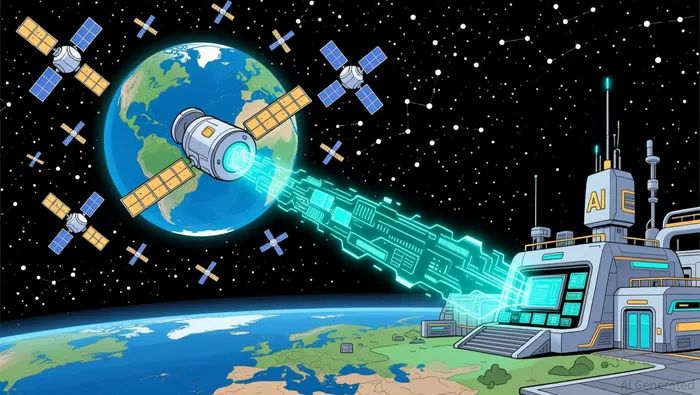
But the prospectus says that whole orbital AI idea might never work. And the spending tells you how much SpaceX is gambling on the possibility that it does.
xAI - Musk's AI company, which SpaceX acquired early this year - spent $12.7 billion on capital expenditures in 2025. That's more than the $8 billion SpaceX spent on Starlink, the one business that actually generates revenue. In the same year, xAI lost $6.4 billion.
SpaceX as a whole lost $4.9 billion in 2025 on $18.7 billion in revenue. The accumulated deficit sits at $41.3 billion.
So what are you buying at $135 a share?
The existing businesses can't explain the number. Starlink is the closest thing to a cash engine, with revenue that's growing but slowing - quarterly growth fell to 15% on a $4.7 billion run rate. The Space segment - launches and defense work - had $4 billion in revenue but lost money on operations. Without orbital AI, SpaceX is a very large infrastructure company that burns billions more than it earns.
With orbital AI, it's potentially the biggest capital goods play in the history of computing. The pitch is straightforward: Earth is running out of power and water to cool data centers. Space has unlimited solar and a vacuum for passive cooling. Put the GPUs up there, beam the answers down.
Except the physics makes it hard. Radiator cooling in space doesn't scale the way it does on Earth. Cosmic radiation flips bits in memory. Replacing a failed GPU in orbit costs millions of dollars and requires a rocket launch. The prospectus acknowledges these problems. It just hopes they'll be solvable.
That's the actual investment question. Not whether Musk can sell a story - he clearly can. The question is whether orbital AI is an engineering problem SpaceX will solve over the next decade, or a physics problem it can't.
I haven't found enough evidence to call one way. The company's own filing admits it doesn't know. What I can evaluate is what the $1.77 trillion valuation assumes.
It assumes orbital AI works at scale. If you subtract that from the thesis, you're left with Starlink growth, launch dominance, and a $41 billion hole in the balance sheet. That's a real company. But it's not a $1.77 trillion company.
The way to think about this isn't whether the stock will pop on the first day. It's what happens three years in. If orbital compute is still unproven by then, the market will reassess what the existing businesses are worth. If it works, the 100,000-satellite plan compounds in ways that are hard to model - each additional satellite adds both capacity and a network effect.
I suspect the market is pricing in the latter outcome with more confidence than the evidence supports. That doesn't make it wrong. Superlinear bets like this are often wrong until they're right.
The test is simpler than it sounds. Watch the capex. If xAI's spending keeps growing while orbital revenue stays at zero past the end of 2027, the thesis is a bridge too far. If you start seeing paying customers for space-based compute, even at small scale, the compounding story begins. Until then, you're buying the option - and the option is priced like a certainty.