

The title of this article is deliberate. SpaceX is not just a bad dividend stock. It is the antithesis of everything this framework looks for - and that is exactly why it has become the most talked-about stock in the world.
Do you know what scares me more than missing the biggest IPO in history? Buying it.
SpaceX priced its initial public offering at $135 per share on June 11, 2026, valuing the company at $1.8 trillion and raising $75 billion - the largest IPO ever. The stock opened at $150 on the Nasdaq under ticker SPCX, peaked at $176.52, and closed its debut at $160.95. The crowd went wild. Then Elon Musk posted that SpaceX revenue could reach roughly $1 trillion by 2030.
Let me put that in perspective. SpaceX generated $18.67 billion in revenue in 2025 and posted a net loss of $4.94 billion. For Musk's number to work, revenue needs to grow more than 50 times over in four years. That would require a compound annual growth rate of roughly 130 percent, sustained, year after year, without a single stumble on the Starship buildout, the AI infrastructure rollout, or the regulatory minefield.
I don't think that is the right way to frame this. The better question is: does this company even pass the three filters I apply to everything before it earns a single minute of analysis?
Filter One: Pricing Power
Can SpaceX raise prices without losing customers? The honest answer: barely.
The launch segment runs on government contracts - fixed-price deals with NASA and the Department of Defense where SpaceX has no room to pass through inflation. Starlink, the satellite internet division, is the only one with any consumer pricing leverage, and it's the only profitable segment, generating $4.42 billion in operating income last year. But Starlink competes in a broadband market where price sensitivity is real and terrestrial alternatives keep improving.
The new AI division - which absorbed the February 2026 acquisition of xAI - generated $3.2 billion in revenue but posted a $6.355 billion operating loss. That is not a business with pricing power. That is a burn rate wearing a growth story.
Filter Two: Cash Flow and Balance Sheet
Here is the number that should end the conversation for any income-focused investor: SpaceX spent over $10 billion on capital expenditures last year. Roughly $7.7 billion of that went into AI infrastructure. The rest funded Starlink expansion and launch operations.
This company has never been profitable. It lost $4.94 billion in 2025 and another $4.28 billion in the latest quarter. There is no free cash flow to distribute. There is no free cash flow to grow. The entire operation is an infrastructure buildout funded by relentless capital raising - and now, by a public listing that values the future promise at nearly $2 trillion before a single profitable year is in the books.
Filter Three: Dividend Growth Trajectory
SpaceX pays zero dividend. It will pay zero dividend. It will likely never pay a dividend. The company needs every dollar of future cash flow to fund the very buildout it's promising will generate that $1 trillion in revenue.
This is not a stock that belongs in a retirement-income sleeve. It does not belong in a dividend growth portfolio. It does not even belong in a total return portfolio unless you are willing to bet that a $1.77 trillion money-losing company can execute a 54x revenue expansion without running out of capital or hitting a regulatory wall.
What Wall Street Is Pricing In - And What It Isn't
Goldman Sachs projects SpaceX's AI division alone could surge 100x, from $3.2 billion to $322 billion by 2030. Morgan Stanley has revenue projections of nearly $330 billion for 2030 and $3.4 trillion by 2040. These are not estimates built on conservative assumptions. They are projections that demand flawless execution across three unrelated businesses - rocket manufacturing, satellite broadband, and AI infrastructure - while ignoring the single factor that kills growth stories: margin compression.
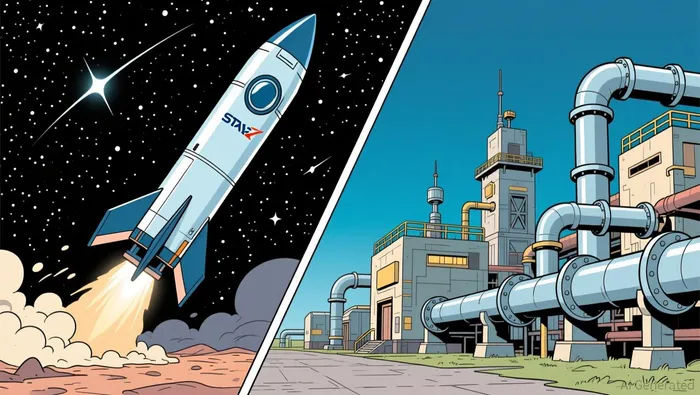
You cannot grow 130 percent annually for four years without competitors entering, without talent costs spiking, without regulatory delays, and without the capital expenditure requirements multiplying at the same rate. Every one of those analyst targets assumes none of that happens.
The Real Opportunity Cost
Here is what this IPO reveals about market psychology right now: capital is flowing into speculative growth at historic valuations while real-economy businesses with pricing power, durable cash flows, and growing dividends sit at reasonable prices.
I believe investors are being asked to choose between two frameworks. One says: buy the biggest name, chase the growth narrative, and hope the $1 trillion revenue number justifies the entry price. The other says: buy companies that provide what the economy cannot function without, that can raise prices without losing customers, that generate free cash flow today, and that compound their dividend payout through full cycles.
Energy midstream companies. Industrial oligopolies. Defense contractors with decades-long government contracts. Logistics operators positioned for reshoring. These are the businesses that protect purchasing power when inflation refuses to disappear - because they have pricing power today, not promises for 2030.
The equity yield curve teaches a simple lesson: the sweet spot is moderate yields with strong growth, bought when cyclicality pushes prices down and yields up. SpaceX sits on the opposite end of that spectrum - zero yield, zero cash flow, and a price that already reflects perfect execution for the next decade.
I'm not saying SpaceX will fail. I'm saying the entry price demands a level of certainty that no investment should require. From an income and risk/reward point of view, the math is clear: you are paying $1.77 trillion for a company that lost $4.94 billion last year, with a founder promising revenue that would need to grow 54x in four years, in exchange for zero current income and a dividend policy that doesn't exist.
The real economy doesn't work that way. It works by buying tangible businesses that generate cash today, grow their payout tomorrow, and protect your purchasing power regardless of whether any single founder's vision comes true. That is what compounding looks like over decades. Not hoping for a trillion-dollar future. Owning businesses that compound in the present.
SpaceX may be the biggest IPO ever. It is also, by every measure that matters for income and long-term compounding, the wrong answer.