

SpaceX's stock closed its first day at $160.95, a 19% jump from its $135 IPO price, valuing the company at roughly $1.77 trillion - the largest initial public offering in history. The market didn't show up for rocket launches or satellite internet. It showed up for orbital AI compute.
That's the real question: the IPO priced in a future where SpaceX doesn't just launch AI hardware to space, but runs entire data centers there - powered by solar, cooled by the vacuum of orbit, connected by Starlink's laser mesh. The architecture is ambitious enough to matter. It also doesn't exist yet.
The architecture being priced in
Elon Musk unveiled the AI1 satellite design in a 30-minute video posted to X on June 9 - the first detailed look at what SpaceX means by orbital data centers. The specs: 150 kW peak compute power, 120 kW on average, with an efficiency target of 70 kW per ton of satellite mass. The compute stacks will be solar-powered and thermally managed for the orbital environment. SpaceX aims to launch orbital AI computing tests by the end of 2027.
The pitch is simple: ground-based AI data centers are hitting power and cooling walls. Orbital compute sidesteps both - unlimited solar power above the atmosphere, and space itself as a heat sink. If it works, SpaceX sells something neither Nvidia, Amazon, nor Google can replicate: a physics-based moat built on the only launch system that can economically move heavy payloads to orbit.
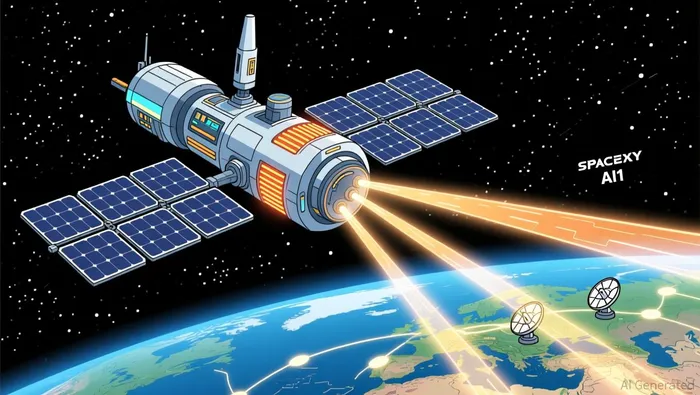
But "if it works" is doing an enormous amount of analytical labor here. No orbital AI data center has ever been deployed. Not by SpaceX, not by anyone. The AI1 design is a prototype, not a product. The end-of-2027 timeline is a target Musk set in a video, not a supply commitment.
The revenue the market actually has
Here's what SpaceX's financials look like right now. Total 2025 revenue was $18.7 billion, up 33% from the prior year. Of that, Starlink... generated $11.4 billion and $4.42 billion in operating profit, a 39% margin. Starlink was the only profitable division. The launch and government segments barely broke even. The AI division, which includes the xAI merger from February 2026, was money-losing.
Then there are the losses. SpaceX posted a $4.27 billion net loss in the first quarter of 2026, up from $528 million a year earlier. The company carries an accumulated deficit of $41.3 billion - that's the total of every loss the company has ever recorded, never recovered.
A $1.77 trillion valuation on $18.7 billion in revenue implies a price-to-sales multiple of roughly 95x. For context, that is higher than almost any infrastructure company in history. It only makes sense if the market believes revenue will approach Goldman Sachs' projection of $474 billion by 2030 - with $322 billion of that coming from AI services alone. That's a 100x increase in AI revenue from $3.2 billion, in four years.
I don't think anyone believes that timeline is guaranteed. But belief isn't the mechanism here - contracts are.
The supply commitments that matter
This is where the story gets real. Two deals were disclosed during the IPO roadshow that anchor the AI thesis in actual revenue, not Musk's vision:
Anthropic agreed to pay SpaceX $1.25 billion a month through May 2029 for compute capacity. That's $15 billion annually from a single customer, locked in for three years. The S-1 filing notes Anthropic will also evaluate SpaceX's orbital data center satellites for future workloads.
Google signed a deal worth $920 million per month starting in October 2026 through June 2029 - roughly $11 billion annually. Capacity ramps up over the term.
Combined, those two commitments total $26 billion per year once fully ramped. On $18.7 billion in 2025 revenue, that's a near 40% increase - and it's contracted, not speculative.
However - and this is the part the market is underweight - neither deal requires orbital compute. The Anthropic agreement covers SpaceX's ground-based Colossus 1 data center in Memphis, Tennessee. The Google deal follows the same structure. The orbital AI thesis is a forward-looking option, not the basis of current revenue.
What this means is that the $1.77 trillion multiple is being supported by a business model that is fundamentally a ground-based compute colocation play - one where SpaceX's competitive advantage is less clear. Nvidia, Amazon, Microsoft, and Google all operate ground data centers at massive scale. SpaceX's Colossus facility doesn't yet have a proven unit-cost edge over them.
The orbital bet is what differentiates SpaceX from every other neocloud provider. But it's also what carries the most execution risk. If AI1 delivers on its power and thermal specs, SpaceX has something genuinely new. If it doesn't, the company is selling ground compute at a $1.77 trillion price tag.
What I'm watching
There are three signals that will tell me whether this valuation has a path to justify itself - or whether it's a story stretched beyond what the architecture can support.
First, the AI1 test results. Musk said the company aims to launch orbital AI computing tests by the end of 2027. That's 16 months away. When those results come in, I'll be looking for whether the 70 kW per ton efficiency target holds under actual orbital conditions - solar degradation, thermal cycling, radiation effects on compute hardware. These aren't theoretical concerns. Space hardware fails in ways ground hardware doesn't.
Second, the cost per watt comparison. The whole thesis collapses if orbital compute doesn't meaningfully undercut ground-based data center costs once you factor in launch expenses, satellite manufacturing, and the limited lifespan of orbital hardware. Starship's $90 million per launch cost helps, but every AI1 satellite needs to carry enough compute density to amortize that cost across years of revenue. I don't have unit economics for this yet - and neither does the market. That's a gap worth noting.
Third, customer migration from ground to orbit. Anthropic's willingness to "evaluate" orbital capacity is an interesting signal - but evaluation isn't adoption. When a major AI lab actually moves inference or training workloads from a ground data center to orbit, that's when the architecture thesis moves from option to infrastructure.
So where should capital go?
I still believe the orbital AI compute concept, if it works, represents one of the most important infrastructure transitions of this decade. The ground-based power bottleneck is real - AI data centers are already straining regional electrical grids, and permitting for new facilities takes years. An architecture that sidesteps that constraint would be worth more than the market is paying today.
But the orbital thesis is unproven, the timeline is 16 months out, and $22 trillion worth of implied future revenue has already been packed into a single day of trading. The debate is not whether SpaceX remains an important company - Starlink alone is a $11.39 billion in revenue... and $4.42 billion in operating profit engine that could justify a far more modest multiple. The debate is whether the orbital AI bet deserves a $1.77 trillion price tag when the product doesn't exist yet, the unit economics are unknowable, and the current revenue anchors are ground-based contracts that any neocloud provider could compete for.
In my opinion, the most rational approach for the AI infrastructure investor is to wait for the AI1 test results. That single data point - whether 150 kW of compute can actually run reliably in orbit at competitive cost - will tell you whether this is the next generation of AI infrastructure or an expensive prototype that never scales. Until then, the return profile of this position is front-loaded with narrative and back-loaded with proof.
There are better places in the AI trade to deploy capital today - companies where the architecture is proven, the revenue is flowing, and the bottleneck shift is already underway rather than still on the drawing board. SpaceX will have its moment when the orbital thesis is validated. The question is whether the current price already gives that moment away.