

- SpaceX scrubbed the Falcon Heavy launch for the Viasat-3 F3 satellite due to adverse weather at Kennedy Space Center on Monday.
- The mission has been rescheduled for Wednesday, April 29, with an 85-minute window opening at 10:13 a.m. ET.
- The Falcon Heavy is returning to service after an 18-month hiatus, highlighting SpaceX's dual-track strategy between Falcon Heavy and Starship.
- Viasat's broadband expansion is critical for Asia-Pacific coverage, impacting the global satellite communications sector.
- Florida's Space Coast is experiencing a record-breaking year for launches, underscoring the high demand for commercial orbital access.
Weather conditions at the Kennedy Space Center forced SpaceX to scrub the highly anticipated launch of its Falcon Heavy rocket on Monday morning. The countdown was halted with just 28 seconds remaining, leaving the vehicle and the Viasat-3 F3 satellite in a healthy, grounded state. This delay marks a temporary pause in the heavy rocket's return to operations after an 18-month hiatus, as the aerospace industry watches closely to see if the rescheduled window will proceed without issue.
When Is the Next SpaceX Falcon Heavy Launch?
SpaceX has officially rescheduled the Viasat-3 F3 mission to Wednesday, April 29. The company has identified an 85-minute launch window that opens at 10:13 a.m. ET, providing a specific timeframe for the next attempt to lift off from Launch Complex 39A. This update follows the initial scrub on April 27, driven by unfavorable atmospheric conditions including strong winds and ominous clouds over the Space Coast.
The delay is a routine operational adjustment in the high-stakes world of orbital mechanics, where weather constraints are absolute. While the exact launch time remains subject to real-time atmospheric checks, the target date is now firmly set for late April. Investors and industry observers should note that this launch is critical for Viasat's infrastructure timeline, as the satellite is designed to expand high-speed broadband coverage across the Americas, Europe, and Africa. The successful deployment is essential for completing the Viasat-3 constellation, which aims to become a cornerstone of a unified global high-capacity network.
What Is the Falcon Heavy and Why Does It Matter?
The Falcon Heavy remains one of the most powerful operational rockets in the world, combining three Falcon 9 boosters to generate over 5.1 million pounds of thrust. This capability significantly outpaces competitors like Blue Origin’s New Glenn and United Launch Alliance’s Atlas V and Vulcan rockets, positioning SpaceX as a dominant force in the heavy-lift market. The vehicle's rarity is a key factor in its significance; with over 200 Falcon 9 launches since the last Falcon Heavy mission in October 2024, the heavy variant is reserved for high-value, heavy payloads that standard rockets cannot accommodate.
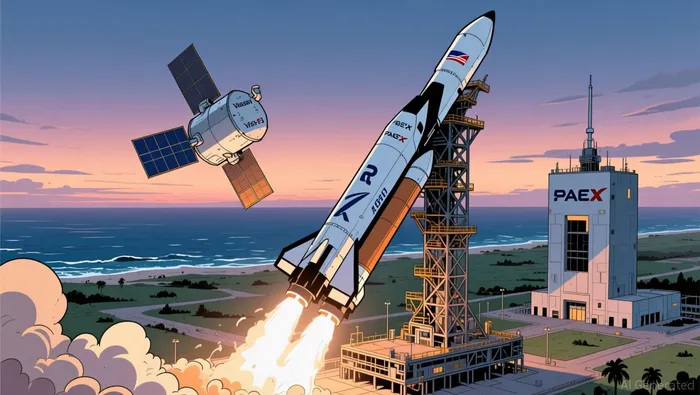
The mission profile for the Viasat-3 F3 satellite highlights the rocket's unique reusability strategy. The two side boosters are designed to detach and execute synchronized landings at Landing Zones 2 and 40 at Cape Canaveral Space Force Station. This recovery process allows SpaceX to reuse these boosters for future missions, reducing the cost per launch. In contrast, the center core is expended into the Atlantic Ocean due to the high-energy trajectory required to deploy the satellite into geostationary orbit. This operational model underscores SpaceX's ability to balance cost efficiency with the demanding requirements of commercial and government payloads.
Viasat-3 F3 Mission: Broadband Expansion and Market Impact
The Viasat-3 F3 satellite is a critical asset for Viasat's global connectivity strategy. Designed to provide high-speed broadband to underserved regions, the satellite will target the Asia-Pacific market, complementing the existing Viasat-3 constellation. For investors in the telecommunications and satellite sectors, the successful deployment of this payload is a key indicator of Viasat's ability to expand its infrastructure and capture market share in the growing global broadband landscape. The satellite's launch is not just a technical milestone but a strategic move to address the increasing demand for high-capacity network solutions.
The mission also provides context for SpaceX's broader operational strategy. While the Falcon Heavy remains a workhorse for near-term heavy-lift responsibilities, the company is actively transitioning its infrastructure toward Starship and Super Heavy. SpaceX is building operational launch towers at KSC’s Launch Complex 39-A and consolidating Atlantic-based droneship operations to support Starship logistics. This transition signals a long-term shift where Starship, with its projected 17 million pounds of thrust, will assume heavy-lift duties. However, the Falcon Heavy continues to support critical missions, including NASA’s Nancy Grace Roman Telescope and classified Space Force payloads, demonstrating SpaceX's ability to manage a dual-track development strategy.
SpaceX Launch Cadence: Context Within the Commercial Space Economy
The Viasat-3 F3 launch occurs against a backdrop of record-breaking activity on Florida's Space Coast. As of late April 2026, the region has logged 29 launches, following a high of 109 orbital launches in 2025. This surge in activity reflects the intensifying competition and demand for commercial orbital access. Alongside SpaceX's missions, United Launch Alliance is scheduled to launch an Atlas V rocket carrying 29 Amazon Leo broadband satellites on the evening of April 27, highlighting the diverse ecosystem of launch providers in the region.
The high cadence of launches underscores the maturation of the commercial space industry. SpaceX's ability to maintain operational readiness for heavy payloads, despite long gaps between flights, demonstrates the reliability of its fleet. For investors, this operational stability is a key differentiator in the space sector. The successful execution of the Viasat-3 F3 mission will not only validate SpaceX's technical capabilities but also reinforce its market position as the preferred launch provider for high-value commercial satellites. As the industry continues to scale, the Falcon Heavy's role in enabling these critical deployments remains vital to the broader space economy.