

The headlines are about control. NYC Comptroller Mark Levine - joined by New York State Comptroller Thomas DiNapoli and CalPERS CEO Marcie Frost - says SpaceX's proposed governance structure gives Elon Musk "unprecedented control, limiting shareholder rights", "no precedent for this". The dual-class setup means Class B shares carry 10 votes per Class A share, and Musk controls roughly 85% of the voting power after the IPO. You can't vote him out. You can't force board independence. The charter restricts what shareholders can do.
The pain is real. But it's not the problem you should be losing sleep over.
SpaceX prices its IPO at $135 per share today, offering 555.6 million shares to raise roughly $75 billion - targeting a post-IPO valuation approaching $2 trillion. The deal is massively oversubscribed, with $10 billion orders piling in. Investors are desperate for the allocation. That's the real tension: governance concerns get swept aside because the tape is too hot to resist.
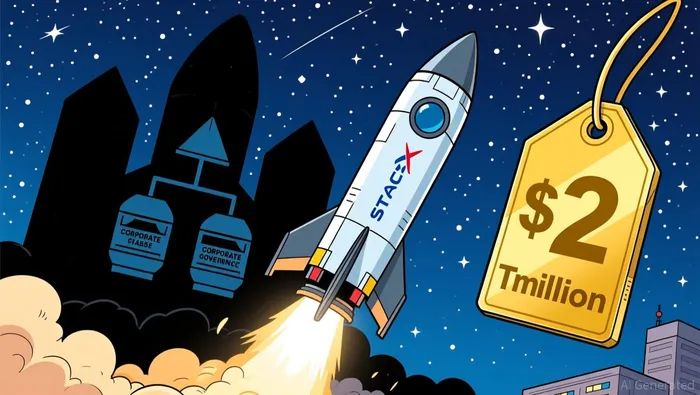
This is where the old story versus the numbers matters. The market is still pricing the Musk brand and the rocket launches and the Starlink vision. But the financial bridge tells a narrower story. SpaceX generated $18.67 billion in revenue in 2025, up sharply from $14 billion the year before. The adjusted EBITDA - earnings before interest, taxes, depreciation, and amortization, a rough proxy for operating cash generation - sits around $6.6 billion. Yet the company posted a net loss of $4.94 billion.
At a $2 trillion valuation on $18.7 billion of revenue, you're paying roughly 107 times sales. For context, that's a multiple usually reserved for companies printing enormous free cash flow with predictable growth - not a business that lost $5 billion last year on nearly $19 billion of top line. The revenue growth is real. The loss is also real. And the market is ignoring the gap between them because the IPO frenzy is too loud.
The governance structure doesn't make the valuation worse. The valuation makes the governance structure matter more. When you pay a rational multiple for a business, limited voting rights are an annoyance - you trust the economics to carry you. When you pay 107x revenue, you need the operator to execute flawlessly for years with no accountability mechanism. That concentration of risk is what Levine is actually pointing at, even if "no precedent" is theater.
Starlink is the one thing that could bridge the gap. The satellite internet division is the growth engine - subscriber revenue, recurring cash, a path to real free cash flow at scale. If Starlink keeps accelerating and SpaceX's launch cadence drives margin expansion across the business, the $6.6 billion adjusted EBITDA base could compound meaningfully. That's the proof path. The operating question isn't whether Musk can make bold decisions - it's whether those decisions generate cash at a rate that justifies this entry price over the next 12 months.
The problem is, no one knows the free cash flow number. SpaceX isn't public. The prospectus gives adjusted EBITDA, not free cash flow. And for a capital-intensive business building rockets and launching satellites, the gap between EBITDA and actual cash in the bank can be enormous. Depreciation is real. Capital expenditures are real. You can show $6.6 billion of adjusted EBITDA and still be a cash consumer.
That's the data gap. And at this valuation, the data gap is a risk multiplier, not a detail.
I can be wrong again. The setup could work if Starlink revenue keeps compounding, launch costs fall, and the business crosses into sustained cash generation over the next two years. The growth trajectory is legitimate. But right now, the IPO is pricing five years of flawless execution at a multiple that leaves no room for error - and the governance structure means no one can step in if it goes off the rails.
This isn't about governance purism. It's about what happens when you pay an extreme multiple for a business that hasn't proven it generates free cash flow at scale, locked under a control structure that removes the normal circuit breakers. The math has to work perfectly. When the entry price demands perfection, the governance risk stops being a structural annoyance and becomes a thesis risk.
The tripwire isn't a stock price - it's the cash flow disclosure. When SpaceX starts filing periodic reports, the first question should be whether free cash flow tracks the adjusted EBITDA narrative or whether the capital intensity is consuming the earnings. If the actual cash generation is materially below the adjusted EBITDA story, the thesis breaks. If Starlink's subscriber growth slows or pricing pressure hits, the same thing happens.
Just sit on your hands at this entry. The IPO frenzy is real, but frenzy is the worst time to examine what you're actually buying. Wait for the first post-IPO filing. See what the real cash flow looks like. Then decide whether the business justifies the price - before the governance debate even matters.