

SpaceX is pricing its IPO at $135 per share for 555.6 million shares, valuing the company at $1.77 trillion. Only six companies in the S&P 500 are worth more. The number is designed to wow. The S-1 filing behind it tells a different story: a company that swung from $791 million in net income in 2024 to a $4.94 billion net loss in 2025, with negative free cash flow of $9.1 billion.
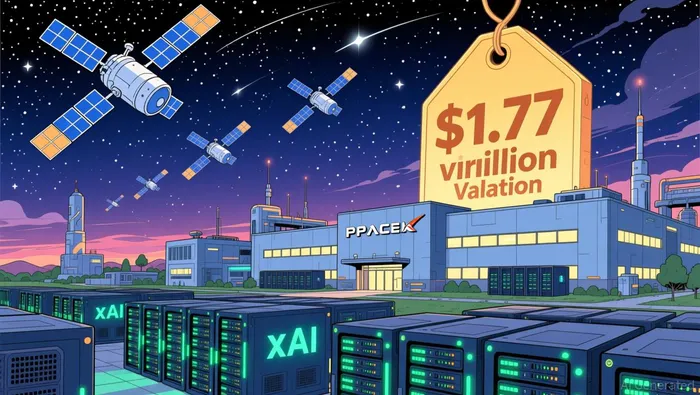
That is not a detail the IPO prospectus hides. It is the core contradiction an investor has to decide whether to buy.
The only profit center is Starlink - and it cannot carry the whole valuation
Starlink is the one segment that works. Revenue hit $11.4 billion in 2025, up 48% from $7.7 billion in 2024, and accounted for 61% of consolidated sales. More importantly, the Connectivity segment generated $4.4 billion in operating income - real cash earnings from satellite internet subscriptions and government contracts.
But Starlink's $4.4 billion in operating income cannot justify a $1.77 trillion enterprise value. The Space segment - launches, contracts, satellite delivery - brought in $4.09 billion with a $657 million operating loss, though it did produce $653 million in adjusted EBITDA (earnings before interest, taxes, depreciation, and amortization, a proxy for cash earnings before heavy reinvestment costs).
So the company's two core businesses generated roughly $5 billion in operating profit on $18.67 billion in total revenue. That is a 27% operating margin on the profitable segments, which is impressive. But then comes the third engine.
xAI is a $6.4 billion black hole
Consolidated into the SpaceX financials is xAI, the artificial intelligence subsidiary. In 2024, xAI lost $1.56 billion on $2.62 billion in revenue. In 2025, losses ballooned to $6.4 billion on only $3.2 billion in revenue. That is a $3.2 billion year-over-year increase in the cash drain.
xAI's losses alone explain why consolidated net income swung from positive to a $4.94 billion deficit. The company is spending $12.7 billion in capital expenditures - building data centers, leasing $20 billion in equipment - to fund an AI business that is nowhere near profitability and is not even close to being its own best customer.
This is the unfunded narrative the investor has to price. The $1.77 trillion valuation assumes xAI becomes a dominant AI player, Starlink keeps accelerating, and Starship (the next-generation rocket) delivers returns that justify the spending. That is a triple-bet, not a single thesis.
Free cash flow is negative $9.1 billion
Operating cash flow was $1 billion - positive, but barely. After $12.7 billion in capex, free cash flow - the cash left over after reinvestment that a company can use to grow, pay dividends, or buy back stock - was negative $9.1 billion. At the $1.77 trillion price, the company would need decades of sustained positive FCF just to approach a single-digit percent free cash flow yield, which is what public market investors typically demand from a company of this size.
Compare that to the valuation multiple: 95 times trailing revenue. That is what you get when you divide $1.77 trillion by $18.67 billion in sales. Even high-growth software companies at their most expensive rarely sustain 30x revenue. The market is not buying current earnings. It is buying a future that requires xAI to turn profitable, Starship to succeed, and government contracts to hold - all without a single quarter of public-market accountability.
Government dependency and governance risk
One-fifth of SpaceX's revenue comes from U.S. government work. The Department of Defense alone has awarded contracts worth billions, including a $5.9 billion deal to launch military satellites. That is a durable tailwind as long as Washington's space spending stays elevated. But it also means a political risk: the company's biggest customer is the same government that can change procurement rules, redirect budgets, or - in the case of a Musk-led company with cross-political exposure - face regulatory scrutiny.
The governance structure makes this harder for public investors to manage. SpaceX is issuing Class A shares with one vote each, but Musk retains super-voting Class B shares with ten votes apiece. He will control shareholder decisions even after going public. That is not unusual for founder-led IPOs, but combined with Musk's roles at Tesla, X, and xAI, it creates a concentration of control that a public shareholder cannot dilute.
The investment case, compressed
SpaceX is a remarkable company. No one disputes that. The launches are happening, the rocket cadence is extraordinary, and Starlink is a real growth engine with $4.4 billion in operating income. The government contracts are genuine demand.
The question is not whether SpaceX will succeed. The question is whether $1.77 trillion prices in too much success too fast. A company that lost $4.9 billion last year, with $9.1 billion in negative free cash flow, an AI division burning $6.4 billion annually, and a valuation 95 times its revenue - that is a stock that leaves zero room for execution miss. The xAI losses need to narrow materially. Starlink needs to keep accelerating past 40% growth. And Starship needs to deliver revenue, not just press conferences.
At $135, the IPO is pricing perfection. If any of those three assumptions falters, the multiple will compress faster than the business adjusts. That is not a reason to short the dream. It is a reason to wait until the first few quarters of public reporting show the operating trajectory can sustain the price.
Rating: Hold - wait for the public earnings to prove the thesis before committing capital at this valuation. The business is real, but the $1.77 trillion tag assumes flawless execution across three different companies. The S-1 already shows one of them - xAI - is a $6.4 billion drag. Let the public market test whether the other two can carry the whole weight.