

Here is the thing that matters about the SpaceX IPO aftermath. SpaceX shares opened at $150 on Friday and closed at $160.95 - up 19% from the $135 offer price. That is a decent day for the largest IPO in history. Nobody is complaining about the underlying event.
The people complaining are the ones who didn't actually buy SpaceX shares. They bought ETFs instead.
DXYZ, an ETF that bundles SpaceX, OpenAI, and Anthropic exposure, is down roughly 41% over the past 20 days and closed today at $28. VCX, which provides broad access to private AI companies, dropped 15.4% today to $110 and is down roughly 44% over the same stretch. The NASA ETF - which targets the space economy - is holding better at $32.48, up slightly today but still down 5.9% over 20 days after a monster run-up.
The odd thing is not that these ETFs are falling. The odd thing is that they were never really holding what people thought they were buying. They were holding a wrapper around an event. And the event happened.
The basic plumbing is worth drawing out. DXYZ holds SpaceX exposure through what is called an SPV - a special purpose vehicle, which is a legal shell that lets an ETF own an asset it can't directly hold because the asset isn't yet publicly traded. DXYZ had roughly 16.2% of its portfolio in SpaceX via this structure. Another fund, XOVR, had 19.13% the same way.
What investors were buying when they poured money into these ETFs was not really a diversified bet on space technology or AI. They were buying a proxy for SpaceX IPO participation. The SPV was the plumbing that made the proxy look like a position.
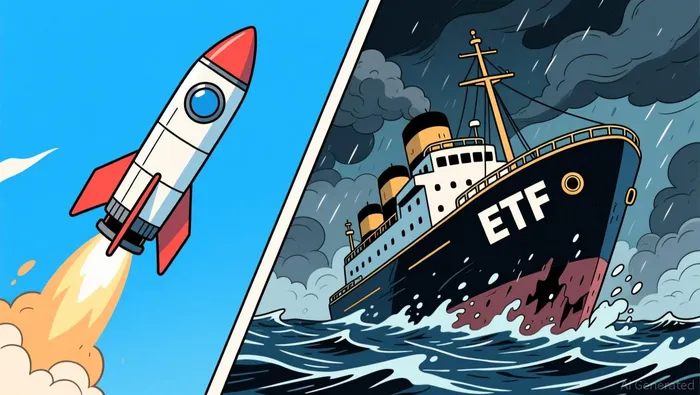
This is not an unusual structure in private markets. What is unusual - and what makes this story worth telling - is the scale at which retail investors coordinated around it. The NASA ETF alone pulled in $2.6 billion in inflows over two months of IPO speculation. These were not long-term believers in the space economy. These were people who wanted to be close to the SpaceX IPO and couldn't get into the allocation queue, so they bought a basket that happened to overlap.
The allocation queue was the other half of this. SpaceX originally said roughly 30% of the offering would go to retail investors - three times the typical allocation for a mega-cap IPO, and a genuinely unusual promise. Then, right before the close, that number was trimmed to the low 20% range. The retail tranche was also spread across more buyers, meaning each individual allocation was tiny.
SpaceX has a well-understood incentive here. By spreading smaller allocations across more holders, you create broader participation, more psychological attachment, and less immediate selling pressure from any single seller. It also means that even if you got into the IPO, your profit on a 19% first-day pop might not be enough to buy you anything interesting. A handful of shares at $135, sold at $161, is a nice lunch, not a portfolio event.
So the people who didn't get an allocation turned to the ETFs. And the ETF managers were more than happy to sell them the wrapper.
Now the event has resolved. The IPO is done. SpaceX stock is trading publicly. And the wrapper is deflating.
Here is the mechanism of the unwind. When investors redeem shares of DXYZ or VCX, the fund has to sell whatever it holds to raise cash. It can't sell the private portion - SPV-held SpaceX shares can't be liquidated on a redemption schedule. So it sells the liquid pieces: the public stocks. To pay those investors out, the fund had to sell its liquid public stocks - you can't exactly flip SpaceX shares on the open market overnight. That means the remaining holders take the hit.
It's a slow-motion version of the classic private-fund liquidity mismatch: illiquid assets funded by investors who want to leave on short notice. Except here, the "illiquid assets" are partly synthetic - they're SPV exposure that looked like real shares until the moment it didn't.
There's a second mechanic at work, too. A good number of actual SpaceX IPO buyers - both institutional and the lucky retail ones - are now sitting on paper profits. Some of them are selling. That selling pressure on the underlying stock flows through the ETFs that hold SpaceX exposure. The ETFs lose value from the stock move, which triggers more redemptions, which forces more sales of the liquid holdings, which pushes the NAV further down. It doesn't need to be dramatic to be self-reinforcing.
The funniest part of all this is the label. DXYZ is the "Destiny Tech100 ETF." VCX is the "Global X Video Games & Esports ETF" - except it isn't, or at least it hasn't been for a while; it pivoted toward private AI company access and that pivot attracted the SpaceX crowd. These funds are not primarily themed on space or rockets or anything the name would suggest. They are access products. They sold liquidity to people who wanted something that didn't have a public market.
That is a perfectly fine business model. The problem is when the underlying event resolves and the access product stops being a proxy and starts being what it always actually was: a basket of stocks with one of them in a legal wrapper. The event premium - the extra value people paid for being close to the IPO - evaporates because the IPO happened.
A simple way to think about it: the ETF was a put on your own patience. You bought it because you were impatient for SpaceX exposure and didn't want to wait for an allocation or for a direct listing. The fund sold you that impatience at a premium. The premium is gone.
The NASA ETF is holding up better today, up roughly 1.7%, partly because it has broader exposure that isn't as concentrated on the SpaceX event. But it too rode a $2.6 billion speculative inflow that was mostly about timing the IPO. That money doesn't just sit there because the filing went through.
This is not a new structure. It's old fund-market behavior in a new costume. Private credit funds used to do something similar: promise access to private loans, fund it with quarterly redemption windows, and hope the borrowers didn't all ask for their money at the same time. The SpaceX ETFs did the same thing but with a more glamorous underlying asset and a much clearer expiration date.
The structural implication is straightforward. The people who actually got SpaceX IPO allocations - even tiny ones - now hold real shares of a real publicly traded company. The people who bought the wrapper hold a basket of public stocks that has been forced to absorb redemptions and mark down its event premium. One group is deciding whether to sell a gain. The other is trying to figure out whether the fund they bought still makes sense now that the event is over.
The wrapper wasn't fraudulent. It was just a wrapper. And wrappers have a way of looking like what's inside until you open them.