

SpaceX is going public this week at a $1.77 trillion valuation - potentially the largest IPO in history. CNBC and the Financial Times are running the story about Tesla investors cashing out early to catch a day-one pop in the next Musk trade. I don't even care. That rotation narrative is the kind of surface-level headline that sounds urgent but misses what is actually changing in Tesla's architecture.
The real signal is three months old and has barely moved the market: Tesla shut down Dojo in August 2025. Dojo was Tesla's custom-built AI training supercomputer - the project Musk said would be key to full self-driving. Instead of scaling it, Tesla killed it. Then it signed a $16.5 billion deal with Samsung to manufacture its AI6 chips, chips Musk explicitly described as optimized for inference, not training.
This is not a car company diversifying. This is a company making a hard architectural choice about which side of the AI compute transition it believes it can win. And the choice tells you everything about Tesla's competitive position in the next generation of autonomous driving.
The training-inference split, in Tesla's own hands
The AI compute cycle is splitting into two radically different hardware problems. Training - where you teach a neural network on massive datasets - demands raw brute-force throughput, interconnected GPU clusters, and software ecosystems like CUDA that lock developers in. That is Nvidia's territory. It has been Nvidia's territory for a decade. The moat here is not just silicon; it is the entire software stack that makes training at scale actually work.
Inference - where the trained model runs in real time, on a car, making split-second driving decisions - demands something different: lower latency, power efficiency, cost per unit, and the ability to run on edge hardware with a 200-watt power budget. In this arena, CUDA's moat weakens. What matters is whether your chip can run the model efficiently and reliably. Custom silicon designed for a specific workload can outcompete general-purpose GPUs.
Tesla just showed you which side it's betting on. By killing Dojo and pivoting to Samsung-manufactured inference chips, Tesla is conceding the training layer and going all-in on inference. Musk told Reuters in August that the AI5 and AI6 chips "will be excellent for inference and at least pretty good for training" - emphasis on at least pretty good. That language is telling. It is not a claim of parity. It is a claim of asymmetry: we will dominate where it matters most.
The supply chain signal
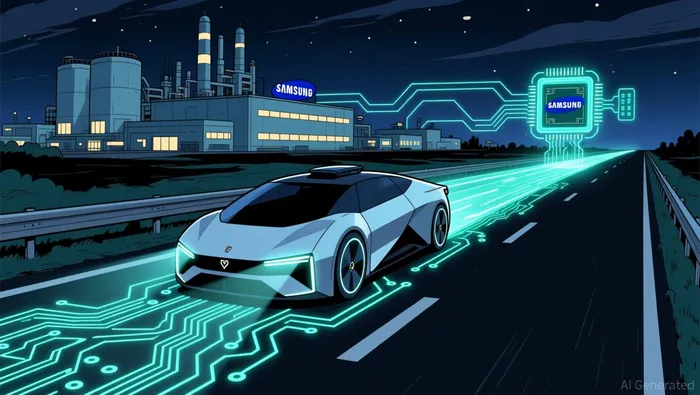
The Samsung deal is the supply chain commitment that validates the architecture shift. $16.5 billion in manufacturing commitments for custom AI inference chips. This is not a prototype; this is a production plan. Tesla is locking in foundry capacity for a chip designed to run inside vehicles, making driving decisions, not training models in a data center.
Put plainly: Tesla is becoming a Samsung foundry customer for its most critical AI workload. That is a supply chain signal that tells you two things. First, the scale of Tesla's inference hardware deployment is massive - $16.5 billion in commitments does not happen for a side project. Second, Tesla is accepting that it will not build its own training supercomputers at scale. It has outsourced that architectural generation to whatever training cluster it rents or buys, while it bets its own silicon talent on the inference chip that lives in the car.
This creates a different kind of leverage risk. Supply commitments of this scale are a demand signal - but they also mean Tesla is locked into a multi-year cycle with Samsung on process node, yield, and capacity. If Samsung struggles with the node or if Tesla's software stack for the AI6 chip does not mature on schedule, that $16.5 billion becomes stranded capital. I would not overstate the risk - Samsung is a top-tier foundry - but supply commitments of this magnitude always carry execution risk, and it is worth monitoring.
What this means for the Nvidia comparison
Here is where the market's mental model needs to update. Tesla was running a 10,000-GPU Nvidia H100 cluster for FSD training in 2023. That training workload is real, and it is expensive. By killing Dojo, Tesla is likely shifting more of that training spend back toward rented or purchased training capacity - which probably still includes Nvidia hardware. Nvidia CEO Jensen Huang has publicly said Tesla is "far ahead" in self-driving technology, and the reason is partly the data advantage from millions of vehicles collecting driving video, not just raw compute.
But Musk's own words from August - dismissing Nvidia's autonomous driving push as irrelevant for "five to six years" - tells you something about Tesla's confidence in its inference advantage. If the competitive gap in autonomous driving is determined by inference quality on the edge, and Tesla's AI6 chip is designed specifically for that workload, then Nvidia's training dominance matters less than the market assumes.
The debate is not whether Tesla remains an AI infrastructure play. It is whether Tesla's bet on inference-over-training is the right side of a cycle that is still in motion.
So what for the investment?
This is the question the SpaceX IPO headline obscures. Tesla is no longer a company trying to own every layer of the AI stack. It has chosen its lane: inference silicon for autonomous vehicles, manufactured at scale by Samsung. The training layer - where Nvidia dominates - is being outsourced.
I believe this is a rational architectural choice. Inference is where the volume is for a company that ships millions of vehicles. Every car is an inference node, and the cumulative fleet intelligence advantage compounds over time. The training workload, while expensive, is a cost center - and outsourcing it to whatever is the best available option makes sense if your competitive advantage is the data, not the training hardware.
But there is a risk asymmetry. If FSD regulatory approval or customer adoption does not materialize on Tesla's timeline, the inference chip becomes a very expensive solution to a problem that isn't generating revenue yet. The $16.5 billion Samsung commitment is a bet that autonomous driving monetization arrives before that capital becomes stranded. I believe the trajectory is right - Tesla's data advantage from its fleet is real, and inference is the correct architectural battleground. But the timing risk is what separates a conviction position from a patient sideline.
The SpaceX IPO noise is real - capital is rotating between Musk assets, and that creates short-term pressure on Tesla's stock. But the structural story is in the architecture. Tesla has chosen inference. It has committed billions to that choice through Samsung. And the question for anyone holding Tesla right now is not whether a Musk IPO rotation will reverse. It is whether Tesla's architectural bet on inference-over-training pays off before the next cycle shift makes the question irrelevant.
I would not trim Tesla on a SpaceX IPO headline. But I would watch the AI6 chip timeline, the FSD regulatory milestones, and whether Samsung delivers on yield and capacity. Those are the signals that actually move the thesis. The rest is just noise around the same portfolio of Musk companies.