

The IPO is the headline. The semiconductor constraint is the story.
Stock index futures edged higher this week as SpaceX prepared to begin trading on the Nasdaq under the ticker SPCX, set to raise $74.4 billion - making it the largest IPO in history. The market is focused on valuation, ownership dilution, and the optics of the public debut. But buried inside SpaceX's IPO prospectus is a supply-side revelation that changes how investors should view every company selling chips to satellites, rockets, and orbital AI.
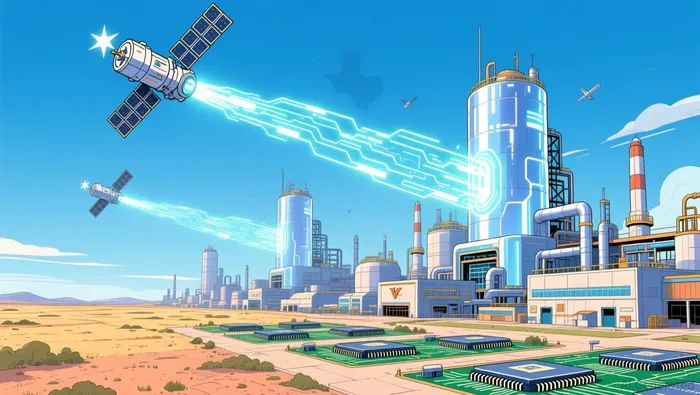
SpaceX admits it cannot find enough semiconductors for its ambitions. Its response is Terafab, a pair of semiconductor factories in Texas Musk announced in March 2026, projected to cost up to $119 billion. The prospectus goes further: it warns that Terafab itself "may not be successful." This is not a company that has won the supply problem. It is a company that has declared war on it.
The customer and the cannibal
The aerospace semiconductor market was valued at approximately $9.1 billion in 2025 and is projected to grow at a CAGR of 8.4% through 2035. That is a modest number compared with AI data center or automotive chips. But within it sits a single customer - SpaceX - that has become the dominant growth engine.
STMicroelectronics, which supplies custom RF antenna chips for Starlink satellites, has shipped 7.5 billion chips to SpaceX since 2021. The company's LEO (low-Earth orbit) revenue grew from approximately $175 million in 2021 to roughly $600 million in 2025. STMicro now targets more than $3 billion in cumulative space semiconductor revenue between 2026 and 2028. The company has also raised its 2026 data center revenue target to roughly $1 billion, up from "nicely above $500 million," as its chips find use in AI infrastructure beyond the space sector.
This is the demand-side thesis. SpaceX is a growing customer, and STMicro is the primary beneficiary. The IPO should validate the trajectory. The implication is that aerospace semiconductor suppliers get a rerating as the market prices in Starlink-driven volume growth.
Then there is Terafab
That thesis is incomplete. SpaceX is simultaneously the largest customer and the largest structural threat to the suppliers that serve it.
SpaceX has been developing beamforming ICs (integrated circuits that control the direction of satellite signals) internally. Germany-based Azur Space and other smaller suppliers contribute to the supply chain. But the trajectory points inward. The company is managing its own packaging site, aiming to vertically integrate satellite system production. The Terafab project in Grimes County, Texas, received full county commissioner approval on June 3, 2026, for a facility that aims to begin production by the end of the year.
The scale is important to understand. A $119 billion capex commitment to semiconductor manufacturing would place Terafab in the same order of magnitude as the largest national semiconductor strategies. This is not a captive production line for legacy chips. SpaceX is attempting to manufacture advanced chips for autonomous satellite operations, inter-satellite link management, and the AI workloads that will run on orbit.
The implication is straightforward. If Terafab succeeds, every supplier currently selling to SpaceX faces a structural displacement risk. The 7.5 billion chips STMicro has already shipped represent a floor of demand that could stop growing - or decline - as SpaceX internalizes what it currently buys.
Two markets, one constraint
The aerospace semiconductor supply chain is bifurcating into two distinct sub-markets, and the split determines who captures value and who gets squeezed.
On one side: radiation-hardened and legacy aerospace chips. The radiation-hardened electronics semiconductor market is projected to grow from $1.74 billion in 2026 to $2.50 billion by 2034. The broader defense semiconductor market was valued at $13.44 billion in 2025 and is projected to reach $38.05 billion by 2035. These are specialty nodes with long certification cycles, small volumes, and high barriers to entry. Companies like Teledyne, Microchip Technology, and smaller specialists operate here. Terafab does not compete with them. The constraint in this segment is technology access and certification, not volume.
On the other side: high-volume commercial satellite chips. This is where Starlink operates. RF antenna chips, beamforming ICs, and the mass-produced electronics that go into thousands of small satellites. The beamforming IC market alone was valued at $12.8 billion in 2025 and is projected to reach $38.6 billion by 2034. This is the segment where SpaceX's in-house development and Terafab create real displacement risk. STMicro is the incumbent, but the constraint here is capacity, not certification.
The key distinction is that the second market is the one growing fastest, and it is the one where the customer is also building its own foundry. That has not happened at this scale before.
What the prospectus won't tell you directly
The IPO prospectus risk factors are telling but incomplete. SpaceX acknowledges it cannot find enough chips for orbital AI and that Terafab may not succeed. But the document does not quantify how many chips it needs versus how many it can source, how much of its current supply would be displaced if Terafab comes online, or what the fallback is if the project fails.
This is a distinction-without-a-difference in reverse. The market treats the prospectus as a signal of growth and execution, but the risk factors reveal a company that is caught between demand it cannot fulfill and a manufacturing solution it cannot guarantee. Either outcome creates turbulence for the supplier chain.
If Terafab succeeds on timeline, STMicro and other commercial satellite chip suppliers face a ceiling on their SpaceX-related revenue growth. If Terafab fails, SpaceX will need to buy even more chips than it does today, and the supply bottleneck could constrain Starlink's expansion - which in turn limits the very revenue growth the IPO is pricing in.
Investor Takeaway
The IPO is not the catalyst for aerospace semiconductor suppliers. The catalyst will be Terafab's progress or failure. For investors holding positions in companies like STMicroelectronics, the question is not whether Starlink demand is growing. It is how long that demand will remain outsourced.
STMicro's track record is impressive: 7.5 billion chips delivered, revenue growing from $175 million to $600 million in four years, a $3 billion target through 2028. But that trajectory assumes the supply relationship remains intact. The more important question is whether SpaceX's vertical integration plan creates a hard ceiling on supplier growth that the current stock price does not reflect.
Watch three signals: Terafab construction milestones and any delays, SpaceX's internal chip design announcements (which would signal displacement before production begins), and STMicro's quarterly space revenue updates. If space revenue growth slows while STMicro maintains its guidance, the market is pricing in demand that the customer may no longer need to buy.