

Summary
- The dominant narrative around TSLA right now is that buying Tesla is like buying a piece of SpaceX. It isn't. Tesla's SpaceX stake is mathematically negligible.
- SpaceX filed for an IPO targeting a raise of about $75 billion at a valuation of roughly $1.75 trillion. It posted a loss of nearly $5 billion in 2025 and carries an "accumulated deficit" of $41.3 billion. That is not Amazon in 2000. That is worse.
- Tesla generated $6.22 billion in free cash flow for 2025. Against a $1.3 trillion+ market cap, that means the stock prices in perpetual, flawless growth with zero margin for error.
- The "bubble" comparison misses the real issue. Tesla doesn't need a SpaceX rescue. Tesla's own numbers cannot support its own price.
- I rate TSLA as a Sell. The stock is riding a false narrative with no structural cash flow to anchor it.
I always keep an eye out for irrational false narratives that frequently take the stock market by storm and lead to some terrific duds. Right now, the one wrapped around Tesla (TSLA) is not even original. It's the same playbook: find the most exciting company the same founder controls, convince retail investors that owning the public company gives you exposure to the private one, and hope the resulting bid hides the gap between price and cash flow.
The narrative went like this: SpaceX filed its S-1 registration statement on April 1, targeting a June IPO. Tesla's own filing revealed it owns nearly 19 million shares of SpaceX Class A common stock as of May 1. Retail traders took this and ran with it - "Buying TSLA is like buying a piece of SpaceX" became the new mantra. TSLA shares rallied on the thesis. Then a former Lehman trader named Larry McDonald issued a warning comparing the SpaceX IPO hype to Amazon's dot-com bubble peak in 2000, and TSLA slipped overnight as the market second-guessed the whole framework.
Here's what no one is saying clearly: the Tesla-SpaceX ownership link is a rounding error. At SpaceX's targeted $1.75 trillion valuation, Tesla's 19 million shares represent roughly 0.1% to 0.2% of the company. That translates to maybe $2 to $4 billion in value on paper. Spread across Tesla's roughly 3.2 billion outstanding shares, that's approximately $0.63 to $1.25 per TSLA share. Tesla trades around $400 to $440 per share.
The SpaceX story adds less than 0.3% to TSLA's per-share value. That is not a thesis. That is noise.
The real false narrative is Tesla's own valuation.
Let's look at the numbers that actually matter. Tesla reported $6.22 billion in free cash flow - operating cash flow minus capital expenditures, the cash actually available for dividends, buybacks, or reinvestment - for all of 2025. That's up from $3.58 billion in 2024, which is a genuine improvement. The Q1 2026 update showed $1.4 billion in FCF for the quarter, beating analyst expectations of negative FCF.
But now look at what the market is paying for that cash flow. At a $1.3 trillion to $1.6 trillion market cap, Tesla trades at roughly 208x to 257x trailing free cash flow. For comparison, most industrial and consumer stocks trade between 15x and 30x FCF. A 200x-plus FCF multiple means the market is pricing in a future where Tesla's cash flow grows by an order of magnitude within a few years and stays there. That is not an investment thesis. That is a wish.
Now let's talk about SpaceX itself, because the Amazon-2000 comparison is wrong in both directions.
Larry McDonald is right that SpaceX's valuation is stretched. He's wrong about the Amazon parallel. Amazon at its 2000 peak had accumulated losses of roughly $1.4 billion. SpaceX entered its IPO with an accumulated deficit of $41.3 billion - roughly 30 times worse. Amazon's losses were concentrated and temporary. SpaceX has been running structural losses at scale, posting a $5 billion net loss in 2025 on $18.5 billion in revenue, and the growth is decelerating: 33% year-over-year from 2024 to 2025, then 15% in Q1 2026.
McDonald's warning is right about the bubble but points in the wrong direction. The risk isn't that SpaceX will crash and drag Tesla down through that tiny 19 million share stake. The risk is that Tesla's stock has been built on narrative after narrative - autonomous driving, robotaxis, AI, Optimus the robot, and now SpaceX - while the underlying car company generates $6 billion in annual free cash flow that barely justifies a $150 billion market cap.
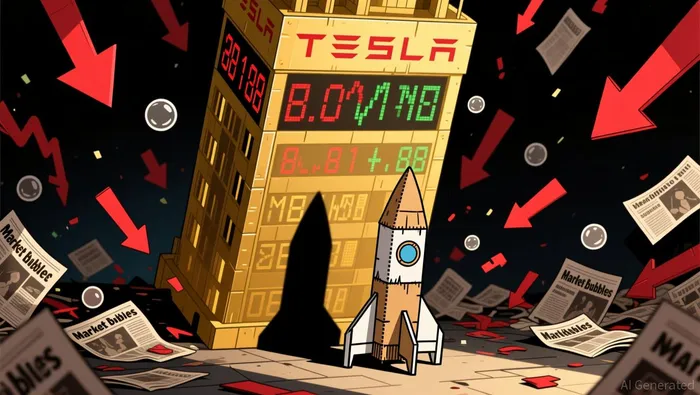
The rest is imagination. And imagination is not free cash flow.
That being the case, my assessment is clear.
Tesla is a well-run company generating growing free cash flow with improving margins. The Q1 2026 surprise on FCF proves the operational execution is solid. But solid execution does not justify a 200x FCF multiple. At current prices, TSLA needs its cash flow to grow by 10x and sustain that level for years, or it needs investors to accept a valuation framework that has no peer in history.
The SpaceX IPO narrative is the latest iteration of a pattern I've watched repeatedly: find a new hook, stack it on top of the old ones, and ignore the denominator. Tesla's denominator is its own cash flow, and it cannot support this price.
I rate TSLA as a Sell. The stock is trading on a false narrative that conflates Elon Musk's portfolio with Tesla's balance sheet. Tesla's own free cash flow and market cap do the math for you - and they don't add up. In my opinion, this is an irrational overreaction in the wrong direction: not toward the IPO, but toward the valuation gap that has been widening for years.
For investors holding TSLA on the SpaceX thesis, I would trim. For investors considering entry, the $400-plus price tag buys you a compelling car manufacturer and a very expensive hope. In my framework, I prefer companies where the cash flow can justify the price, not the other way around.