

Key takeaways
- The IPO is structured as a primary capital raise, so new investors are funding SpaceX's next expansion phase rather than buying stock from selling insiders.
- Connectivity, led by Starlink, is the clear profit engine, with 2025 operating income far ahead of the losses reported in Space and AI.
- The valuation case depends on execution after listing: AI losses must narrow, Starship spending must improve launch economics, and Starlink must keep expanding margins.
SpaceX began its IPO roadshow on June 4 with 555,555,555 Class A shares expected at $135 each, a base deal of roughly $75 billion before any overallotment option. Reuters has reported a June 11 pricing and June 12 Nasdaq debut. The central question for investors is no longer whether SpaceX has scale. It is whether Starlink's cash flow can justify a valuation above $1.75 trillion while SpaceX continues to spend heavily on launch systems, satellite capacity and AI infrastructure.
The roadshow is therefore selling two stories at once. The first is a rare chance to own a dominant launch and satellite-connectivity franchise. The second is a capital-intensive reinvestment plan in which the most profitable unit is being asked to help finance businesses that are still in ramp-up mode. That tension should shape how investors read the prospectus.
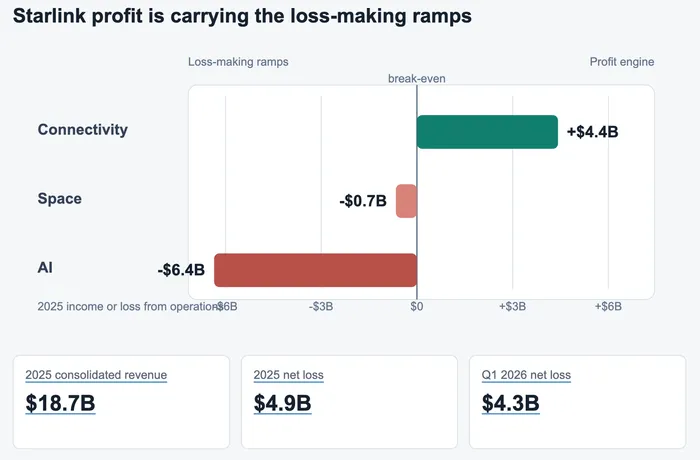
Source. SEC preliminary prospectus. Symbol SPCX. Date range fiscal 2025 and Q1 2026. Interval fiscal year and fiscal quarter. Basis reported segment income or loss from operations and reported net loss values in billions of dollars.
A record-sized deal with limited price discovery
At the expected $135 offering price, 555,555,555 shares imply about $75 billion in gross proceeds before the banks exercise any additional-allotment rights. SpaceX's announcement says underwriters have a 30-day option to buy up to 83,333,333 more shares and that the company has applied to list on the Nasdaq Global Select Market and Nasdaq Texas under the SPCX ticker.
The structure leaves little time for public-market digestion before the first trade. Reuters has reported that as much as 30% of the offering is reserved for retail allocation, a choice that could broaden demand but does not change the underlying valuation test. Because the deal is all primary, the proceeds are about funding the next stage of the company, not providing an exit for existing shareholders.
Starlink is the bridge from promise to profit
The preliminary prospectus reports $18.674 billion of consolidated revenue and $6.584 billion of adjusted EBITDA for 2025. Connectivity, primarily Starlink, supplied the strongest operating proof point: $11.387 billion of revenue, $4.423 billion of income from operations and $7.168 billion of segment adjusted EBITDA.
That makes Starlink the core of the public-market argument. Unlike launch milestones or long-dated space infrastructure plans, connectivity revenue is tied to subscribers, enterprise customers and network capacity that can be measured quarter by quarter. A valuation above $1.75 trillion still requires investors to assume that Starlink can keep scaling without losing the margins that make it valuable in the first place.
AI and Starship explain why SpaceX wants new capital
The same filing also shows why SpaceX cannot be valued as a pure Starlink business. The AI segment generated $3.201 billion of 2025 revenue but a $6.355 billion operating loss. The Space segment generated $4.086 billion of revenue and a $657 million operating loss while continuing to fund Starship development. Capital expenditures reached $12.727 billion in 2025.
SEC free-writing prospectus materials say proceeds are intended for AI compute infrastructure, launch infrastructure and launch vehicles, satellite-constellation capacity and general corporate purposes. Those priorities fit SpaceX's long-term strategy, but they also make the IPO a funding event for several expensive growth bets at once.
Founder control is part of the trade-off
Governance is another valuation input. The prospectus says Elon Musk will be able to control matters requiring shareholder approval, including board elections, and that SpaceX will be a controlled company after the offering. That structure may be acceptable to investors seeking exposure to Musk's operating record, but it limits the influence new Class A holders will have if capital allocation, AI spending or launch delays become contested.
In other words, buyers are not only underwriting a financial model. They are also accepting a governance model in which public shareholders have less ability to reshape strategy once the stock is trading. That trade-off matters more when the company is still reporting consolidated losses.
The first public quarters will matter more than the first print
Demand for SpaceX exposure is not the hardest question. Scarcity, brand power and retail allocation can all support a strong debut. The more durable test comes after listing, when public filings have to reconcile scale with losses. SpaceX reported a $4.937 billion net loss for 2025, a $4.276 billion net loss for the first quarter of 2026 and a $41.311 billion accumulated deficit as of March 31.
June 12 may show how much investors want access to SpaceX. The quarters after June 12 will show whether the valuation has enough earnings support. The watch items are clear: continued Starlink margin expansion, lower AI operating losses, measurable progress in Starship economics, disciplined capital spending and investor tolerance for controlled-company governance. Until those points become clearer, the IPO is best read as a stress test for Starlink's cash engine, not simply as a celebration of a record listing.