

SpaceX priced its IPO at $135 a share on June 3, valuing the company at $1.77 trillion and raising $74.4 billion - the largest public offering in history. The financial press has a field day. Brokerages published buy-the-IPO guides. Retail accounts are queuing.
If your portfolio's job is to produce income that funds real life, none of that matters. The question isn't whether you can buy SpaceX on day one. The question is whether there's any reason for you to buy it at all.
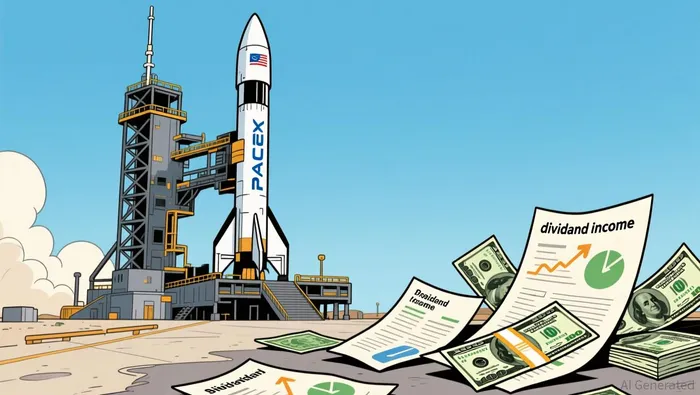
Let's look at what's actually producing the income. In SpaceX's case: nothing. The company pays no dividend. It has no stated plan to start. Its S-1 filing reveals a $4.9 billion net loss in 2025 on $18.7 billion of revenue. That loss follows only a brief flicker of profitability in 2024, when the company earned $791 million - and then immediately swung back into the red. As of March 31, the accumulated deficit sits at $41.3 billion. That's the running total of every dollar spent that wasn't covered by revenue, stretched back over the life of the company.
Revenue growth is real. The $18.7 billion figure is up 33% from 2024. Starlink alone brought in $11.4 billion, up nearly 50%, with 10.3 million subscribers across 164 countries. If you're tracking growth narratives, there's a story here. But revenue growth and cash returned to shareholders are not the same thing, and for the income investor they might as well be different languages.
There's a subtler problem inside the Starlink engine that the growth headline doesn't show. The average revenue per user fell 18% between 2023 and 2025, dropping to roughly $81 per month. Subscriber count is up, but each subscriber is worth less. That can happen when a company aggressively expands into lower-income markets or discounts pricing to fill demand - both valid growth strategies, neither of them a recipe for the kind of cash generation that eventually becomes dividend-paying capacity.
Now layer on the governance structure, because this is where income investors lose not just yield but control. SpaceX uses a dual-class share system: the public buys Class A shares with one vote each, while the founder holds Class B shares with ten votes each. Elon Musk retains 85.1% of the company's cumulative voting power. You are buying a slice of the cash flow - which currently doesn't exist - with almost no say over how the remaining cash flow gets spent. If the company never pays a dividend, you have no voting mechanism to ask it to consider one. Governance experts at Harvard's corporate law program called the structure weak before the shares even started trading.
We get it - the temptation to participate in a once-in-a-generation company is real. The rockets land. The satellites beam internet to places that didn't have any. The story is compelling. But "compelling" doesn't buy groceries. If you're trying to build a portfolio that produces predictable cash flow across many holdings, SpaceX doesn't fill a role. It fills a speculative growth bucket, and at $1.77 trillion it's a bucket that assumes everything goes right for a very long time.
Here's how to think about this in portfolio terms. The $74.4 billion SpaceX is raising from public investors is going into more rockets, more satellites, more infrastructure. None of it is coming back to your account. Compare that with a diversified basket of dividend payers - REITs returning rent, BDCs distributing lending spreads, utilities paying regulated cash flows - where every quarter brings a check, not a promise. You can argue about which approach wins over twenty years. You can't argue that one of them pays you today and the other doesn't.
If you're in the reinvestment phase and have a separate growth allocation that can afford to go years without a cash return, SpaceX may earn a small position there. The growth case is legitimate even if the income case is blank. But don't dress up speculation as portfolio diversification. A rocket company that lost nearly $5 billion last year doesn't stabilize your income architecture. It adds volatility to it.
The practical takeaway: skip the IPO hype and keep your capital in assets that already produce. If SpaceX ever reaches the point where it's generating enough free cash to consider a payout - and at the current trajectory, that's years away - the price will be lower relative to income than it is right now relative to nothing. That's when the income investor takes a second look. Until then, we're ignoring the noise and collecting what's already ours.