

DXYZ, the Destiny Tech100 stock that positioned itself as the best way for ordinary investors to own SpaceX before the IPO, has fallen 29% over the past five trading days. It's at roughly $28 now, down from a 52-week high near $73.
VCX, the VanEck Space ETF that climbed from its 52-week low of $31 to a peak of $575 over the past year, has been down 26% in that same five-day window. It closed Monday at $110 after trading as low as $103.
Meanwhile SpaceX itself - ticker SPCX - has surged 43% since it started trading on June 12. It opened at $150 against a $135 IPO price and climbed to nearly $193 on Monday.
The odd thing is not that the proxies sold off. The odd thing is that anyone expected them to survive the IPO at all.
The basic point is simple. DXYZ and VCX were never investments in SpaceX. They were bets on the premium you can charge for being the closest thing to SpaceX that an ordinary investor can actually buy. Once SpaceX itself became something an ordinary investor could buy, the premium evaporated. Not because SpaceX disappointed. Because the plumbing finally connected.
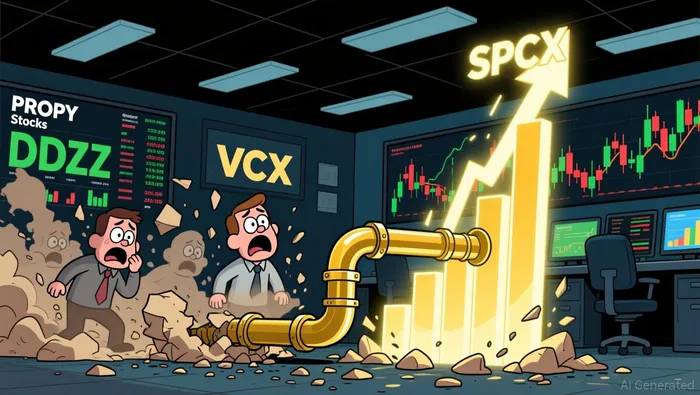
Let's walk through the plumbing.
DXYZ is a single-stock company. It doesn't manage a diversified portfolio in the traditional sense. Its claim to fame was holding SpaceX through a private vehicle called "DXYZ SpaceX I LLC" - which held 99% Class A common stock and 1% Series J preferred - representing 16.2% of the company's portfolio. When retail investors wanted SpaceX exposure before the IPO, DXYZ was the wrapper. You bought DXYZ. DXYZ held SpaceX. The relationship was two steps removed, but good enough if your alternative was nothing.
VCX is even further removed. VanEck's own website noted before the IPO that SpaceX is not held by the VanEck Space ETF. VCX is a basket of public space-related companies. But the market priced it as if SpaceX's arrival would validate the entire space theme, lift sector multiples, or - in some versions of the story - eventually get pulled into the fund's holdings. The ETF was trading on the halo effect, not on direct ownership.
Neither structure was fraudulent. Both were just sort of temporary arrangements that only made sense while SpaceX stayed private. The moment SPCX started trading, every dollar tied up in a proxy had a clear alternative: buy the actual shares.
And that's exactly what happened. SpaceX filed to offer 555.6 million shares at $135, raising roughly $75 billion and targeting a $1.8 trillion valuation. Demand was so heavy that the final retail allocation - what goes to individual investors rather than institutions - landed in the low 20% range, below the roughly 30% that had been expected. The company had initially promised a record retail slice, but the math of a $75 billion book forced a compromise.
The shares opened at $150, closed debut day at $161, and then kept climbing. By Monday they were at $193. The company's market value has climbed well past $2 trillion.
The proxy holders watched this happen and sold.
Here's the tiny dialogue that explains the trade:
DXYZ buyer, June: I'm paying $70 for a company that's 16% SpaceX. DXYZ buyer, now: SpaceX is trading at $193. I can buy the actual company and not have to guess about the other 84% of DXYZ's portfolio. Done.
VCX buyer, months ago: Space is the future, this ETF has surged from its 52-week low of $31 to a peak of $575. VCX buyer, now: It doesn't even own SpaceX. And the 15 other holdings inside it don't move the needle like a $2-plus-trillion company.
The collapse in both names isn't a verdict on the space economy. It's a mechanical unwinding. When the direct asset becomes available, the proxy trade is the first thing to go. It's always the first thing to go. That's how arbitrage works, even when the arbitrageurs are retail traders on their phones.
There's a secondary wrinkle worth noting. DXYZ's turnover rate today was 63%. That means more than half the outstanding shares changed hands in a single session. This isn't a stock with patient holders digesting a pullback. This is a name where the liquidity has become the event.
VCX's daily volatility hit 27%. It's moving like a meme stock, not an ETF holding aerospace contractors. The amplitude - the distance between its high and low on the day - was 21%. At some point the name stops being a space fund and starts being a vehicle for margin calls.
The simplest model is: the proxy premium was the gap between what you could buy and what you wanted to buy. That gap is now zero for SPCX. The DXYZ and VCX positions were the gap itself. When the gap closes, the positions that were only worth something because of the gap become something else entirely.
Not worthless - both have actual businesses underneath them. But the valuation premium - the thing that pushed DXYZ toward $73 and VCX toward $575 - was a temporary liquidity promise. The promise was: hold this, and it will get you there eventually.
The thing is, you can get there now. And the market priced that in Monday.