

SpaceX (SPCX) finally made its long-awaited debut on public markets Friday, and the stock delivered exactly the type of volatile first-day action investors expected from the largest and most anticipated IPO in history. While today's price action may be tempting to interpret as a referendum on valuation, investors should remember that first-day IPO trading is typically driven far more by supply and demand dynamics than by fundamentals. In that regard, SpaceX's debut appears to be following the playbook of a highly successful offering.
Shares were priced at $135 Thursday evening, valuing the company at approximately $1.75 trillion. The stock opened for trading at $150, representing an immediate 11% premium to the IPO price and implying a market capitalization approaching $2 trillion. The excitement did not stop there. Shortly after opening, shares briefly retreated to test the IPO price, dipping toward the $135 area as some early investors took profits and others attempted to establish positions.
That pullback proved short-lived.
Buyers quickly stepped in and aggressively accumulated shares, sending SpaceX sharply higher throughout the afternoon. The stock eventually reached an intraday high of $176.52 before consolidating. At the highs, shares were trading more than 30% above the IPO price and comfortably outperforming the average first-day IPO gain.
Historically, large IPOs have generated average first-day gains of roughly 26%. Based on today's trading range, SpaceX appears on pace to meet or exceed that benchmark despite entering the market with a valuation that has generated substantial debate among analysts and investors alike.
The real story of the session, however, was retail participation.
According to data highlighted by Zero Hedge, retail investors purchased approximately $18.1 million worth of SpaceX stock during the first 20 minutes of trading. That immediately made SPCX the second most purchased stock among retail traders, trailing only Nvidia Corporation (NVDA). Even more impressive was the pace of activity. Total turnover reached approximately $62 million during that initial period, roughly three times the retail turnover seen in Netflix Inc. (NFLX) despite Netflix having traded for several additional hours.
Vanda Track:
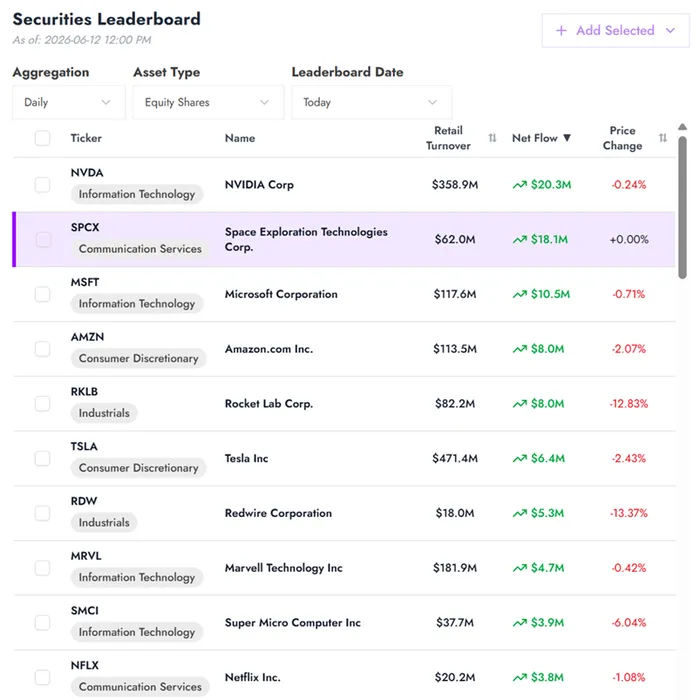
The buying did not slow as the session progressed.
Reports indicated that net retail purchases during the second ten-minute trading interval exceeded purchases during the first, suggesting investors were adding to positions rather than taking quick profits. That behavior helped fuel the rally from the IPO test near $135 to the afternoon highs above $175.
The strength of demand should not come as a surprise.
SpaceX is not simply another IPO. The company sits at the intersection of multiple themes that have captivated investors over the last several years, including artificial intelligence, satellite communications, defense technology, commercial space exploration, and Elon Musk's broader technology ecosystem. For many investors, the IPO represented the first opportunity to directly own one of the most closely followed private companies in the world.
Institutional demand was equally robust.
Earlier reports suggested the offering was significantly oversubscribed, while Citadel reportedly handled record levels of retail IPO orders. That combination of strong institutional participation and intense retail enthusiasm created a powerful demand backdrop that overwhelmed the relatively limited float available on day one.
Not everyone is convinced the valuation makes sense.
CFRA initiated coverage during the session with a Sell rating and a $115 price target, implying meaningful downside from current trading levels. Bears continue to point to the company's substantial losses, uncertain path toward profitability, and lofty valuation as reasons for caution.
However, valuation debates are often secondary during the early stages of a high-profile IPO.
For now, investors appear far more interested in gaining exposure than debating discounted cash flow models.
The ripple effects were felt throughout the broader space sector.
Many investors expected a rising tide to lift related names, but Friday's action was more mixed than some anticipated. Several publicly traded space companies actually traded lower despite SpaceX's strong debut. Rocket Lab USA (RKLB), Redwire Corporation (RDW), Voyager Technologies (VOYG), AST SpaceMobile (ASTS), Planet Labs (PL), BlackSky Technology (BKSY), and Intuitive Machines (LUNR) all experienced varying degrees of weakness.
This type of reaction is not unusual.
In many cases, investors rotate capital away from existing thematic holdings to fund purchases of a newly listed industry leader. Similar dynamics have occurred in prior IPO cycles, particularly when a dominant company enters a sector that previously lacked a clear flagship investment vehicle.
Meanwhile, Tesla Inc. (TSLA) traded lower during the session despite SpaceX's successful launch into public markets. The decline likely reflected some investors rotating capital from Tesla into SpaceX rather than any negative assessment of Tesla's underlying business.
For traders, there are very few meaningful technical levels available given the stock's limited trading history.
That said, two areas emerged during the opening session.
The first sits near $170, which acted as an area of consolidation after the initial surge and may serve as an important reference point for short-term traders. The second is near $162, representing the closing level of the first ten-minute trading bar. After briefly pausing at that level, buyers aggressively stepped in and launched the stock toward new highs, making it an early support area to watch.
Another important development is just around the corner.
Options on SpaceX are expected to begin trading Tuesday. The introduction of listed options should significantly increase trading volume, provide investors with additional hedging tools, and likely increase volatility as market makers begin managing exposure.
Ultimately, today's price action tells us very little about what SpaceX is worth.
What it does tell us is that demand for the stock is enormous. Investors have waited years for this IPO, and the combination of limited supply, heavy retail participation, institutional interest, and Elon Musk's brand has created one of the strongest IPO debuts Wall Street has seen in years.
The next several weeks will determine whether today's enthusiasm evolves into a sustainable trend or simply represents the opening chapter of a much longer valuation debate. For now, however, the bulls clearly own the tape.