

SpaceX lists on the Nasdaq on June 12 at a $1.77 trillion valuation, and the loudest headline problem European asset managers are flagging is sustainability. That sounds like it should be about rockets burning kerosene and black carbon going into the stratosphere. It is, partly. But the more structural part of the story - the part the market is missing because it's fixated on governance - is that the EU's entire sustainable finance framework has no category for a company that runs on fossil fuel but delivers what Europe increasingly needs.
Let me be clearer about what's actually happening here.
The governance headline is doing heavy lifting
European funds are split on whether to buy SpaceX. Denmark's AkademikerPension, a $25 billion fund, has already blacklisted the company, calling its governance structure "catastrophic." Several institutional investors have flagged board composition, conflicts of interest, and the dual-class share structure that gives Elon Musk ten times the voting power of ordinary shareholders.
These are real problems. The dual-class structure means Musk can dramatically reduce his economic stake without losing control. Binding arbitration clauses in the IPO filing strip shareholders of class-action rights. Corporate governance experts... have called it one of the weakest investor-protection structures in a modern mega-IPO.
But governance is the easy objection. You can exclude on governance. European asset managers have done it for years. What's harder - what actually forces a conversation inside compliance departments - is the sustainability question.
The taxonomy gap
Here's the issue that most market coverage is skipping over. SpaceX's Falcon 9 rockets burn RP-1, a purified form of kerosene. When that burns with liquid oxygen, it releases carbon dioxide, water vapor, and black carbon soot into the upper atmosphere. A 2026 study estimated that global rocket launches in 2019 alone produced 5,820 tonnes of CO₂, 280 tonnes of black carbon, and 220 tonnes of nitrogen oxides - and launch cadence has surged since then.
Starship, the vehicle SpaceX is building to replace Falcon, uses methane, which burns cleaner. But Starship isn't the primary revenue engine yet.
Now cross that with the EU's climate taxonomy - the classification system that defines which economic activities count as environmentally sustainable, and which financial products can label themselves as green. The taxonomy has struggled to classify fossil gas. It faced legal challenges over fossil fuel aviation. And it has no category at all for commercial space launch.
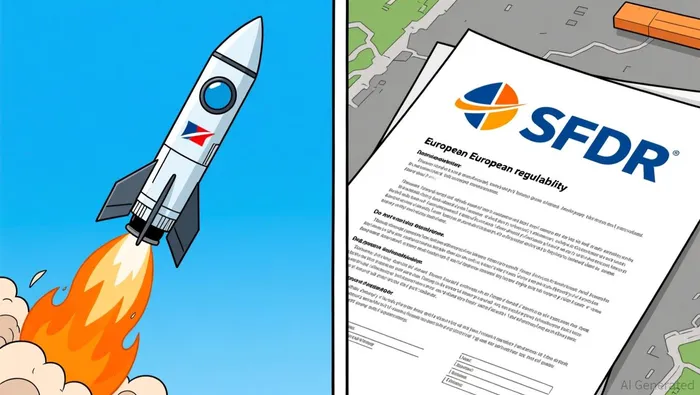
SpaceX falls into a classification void. It is neither clearly aligned with the taxonomy nor formally excluded from it. For European asset managers who manage funds under the SFDR - the Sustainable Finance Disclosure Regulation, which forces funds to declare how sustainability factors fit into their investment decisions - this is a compliance gray zone that doesn't resolve itself with a "buy" or "sell" call.
Why this matters beyond one IPO
The SFDR is already under revision. The proposed SFDR 2.0 would tighten exclusion criteria, and analysts estimate around 40% of current Article 9 "sustainable investment" funds could fail the new rules. If anything, the regulatory architecture is moving toward stricter classification, not more ambiguity.
In that direction of travel, a company like SpaceX - which is genuinely mission-critical for satellite communications, Earth observation, and defense infrastructure - tests whether the EU's sustainability framework can handle infrastructure that doesn't fit neatly into a green or brown bin.
This isn't unique to rockets. Nuclear energy took years of political wrangling before the taxonomy allowed conditional inclusion. Fossil gas is still contested. Space launch is next in line for the same messy argument.
What's different about SpaceX is the timing. The company is listing at a valuation that makes it a material holding for any major European fund that wants exposure to space or satellite infrastructure. Retail enthusiasm is also real - European retail brokers are reporting surging interest, jolting life back into what has been a quiet market for IPO day-trading on the continent. But institutional money is the flow that moves the price over weeks, not hours. And institutional money in Europe runs through compliance gates before it runs through conviction.
The constituency map
This is where the story becomes less about environmental science and more about who gets to decide what counts as sustainable investment. The taxonomy is designed to channel capital, not just describe companies. If SpaceX eventually qualifies for a transition category or a defense infrastructure carve-out - both politically possible given how desperately Europe wants strategic autonomy in space - then the current hesitation disappears.
If it doesn't, then a significant pool of European institutional capital is structurally sidelined from one of the largest IPOs in history. Not because the money doesn't want to be there, but because the labeling rules don't yet have an answer.
I'm more interested in what happens next than in whether the stock opens up or down. Watch whether the European Commission or the Platform on Sustainable Finance issues guidance on how to classify space infrastructure under the taxonomy. Watch whether any major European fund manager signals a willingness to classify SpaceX as a "transition" company - a label that would allow investment while acknowledging the fossil-fuel operations. And watch whether the governance objections end up doing the excluding that the sustainability framework can't.
The real story here isn't whether SpaceX is green. It's that the rules written to define green investment were never designed for a company that straddles infrastructure, defense, and aerospace while burning kerosene. Someone has to write that category. Until then, the split among European funds isn't really disagreement. It's a placeholder for a rule that doesn't exist yet.