

The story of Spirit Airlines isn't written in quarterly reports anymore. It's written in the desert. The airline ceased all passenger flights on May 2 after a last-ditch $500 million government bailout fell apart due to disagreements among its own creditors. In a single weekend, a company that once buzzed across the country went silent.
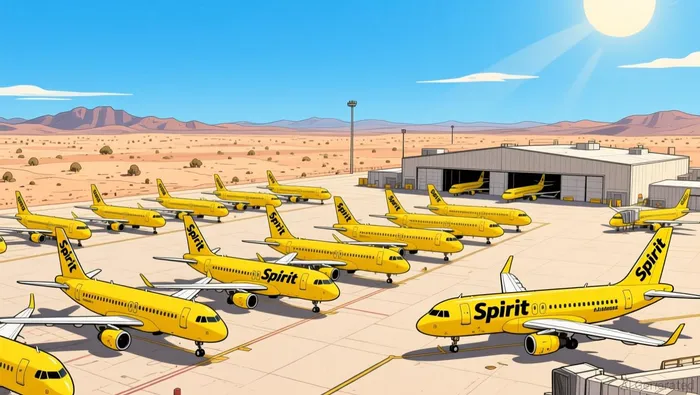
Now, the real work of liquidation has begun. Spirit is in a court-approved wind-down, and its fleet of over 90 planes is being ferried to dry storage in Arizona to prevent them from deteriorating in the humid air. The mechanics are straightforward: contracted pilots, many of them former Spirit employees, are flying the empty planes to locations like Phoenix Goodyear Airport and the massive Pinal Airpark. These are not revenue-generating flights. They are logistical moves, part of an orderly wind-down plan filed with the bankruptcy court.
The sight is telling. You can still see Spirit's bright yellow jets in the sky, but they are not carrying passengers. They are being moved, one by one, to storage. This is the tangible reality of the collapse. The company's assets-its engines, spare parts, and real estate-are now the focus, as leasing firms and potential buyers decide their fate. The budget airline model that once thrived on ultra-low fares and high utilization has been reduced to a fleet of grounded aircraft, waiting for its next chapter.
Kick the Tires: The Real Reasons the Engine Stopped
When you kick the tires of a business, you're looking for the obvious cracks. Spirit Airlines didn't just break down; it was falling apart for years. The common-sense story is one of relentless financial pressure, a major unexpected hit, and a missed lifeline.
The financial struggles began long before the final shutdown. Since the start of 2020, the airline has lost more than $2.5 billion. That's a massive drain, especially for a company that relies on high-volume, low-margin flying. It filed for bankruptcy protection for the second time in less than two years, a clear sign the model was broken. The numbers don't lie: it emerged from its first bankruptcy in 2024 only to file again in August 2025, this time with $8.1 billion in debts. This wasn't a temporary hiccup; it was a deep, structural problem.
Then came the final, unexpected blow. Spirit blames a surge in fuel costs, a major operational expense, for its final liquidity crisis. The company says this spike, driven by geopolitical events like the war with Iran, could have cost it $70-$83 million in the current quarter. For a budget airline, where every dollar counts, that's a crippling hit. It wasn't a slow bleed but a sudden, massive cash drain that the airline simply couldn't absorb, even with a last-ditch $500 million government bailout plan that collapsed.
The failed merger with JetBlue in 2023 removed a potential lifeline and left Spirit isolated. The Biden administration blocked the deal over competition concerns, a decision that cut off a path to stability and scale. Spirit had been counting on that merger to strengthen its position. Without it, the airline was left to face a tough market alone, trying to restructure its way out of a hole that had been growing for years. The merger's collapse was a critical moment where the real-world utility of the business model was put to the test-and found wanting.
In the end, the engine stopped because the fuel ran out, the balance sheet was too thin, and the company was too small to weather the storm. It's a classic case of a business model that worked in good times but couldn't adapt when the fundamentals changed.
What's Left on the Ground: The Real Prize and Who Wins
The real prize now is what's left on the ground. With Spirit's operations ceased, the focus has shifted from flying to liquidation. The company's assets-over 90 planes, engines, and spare parts-are being sold or leased to recoup cash for creditors. Around 40 of those aircraft are already stored at Phoenix Goodyear Airport, with more being ferried to massive desert facilities like Pinal Airpark. These are not just idle jets; they are valuable, tangible assets. Companies like Nomadic Aviation Group are contracted to retrieve them, using former Spirit pilots for the ferry flights. The goal is to strip them for parts, reposition them for lease, or sell them outright. This is the messy, real-world utility of the business model's end: turning grounded aircraft into cash.
For its rivals, the immediate impact is a bit of breathing room. JetBlue and Frontier, which had the biggest route overlaps with Spirit, now have more room to raise fares on those shared corridors. Spirit's exit removes a fierce competitor that kept prices low. But here's the catch: they face the same high fuel costs that doomed Spirit. The surge in jet fuel prices, which Spirit blamed for its final liquidity crisis, is still a major headwind for all budget carriers. So while the liquidation gives competitors a slight tactical advantage, it doesn't fix the underlying strain on the entire ultra-low-cost model.
The collapse of Spirit Airlines is a stark highlight of that fragility. The model, built on ultra-low fares and high utilization, is still under pressure from soaring operating costs and geopolitical fuel price shocks. Experts note that the challenges for discounters-rising wages, lease rates, and maintenance bills-won't disappear just because one airline has gone out of business. In fact, the strain is evident across the sector. Frontier has reported adjusted per-share losses in eight of the past 13 quarters, and JetBlue hasn't posted a full-year profit since 2019. Their stocks have lost about three-quarters of their value in five years. The real-world utility of the budget airline model is being tested, and Spirit's liquidation shows how quickly it can unravel when the fundamentals shift.
What to Watch: The Next Moves on the Ground
The liquidation is underway, but the real story now is in the details. For creditors, investors, and competitors, there are a few key observable events to watch that will determine the pace of the wind-down and the future of the budget airline sector.
First and foremost, watch the speed and price at which Spirit's aircraft and parts are sold. The planes are now in storage, but their value is in the engines and spare parts. The dry Arizona air is protecting the assets, but the real prize is what's inside them. Companies like Nomadic Aviation are ferrying the jets to massive storage facilities like Pinal Airpark, where leasing firms and buyers will decide their fate. The return to creditors depends heavily on how quickly and for how much these assets can be stripped and repositioned. A slow, low-priced sale would mean a poor recovery for everyone, while a brisk, high-value auction would signal stronger underlying demand for used aircraft.
Second, monitor if JetBlue and Frontier actually raise fares on Spirit's old routes, and whether those gains are eroded by the ongoing fuel cost spike. The collapse gives rivals breathing room, but the experts are skeptical. As Joe Rohlena of Fitch Ratings noted, the benefit is likely to be modest. The real-world utility of the budget model is still under pressure from soaring operating costs. If JetBlue and Frontier hike prices but then face the same surging fuel costs that doomed Spirit, their profit margins could be squeezed again. The observable test will be whether ticket prices on those shared corridors hold steady or if the gains are quickly washed away.
Finally, watch for any regulatory or policy changes that could affect the future of airline mergers and competition. Spirit's failed $500 million government bailout plan and its blocked merger with JetBlue in 2023 were critical moments. The Biden administration's decision to block that deal over competition concerns set a precedent. Now, with one major discount carrier out of the picture, regulators may face new pressure. Any shift in policy that makes future mergers easier or harder could impact the stability of other budget carriers, making the regulatory landscape a key watchpoint for the sector's long-term health.