

The Araxá project is rapidly emerging as a potential new node in the global rare earths and niobium supply chain. Its scale is now quantified by a major resource upgrade, with the company delivering a Mineral Resource Estimate (MRE) of 70.91 million tonnes at 4.06% total rare earth oxides (TREO). This represents a substantial 75% increase in the resource base since February 2025. The deposit is not just large in tonnage but also significant in grade, positioning it among the largest and highest-grade carbonatite-hosted rare earths deposits outside China, comparable to major operations like Lynas's Mt Weld and MP Materials' Mountain Pass.
The resource's value extends beyond rare earths. It carries a substantial niobium inventory of 95.47 million tonnes of Nb₂O₅ associated with the same mineralisation. This dual-metal character is a key feature, as niobium is a critical alloying element in high-strength steel, and a single project producing both can offer supply chain diversification benefits. The higher-confidence portion of the resource has seen an even more dramatic surge, with Measured and Indicated (M&I) tonnes increasing by 218% to 29.49 million tonnes. This jump provides a much stronger foundation for future economic studies and development planning.
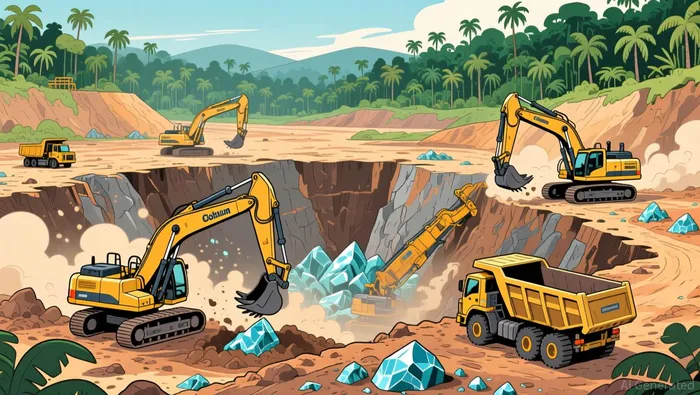
In practical terms, the near-surface nature of the mineralisation-beginning at surface and extending to around 100–120 metres depth within a weathered, free-digging profile-suggests the potential for low-cost open-pit mining. This, combined with the project's location in an established mining region with access to infrastructure, supports a favorable development profile. The sheer scale of the resource, now nearly 71 million tonnes of ore, means that if developed, Araxá could contribute meaningfully to global supply, helping to balance the market that has long been dominated by Chinese producers.
Demand Drivers and Market Context: Where is the Need?
The case for Araxá hinges on a global market where demand is accelerating but supply remains constrained. For rare earths, the primary drivers are high-tech and green energy applications. The need for permanent magnets in electric vehicles and wind turbines is scaling rapidly, creating a strategic imperative for Western nations to diversify away from a supply chain dominated by China. Yet, global production outside China remains limited, with few projects at the scale and grade of Araxá. This creates a clear gap that new, de-risked sources must fill.
For niobium, the demand story is more straightforward but equally concentrated. The metal is a critical alloying element for high-strength, low-alloy (HSLA) steel, used in construction, pipelines, and automotive manufacturing. The global supply is dominated by a handful of operations, with Brazil's CBMM being the undisputed leader. Araxá's location adjacent to CBMM's massive Araxá mine is not coincidental; it sits within the world's premier niobium district, which produces about 80% of the planet's supply. This concentration means any new niobium producer must either compete directly with or complement this established giant.
Recent drilling results at Araxá demonstrate the project's potential to meet this demand. The company has delivered a standout intercept of 178.7 metres at 4.34% total rare earth oxides (TREO) from surface. This is the thickest mineralised interval recorded at the site, underscoring the scale and near-surface continuity of the deposit. Multiple other wide, high-grade intercepts have been confirmed, showing strong grade continuity over broad intervals. This drilling success is critical for validating the resource's commercial viability and its ability to contribute meaningfully to the global supply equation.
The Supply Chain Equation: From Resource to Market
The path from a massive resource to a functioning supplier is the critical test for Araxá. The project has made tangible progress on this front, with its location, partnerships, and capital structure all shaping the development equation.
First, the project's geography is a major asset. It sits adjacent to CBMM's world-leading niobium mining operations within Brazil's premier niobium district. This proximity offers immediate infrastructure and operational synergies. The region has a long history of commercial production, providing access to transport networks, low-cost hydroelectric power, and a skilled mining workforce. This established ecosystem can significantly de-risk the permitting and construction phases, allowing St George to focus on development rather than building a greenfield operation from scratch.
Second, securing offtake deals is a key step toward de-risking the project's path to production. The company has locked in strategic partnerships that provide a forward-looking sales channel for its output. These agreements, while not detailed in the evidence, are a crucial signal to the market that there is pre-existing demand for the project's rare earths and niobium. They help bridge the gap between resource estimation and economic feasibility, reducing the uncertainty around market absorption.
Third, the company has expanded its capital base to fund this transition. In a move that provides necessary cash but also dilutes shareholders, St George issued 18 million fully paid ordinary shares following the conversion of employee performance rights. This capital infusion supports the ongoing 13,000-meter drilling campaign and the upcoming work on a preliminary economic assessment. The expanded share base gives the company the runway to advance the project, but it also means existing investors now own a smaller percentage of the company.
The bottom line is that Araxá is moving from exploration to project advancement. The combination of a strategic location, pre-secured offtake interest, and a strengthened balance sheet creates a more concrete development pathway. The next milestones-finalizing the resource estimate and delivering a preliminary economic assessment-will be the true tests of whether this supply equation can be solved.
Catalysts and Risks: What Moves the Balance?
The path from a massive resource to a functioning supplier is now defined by a clear set of near-term milestones and a looming execution risk. The project's success will hinge on converting geological promise into economic reality, with the next 12 to 18 months being critical.
The primary catalyst is the completion of a feasibility study. St George has taken a decisive step by appointing Worley Engenharia as its technical adviser for this phase to support development studies for a niobium and rare earths mining operation at Araxá. This appointment signals a move from resource estimation to engineering and cost planning. The study will be the definitive test of whether the project's high-grade, near-surface ore can be mined and processed profitably at scale. Its findings will directly influence financing decisions and the final go/no-go investment verdict.
A second, equally important catalyst is the finalization of processing partnerships. The company has already locked in strategic partnerships that provide a forward-looking sales channel. However, the next step is to secure the specific technical and commercial agreements needed to process the complex mix of rare earths and niobium. This includes partnerships for separation and refining, which are critical for unlocking the value of the rare earth concentrate. Without these downstream links, the project's output faces a market absorption risk.
The overarching risk is execution. Converting a large resource into a profitable mine requires significant capital and time. The company has expanded its capital base, but the feasibility study and subsequent construction will demand substantial investment. The project's location offers logistical advantages, but navigating the permitting process, securing financing, and managing a major construction project in Brazil are complex tasks. The recent drilling campaign, which has now completed 13,700 metres, demonstrates the company's operational momentum. Yet, the real test is in the execution of the engineering and economic studies that follow.
In the end, the Araxá project's impact on the global supply equation depends on its ability to bridge the gap between resource and market. Its success will be measured by whether it can secure the necessary partnerships to process its output and deliver a bankable feasibility study. If it does, it could become a meaningful new source of critical metals. If execution falters, the promise of a 75% larger resource may remain just that-a promise.