

The Consensus Frame Is Wrong
Headlines say Iran has declared no progress in U.S. nuclear talks while Lebanon experiences renewed clashes. The market's reflex is to price geopolitical risk. That reflex misses what has already happened beneath the headline. The Iran conflict did not create a new risk to the semiconductor industry. It removed one-third of the world's helium supply from the market and drove energy prices to levels that have permanently altered foundry cost geography. The negotiations stalling is not the catalyst. It is the mechanism that extends the disruption window.
The real question is no longer whether the Middle East creates semiconductor risk. It is whether the structural cost advantage that has already shifted toward U.S.-based fabrication will accelerate - or whether the helium crisis resolves before the new cost regime locks in.
The Constraint Has Migrated to Two Inputs
This is not about diplomatic progress. It is about helium and electricity. Both are structural inputs to semiconductor manufacturing, and both have been disrupted simultaneously for the first time.
Helium is used throughout the fabrication process to purge lithography chambers, cool extreme ultraviolet tools, and maintain the ultrapure environments that advanced nodes require. Without a reliable supply, fabs slow production runs or delay line expansions. Qatar produced approximately 63 million cubic meters of helium in 2025 - close to one-third of global supply. On March 2, Iranian drone strikes hit the Ras Laffan industrial complex. Roughly one-third of global helium supply has been offline since. Existing shipments sustained Asian fab operations through approximately early April 2026. After that, the shortage tightened across Samsung, SK Hynix, and TSMC's Asian production lines.
The recovery timeline matters more than the initial shock. Industry assessments indicate helium recovery will take years, not months, because the damaged infrastructure is specialized and capital-intensive to rebuild. This is not a temporary pinch. It is a structural supply reduction that changes the cost floor.
Table 1: Dual constraint framework
Constraint
Pre-March 2026
Post-March 2026
Primary impact
Helium supply
Stable, Qatar providing ~33% of global supply
~33% offline; recovery estimated at years
Advanced node fabrication, especially lithography
Energy costs
Rising but manageable (U.S. avg. $0.15/kWh in 2022)
Foundry operating margins, geographic arbitrage
Both constraints hit the same segment of the supply chain. Advanced node fabs - the segment that already runs the most capital-intensive production - are now simultaneously short on a specialty gas and facing spiked power bills.
The Two-Market Split: Geography, Not Technology
The conventional split in foundry analysis is advanced versus mature nodes. That framework is no longer sufficient. A new split has emerged: fabs in low-cost power regions versus fabs in high-cost regions. The helium shortage affects all fabs, but the energy cost shock affects them asymmetrically.
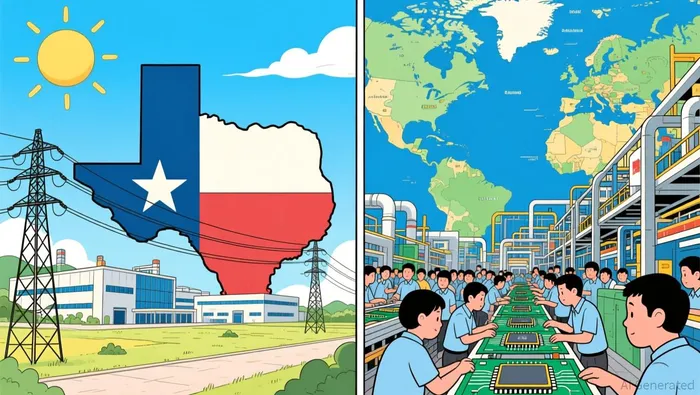
Table 2 below maps the cost differential. Texas offers the lowest industrial electricity rates among major semiconductor hubs at approximately $0.061 per kilowatt-hour, followed by Ohio at $0.071. The U.S. national average electricity rate rose 17% over four years, from 15.04 cents per kilowatt-hour in 2022 to 17.65 cents in 2026. Taiwan's average industrial rates sit materially above U.S. low-cost corridors, and Japan's are the highest among major fab locations.
Table 2: Foundry electricity cost by region (public data estimate)
Region
Industrial rate (¢/kWh)
Trend
Implication
Texas
~6.1
Stable
Structural cost advantage for new fabs
Ohio
~7.1
Stable
Same - basis for Intel, Samsung expansion
U.S. average
17.65
+17% since 2022
Rising pressure on non-optimized locations
Taiwan
~8-9
Rising
TSMC's margins face asymmetric squeeze
Japan
~18-22
Rising
Highest structural cost among major hubs
The implication is fairly straightforward. Every new fab being built in Texas or Ohio starts with a structural power cost advantage that Asian fabs cannot match. The Hormuz disruption made that gap wider by pushing global energy prices higher. The helium shortage made it more consequential by forcing all fabs to run leaner - because when your critical input is rationed, the facility with the lowest other operating costs wins allocation priority.
This is a constraint migration. The bottleneck has shifted from "who can build the smallest transistor" to "who can build it at a sustainable energy cost." The companies that recognized this earlier - Samsung expanding in Texas, Intel in Ohio - are capturing an advantage that has nothing to do with node technology.
TSMC's Response: Pricing, Not Volume
TSMC has been explicit about how it plans to manage the cost shock. The company announced price increases of 3% to 10% on advanced nodes starting in 2026, with plans to extend annual increases through 2029. It also projected 2026 capital expenditure of $52 billion to $56 billion - a 40% increase from 2025 - while simultaneously warning that Middle East conflict may impact profitability as costs increase.
The pattern is consistent with the supply discipline override thesis. TSMC is not responding to the crisis by expanding volume. It is responding by raising prices and increasing capex to lock in capacity at locations where it can control its own power cost. The $52-56 billion capex budget includes expansion in the U.S. (Arizona, Ohio) and Japan - both high-cost regions, but both with power purchase agreements and government incentives designed to offset the rate differential.
This is not a demand play. It is a supply-side hedging strategy. The price hikes are not about capturing AI demand - that story was already priced. They are about transferring rising input costs downstream before the margin erosion becomes structural.
Table 3: What each foundry is doing
Company
Action
Signal
TSMC
3-10% price hikes on advanced nodes; $52-56B capex in 2026; warns of profitability impact
ASP-led defense, supply-side hedging
Samsung
Texas fab expansion (low-cost power corridor)
Geographic arbitrage play
Intel
Ohio fab cluster (subsidized power rates)
Same - cost geography lock-in
Global industry
~$200B total capex projected for 2026
Capital spending continues despite cost shock
The second-tier foundries - those without advanced node pricing power and without low-cost geographic options - are the structural losers in this split. They cannot raise prices like TSMC. They cannot relocate like Samsung. They absorb the helium and energy cost shock directly, and their margins compress accordingly.
Why the Stalled Talks Extend the Window
The latest draft of the U.S.-Iran agreement reported on June 3 calls for a 60-day ceasefire extension and nuclear restrictions. Iran has declared no progress. The talks began in April 2025 and have produced no binding resolution. Meanwhile, the Hormuz Strait remains effectively closed, blocking approximately one-fifth of the world's oil and one-quarter of its liquefied natural gas.
For the semiconductor industry, this means the disruption window stays open. Helium recovery from Ras Laffan cannot happen until infrastructure security is restored. Energy prices cannot normalize until Hormuz transit resumes. The stalling of talks is functionally equivalent to a confirmation that the cost regime the industry is operating under is not temporary.
Investor Takeaway
The key issue is not whether the Iran talks succeed or fail. The helium supply loss and energy cost shock have already restructured foundry economics. The helium shortage is estimated to take years to recover, and the geographic cost split between low-power U.S. corridors and higher-cost Asian locations is now permanent even if energy prices eventually normalize - because the new fabs being built today in Texas and Ohio will operate at lower cost structures for their entire lifecycles.
The more important question is whether investors are pricing the two-market split that has already formed. TSMC's price hikes and capex increases are supply-side hedges, not demand signals. Companies with advanced node pricing power and geographic flexibility are structurally insulated. Second-tier foundries without either are structurally exposed. The geopolitical headline determines the timeline. The constraint determines the winners.
The structural shift is already underway. The only question is how long it takes for the market to price it correctly.