

The margin accretion is real. It is also completely useless.
When Starbucks closed its joint venture with Boyu Capital in April 2026, investors celebrated. The headline math was clean: the company sold 60 percent of its China retail operations for $3.1 billion in cash, kept 40 percent ownership, shifted from a company-operated model to a licensing model, and management promised "lower revenue, higher margin." Sell-side analysts updated models. Consensus called it margin accretive. The stock moved higher.
This is accounting reclassification, not strategic improvement. The economics of every cup sold in China haven't changed. What changed is which line on the P&L they land on.
The deal mechanics, decomposed
Under the old model, Starbucks operated roughly 8,000 stores in China directly. It recognized nearly the full revenue from every latte sold, carried all the rent, labor, real estate, and supply chain costs, and kept whatever margin survived. The unit economics were thin - China has been a capital sink for years.
Under the new model, Starbucks licenses its brand and intellectual property to the JV and takes a royalty stream. It retains a 40 percent equity stake in the JV. Boyu - the majority owner - funds new store builds, carries operating costs, and manages daily operations. Starbucks' China revenue on its income statement collapses because it no longer books top-line store revenue. Instead it receives royalties and its 40 percent share of JV profits. The top line shrinks. The margin percentage rises. It is the same economic reality wearing different accounting clothes.
The real question isn't whether the margin ratio improves on paper. It's whether the total economics - the $3.1 billion in cash plus the ongoing royalty and JV income stream - are better than what Starbucks had. And the evidence says the answer depends entirely on whether the China business can grow from here, which is where the deal starts looking less like optimization and more like surrender.
What happened to 20 percentage points of market share?
Starbucks' market share in China has fallen to 14 percent from 34 percent. That is not a cyclical dip. That is a structural collapse over roughly a decade, accelerating sharply in the last three years. The primary competitor doesn't need introducing but the scale is worth stating: Luckin Coffee built over 30,000 stores in eight years. Starbucks needed 26 years for roughly 8,000.
In mid-2024, both Starbucks and Luckin posted double-digit same-store sales declines - 14 percent and 20.9 percent respectively in the June quarter. By the time of the JV announcement in November 2025, China revenue had been essentially flat from fiscal 2022 through fiscal 2024, hovering around $3 billion. The brand was stuck. Store counts weren't growing fast enough to offset erosion at existing locations. Capital spend to open new stores generated returns that didn't justify the investment.
Starbucks can spout about unlocking the vast market opportunity in China. The data says the opportunity was already lost.
The $3.1 billion cash - that part matters
The one genuinely useful element of this deal is the $3.1 billion in cash Starbucks received. Based on the $4 billion cash-free, debt-free enterprise valuation for the China business, Boyu's 60 percent stake implies roughly this is what the remaining 40 percent is worth too. That valuation may be generous given the trajectory, but it's cash in hand now.
This is capital repatriation from a business that has been consuming capital for years. The Q2 fiscal 2026 results showed operating income of $679.9 million on an operating margin of 9.9 percent, down from $748.3 million and 11.6 percent a year earlier. The company was bleeding margin even before the JV transition. Getting $3.1 billion out of China and back onto the balance sheet gives Starbucks real optionality: buybacks, debt reduction, investment in North America where it still dominates, or simply a buffer against further deterioration.
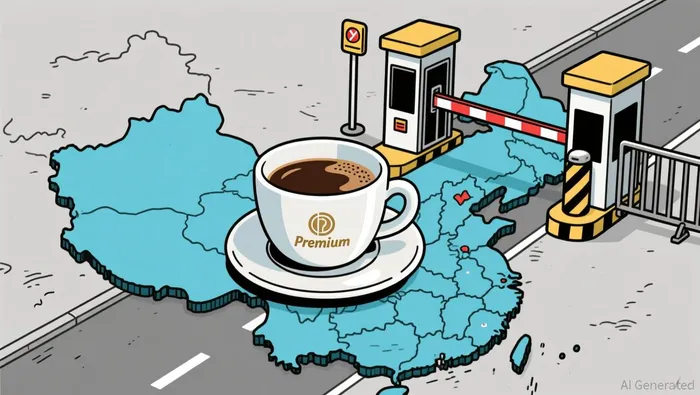
But the ongoing economics are a toll booth on a shrinking road
Here is where the "margin accretion" thesis breaks down. Going forward, Starbucks' China economics depend on two things: the royalty rate it charges the JV on top-line revenue, and its 40 percent share of JV profits. Neither of those scales favorably if the business stops growing.
The royalty is a percentage of revenue - meaning it falls if China's top line falls. The JV profit share is 40 percent of operating profit - meaning Starbucks captures less than half the upside on any recovery, while Boyu captures 60 percent. The company built China for 26 years, established the premium positioning, created the brand equity, and then handed majority control to Boyu in exchange for a toll booth fee.
Any astute investor would have noticed the asymmetry: if the JV grows to 20,000 stores as Boyu plans - doubling the footprint - the majority of that growth benefit goes to Boyu. Starbucks gets a royalty on each new store's revenue and 40 percent of the profits. That is not how you capture value from expansion. That is how you monetize exit.
The stock still demands what the deal abandons
Starbucks trades at roughly $99 per share with a market capitalization around $110 billion. The P/E multiple is approximately 76x. That is not a multiple for a company that just converted its largest international market from an operating business to a passive royalty stream. That is a multiple for a company still expected to deliver sustained growth from a market where it just conceded control.
The cross-currents are clear: the $3.1 billion in cash provides real balance-sheet relief and operational simplification; the margin percentage will mechanically improve because the top line shrinks faster than the bottom line; comparable store sales turned positive globally in Q2 FY26, rising 6.2 percent, the first time all 10 largest international markets posted positive comps in nine quarters; and the company has a new CEO in Brian Niccol attempting an operational turnaround. Directionally, the capital return is beneficial. The ongoing China economics are suboptimal. The valuation does not reflect the gap between the two.
You decide which was marketing fluff and which one was analysis
The consensus narrative frames this deal as a clever restructuring that unlocks margin. It does not. What it does is take a business where Starbucks can no longer compete on store count, pricing, or growth velocity, and convert it into a licensing arrangement that costs nothing to maintain. The margin expansion is real on an accounting basis. The strategic implication is capitulation.
Starbucks built China into a $4 billion enterprise over 26 years. It now owns 40 percent of it. The remaining 60 percent belongs to Boyu, which gets the majority of future expansion upside. The royalty stream is passive income - attractive if the brand holds, worthless if it doesn't. The stock at 76x earnings prices in growth that the deal itself signals Starbucks no longer controls.
The thesis for SBUX from here is no longer "China growth engine." It is "does the North America turnaround justify the multiple while China slowly becomes a licensing footnote." Those are not the same story. The market is still pricing the former.